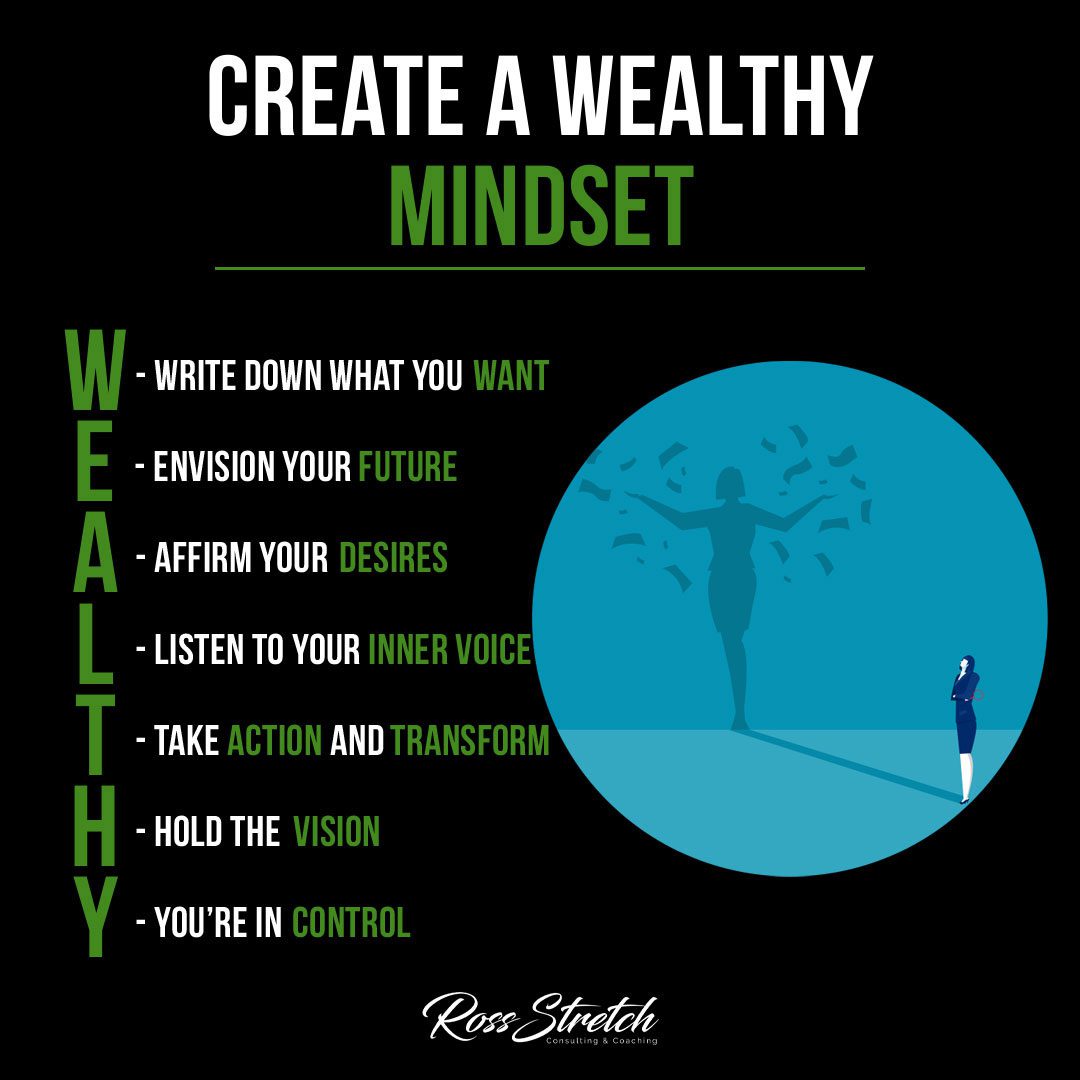
Most people believe wealth is primarily a function of income — earn more, accumulate more. But the evidence tells a different story. Mindset shapes behavior, behavior shapes habits, and habits shape financial outcomes over a lifetime. Building a wealthy mindset isn’t about positive thinking or wishful visualization — it’s about developing a systematic, deliberate approach to how you think about, talk about, and act on financial opportunity. The W.E.A.L.T.H.Y. framework provides a practical structure for doing exactly that.
Why This Matters More Than You Think
Research from Stanford, Harvard, and the broader field of behavioral economics consistently shows that our beliefs about money are the primary driver of our financial outcomes — not our income, education level, or starting circumstances. A landmark study found that lottery winners returned to their baseline happiness and financial habits within two years of winning — because their mindset hadn’t changed. Money without the right mindset is temporary. The right mindset without money is a prerequisite for eventually getting it.
The wealthy mindset is not about obsessing over money or adopting a selfish, zero-sum worldview. It’s about developing clarity, intention, and competence around the financial decisions that shape your life. It’s about replacing scarcity thinking — the belief that resources are limited and opportunity is zero-sum — with an abundance orientation that recognizes financial growth as achievable through skill, discipline, and consistent smart action.
The encouraging truth is that every component of a wealthy mindset is learnable. You don’t need to be born into wealth or graduate from an elite university. You need a framework, consistent daily practice, and the willingness to do the work. The W.E.A.L.T.H.Y. system gives you that framework in seven concrete steps.
The Science Behind the Wealthy Mindset
Neuroscience offers a compelling explanation for why mindset changes produce real-world financial results. The brain’s reticular activating system (RAS) acts as a filter for the enormous volume of sensory data you encounter every day — drawing your conscious attention to things that match your existing beliefs and goals. When you genuinely believe wealth is possible and you focus consistently on building it, your RAS begins surfacing opportunities, connections, and information that support that goal. You quite literally begin seeing a different world.
Carol Dweck’s foundational research on growth mindset adds another dimension: people who believe their abilities can be developed through effort are dramatically more likely to persist through challenges, seek honest feedback, and achieve higher levels of performance. Applied to finance, this means that people who believe they can learn to invest intelligently, build businesses, and generate wealth consistently outperform those who believe their financial situation is fixed by circumstance or background.
The W.E.A.L.T.H.Y. Framework in Practice
W — Write Down What You Want
The first and most foundational step in creating a wealthy mindset is to write down exactly what you want to achieve. Clear and specific goals provide direction and purpose, allowing you to focus your energy on what truly matters. Research from Dominican University found that people who write their goals down are 42% more likely to achieve them than those who simply think about them. Writing solidifies intention and activates the subconscious mind to align your thoughts and actions toward your desired outcome.
- Be specific and measurable: Don’t write “I want to be wealthy.” Write “I want a net worth of $500,000 by age 40, through index fund investing and a side business generating $5,000 per month.”
- Review daily: Your written goals activate intention — revisiting them each morning keeps your daily priorities aligned with your long-term vision.
E — Envision Your Future
Envisioning your future is a practice that goes far beyond wishful thinking. Olympic athletes use visualization as a core training tool because mental rehearsal activates the same neural pathways as physical practice. Take time each day to vividly imagine yourself living the life you’re building — with the income, the freedom, and the impact you are working toward. By visualizing your future success, you create a mental blueprint that guides your decisions and helps you stay focused through inevitable obstacles.
- Engage all senses: Don’t just see the outcome — feel the confidence, hear the conversations, experience the environment you’re creating.
- Use visualization as preparation, not escape: Mental rehearsal is most powerful when paired with deliberate daily action, not used as a substitute for it.
A — Affirm Your Desires
Affirmations are positive statements that reinforce your beliefs and aspirations. Through consistent practice, they help you replace limiting beliefs — “I’m not good with money,” “Rich people got lucky,” “I could never earn that much” — with empowering ones. This isn’t magic; it’s behavioral conditioning. What you rehearse mentally becomes what you act on automatically. Rewriting limiting beliefs through consistent affirmation practice shifts your mindset from scarcity to abundance, attracting better financial decisions and opportunities into your life.
- Make them present-tense and specific: “I manage my money with discipline and intelligence. I create and attract wealth through the value I provide.”
- Pair affirmations with evidence: Each time you make a smart financial decision, consciously reinforce the identity: “I am someone who builds wealth thoughtfully.”
L — Listen to Your Inner Voice
Your intuition is the accumulated pattern recognition of everything you’ve experienced and learned. Listening to your inner voice means developing the self-awareness to distinguish between fear — which paralyzes and keeps you small — and genuine concern, which informs and protects. Wealthy people make confident decisions because they’ve developed self-trust through repeated action and honest reflection. Cultivating a deeper connection with your intuition through mindfulness and self-reflection is essential to this process.
- Practice regular reflection: Journaling, meditation, or even quiet walks create the mental space needed to hear intuitive signals that get drowned out by daily noise.
- Act on insights without excessive delay: Intuitive clarity has a short shelf life — the longer you wait, the more rationalization and doubt crowd it out.
T — Take Action and Transform
All the vision and affirmation in the world produces nothing without deliberate action. The wealthy mindset is fundamentally an action-oriented mindset — it sees opportunity and moves, takes calculated risks, and learns from results rather than waiting for perfect certainty before starting. Breaking your goals down into actionable weekly steps and consistently taking small, progressive actions toward their achievement is what turns intention into reality. Adopt a growth mindset that views challenges as opportunities for learning rather than threats to avoid.
- Break goals into weekly actions: What specific action can you take this week that moves you measurably closer to your financial goals?
- Embrace imperfect action: Done imperfectly is infinitely more valuable than perfect ideas that never get executed. Build, measure, adjust, repeat.
H — Hold the Vision
Building wealth takes significantly more time than most people expect — and significantly less time than they fear, when they look back after a decade of consistent effort. Holding the vision means maintaining steadfast focus on your long-term goals even during the inevitable setbacks, slow periods, and moments of doubt that accompany any meaningful pursuit. This is where patience and resilience become financial assets every bit as valuable as your investment portfolio.
- Celebrate small wins: Progress reinforces motivation. Acknowledge every milestone — each one is evidence that the system is working.
- Return to your written goals: When momentum flags, your vision statement is an anchor that reconnects you to your purpose and direction.
Y — You’re in Control
The final and most empowering element of the wealthy mindset is the recognition that you hold the steering wheel. Your financial outcomes are not dictated by your background, your starting capital, or forces beyond your control — they are the compounded product of decisions you make every day. This is not about toxic positivity that denies real obstacles. It is about retaining your agency in the face of those obstacles and refusing to outsource responsibility for your results to external circumstances.
- Invest in financial literacy: The more you understand about investing, taxes, business models, and real estate, the more options you have and the better your decisions become over time.
- Seek accountability: Share your financial goals with a trusted mentor or peer who will challenge you when you slip into passive or victim-oriented thinking.
Common Mistakes People Make
- Treating mindset work as a replacement for financial literacy — the wealthy mindset supports smart action, it does not substitute for understanding how money actually works
- Expecting rapid transformation — genuine mindset shifts happen through consistent daily practice over months and years, not through a single insight or weekend seminar
- Skipping the “Write It Down” step — without written, specific goals, the rest of the framework lacks direction and measurable accountability
- Confusing positive thinking with optimism bias — a wealthy mindset acknowledges real risk and plans for setbacks rather than pretending obstacles don’t exist
The Bottom Line
Cultivating a wealthy mindset is not a luxury — it is a prerequisite for lasting financial success. The W.E.A.L.T.H.Y. framework gives you a systematic, repeatable approach: write your goals with precision, envision your future vividly, affirm your capabilities daily, listen to your intuition, take consistent imperfect action, hold your long-term vision through adversity, and own your outcomes completely. Each element reinforces the others, creating a compounding effect that transforms not just your finances but your entire relationship with opportunity and growth.
Begin with one element this week. Write down exactly what you want your financial life to look like in ten years — be specific, be bold, and be honest about the gap between where you are and where you’re heading. That single act of clarity is often the most powerful step toward a fundamentally different financial future.
Resources
- Carol Dweck — Mindset: The New Psychology of Success (official site)
- Psychology Today — The Science of Accomplishing Your Goals
- Investopedia — How Your Money Mindset Shapes Your Financial Future
- Harvard Business Review — Why Financial Literacy Alone Isn’t Enough


 Ross Stretch