
The habits and beliefs a child develops before age twelve often shape their entire relationship with money, risk, and learning for the rest of their life. Most parents want to raise financially capable kids, but the strategies they use can inadvertently install an employee mindset rather than an entrepreneurial one. The difference is subtle but significant — and it comes down to how and why children are rewarded. This guide explores two fundamentally different approaches to developing financial intelligence in children, and what that difference produces over a lifetime.
The Chores-for-Money Model: Teaching the Employee Mindset
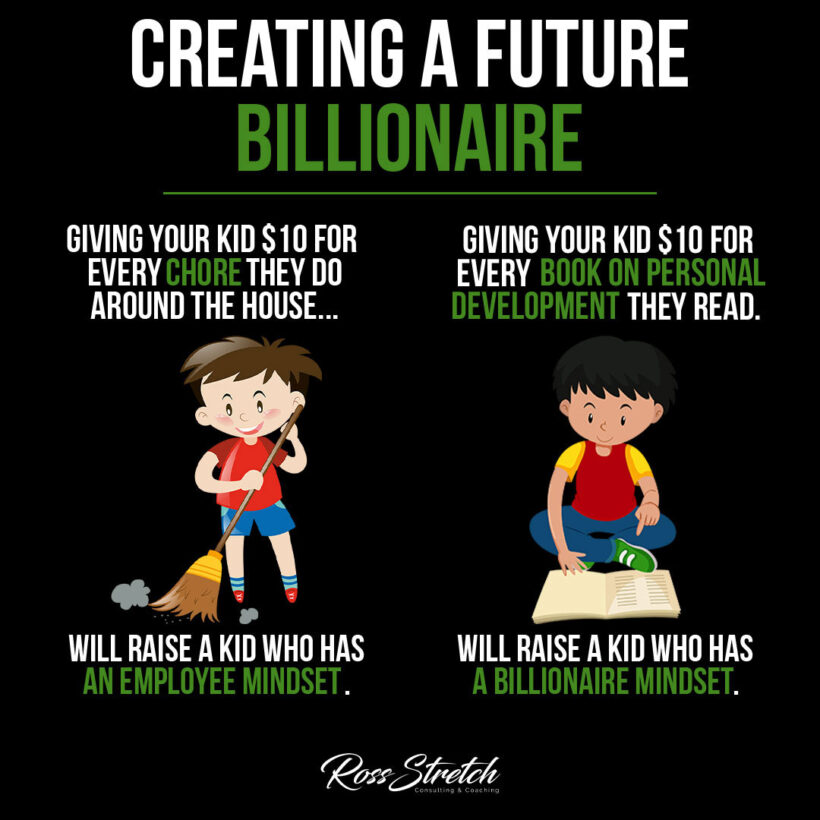
The most common approach parents take to money is the chores-for-cash exchange. Kids complete tasks — washing dishes, mowing the lawn, cleaning their room — and receive payment in return. This method teaches valuable lessons about responsibility and the basic connection between effort and reward. There is nothing inherently wrong with it. In fact, it builds useful discipline, work ethic, and a baseline understanding that income requires action.
However, it also establishes a specific mental model: money is earned by completing tasks assigned by someone else. The child learns to wait for direction, complete defined work, and receive predetermined compensation. This is precisely how a traditional employment relationship functions — and for children who grow up to be employees, it is a perfectly adequate framework. But if your goal is to raise a child who thinks entrepreneurially — one who creates opportunities rather than waiting for them — this model has real limitations that are worth understanding.
The most significant limitation is what economists call time-for-money thinking. When a child earns ten dollars for washing dishes, they understand implicitly that their earning capacity is capped by the number of hours they can work and the tasks available to them. This is not the cognitive framework of someone who later builds scalable income, creates systems that generate value independently, or takes financial risks with a long-term upside.
The Learning-Reward Model: Building the Entrepreneurial Mindset
An alternative approach rewards children not for completing tasks, but for investing in their own growth. Instead of paying a child ten dollars for doing dishes, a parent might pay them ten dollars for reading a book on business, personal development, or a subject that expands their thinking. The behavior being reinforced is not compliance with an assigned task — it is self-directed learning and intellectual curiosity. Those are the inputs that produce entrepreneurial outcomes.
This model sends a fundamentally different message about where value comes from. The child learns that knowledge and personal growth are worth investing in — financially and in terms of time. Over time, this association becomes intrinsic rather than extrinsic. The goal is not to pay for every book indefinitely; it is to establish the mental habit of connecting learning with advancement, which mirrors how successful entrepreneurs and investors actually operate throughout their careers.
Research in developmental psychology consistently shows that children who are rewarded for effort and learning — rather than for outcomes or task completion — develop higher intrinsic motivation, greater resilience in the face of failure, and stronger long-term goal orientation. These are precisely the cognitive traits that correlate with entrepreneurial and financial success in adulthood.
Why This Distinction Matters More Than Most Parents Realize
The gap between these two approaches is not about chores versus books — it is about what story you are telling a child about where value originates. In the chores model, value is defined by what someone else is willing to pay you for a specific, finite task. In the learning model, value is defined by what you know, how you think, and how creatively you can apply your capabilities. That is a fundamentally different theory of the world, and children internalize the version they live inside.
Billionaires and highly successful entrepreneurs share a common trait: they treat continuous learning as their primary competitive advantage. Warren Buffett famously read every book in the Omaha public library on business and investing before he turned twelve. The orientation toward knowledge as opportunity — rather than knowledge as obligation — typically develops in childhood, shaped by what the adults around them chose to reward and celebrate.
This does not mean every child who reads a personal development book will become a billionaire. It means that the habits of mind cultivated early — curiosity, long-term thinking, self-directed growth — dramatically increase the probability of financial and professional success across whatever path a child eventually chooses. The compounding effect of mindset works exactly like the compounding effect of money.
Practical Strategies for Parents
The good news is that these principles do not require abandoning chores or overhauling your entire parenting approach. They require layering in a second reward system that explicitly values growth alongside responsibility. Here is what that looks like in practice.
- Create a reading challenge with meaningful rewards: Offer a real incentive for completing books in categories like business, biography, personal finance, or science. A biography of a successful entrepreneur installs fundamentally different mental models than passive entertainment does.
- Pay for demonstrated learning, not just consumption: Ask your child to summarize what they learned from the book in three sentences before they collect the reward. This reinforces comprehension and trains them to extract and articulate value — a core skill in every business context.
- Ask open-ended questions regularly: Replace questions about task completion with questions about learning. Ask them what surprised them today, what they would do differently about a decision they made, or how they would solve a problem they are facing. The question signals what you actually value.
- Model the behavior you want to see: Talk openly about what you are reading, what you are trying to learn, and how that knowledge is helping you make better decisions. Children learn far more from observation than from instruction, especially in the early years.
- Give them real financial decisions to make: Let children allocate a portion of their money between spending now, saving for something larger, and giving to others. The earlier they face real financial tradeoffs, the faster they develop genuine financial intuition.
Conclusion
You do not have to choose between raising a responsible child and raising an entrepreneurially minded one — both are possible, and the best approaches overlap significantly. But the habits and beliefs children develop around money, learning, and effort will compound over decades, just like an investment account. Small differences in the mindset they internalize in childhood produce dramatically different financial realities in adulthood. By shifting even a portion of your reward system toward growth and learning rather than task completion alone, you give your child something far more valuable than spending money — you give them a framework for creating their own.
Resources

 Ross Stretch