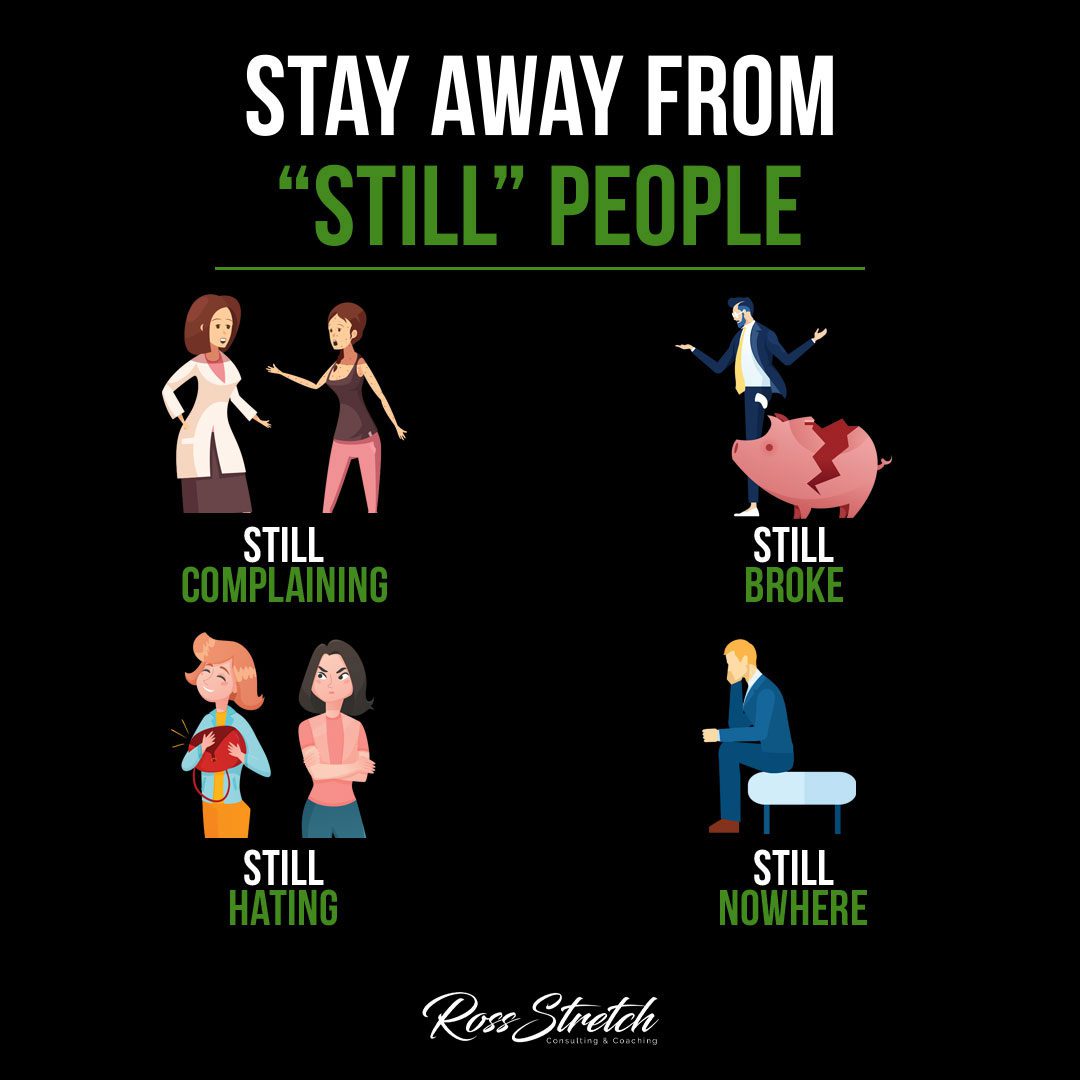
One of the most underappreciated drivers of personal success is your social environment. Your ambitions, habits, spending patterns, and self-belief are all shaped — often invisibly — by the people you spend the most time with. Research in social psychology consistently shows that behaviors and attitudes spread through networks much like contagion: the closer your connection to someone, the more their patterns influence yours. That’s why one of the highest-leverage decisions you can make for your growth is choosing who gets access to your time and energy. The concept of “still” people — those who are still complaining, still broke, still envious, still going nowhere — isn’t about judgment. It’s about understanding the invisible forces that are either accelerating or stalling your progress.
\
\
\
\
The Science of Social Contagion
\
\
Nicholas Christakis and James Fowler, researchers at Harvard and UC San Diego, spent years mapping the spread of behaviors through social networks. Their work, published in their book Connected, demonstrated that obesity, smoking, happiness, and financial behaviors spread through social ties up to three degrees of separation. If your close friend gains weight, your own risk increases by 57%. If your close friend is chronically pessimistic, your own outlook trends negative over time — even if you consciously resist it.
\
\
This isn’t a character flaw — it’s a neurological reality. Our brains are wired for social mirroring. We unconsciously adopt the speech patterns, attitudes, and worldviews of those we spend significant time with. This is adaptive when your environment is healthy and growth-oriented. It’s destructive when your environment is defined by stagnation, victimhood, or chronic negativity. Understanding this mechanistically — not morally — makes the case for curating your social environment with the same intentionality you apply to your diet or your finances.
\
\
\
\
The Toll of Constant Complainers
\
\
Everyone goes through difficult periods and needs to process them with people they trust. That’s not what we’re discussing here. “Still” complainers are people for whom complaint is a permanent mode — not a temporary release valve. They bring problems to every conversation and leave before solutions arrive. Their worldview is one of persistent victimhood, where circumstances are always to blame and personal agency is absent. Spending regular time with people in this mode gradually erodes your own sense of efficacy and possibility.
\
\
The antidote is deliberate. Seek out people who acknowledge problems but pivot quickly toward action. People who face setbacks and ask “What can I do about this?” rather than “Why is this always happening to me?” These individuals model a mindset that compounds positively over time — and proximity to them raises your own standard for how you process adversity. You don’t need to eliminate complainers from your life entirely; you need to consciously reduce the proportion of your mental bandwidth they occupy.
\
\
\
\
The Financial Cost of “Still Broke” Company
\
\
Financial habits are among the most contagious behaviors in Christakis and Fowler’s research. If your social group normalizes living paycheck to paycheck, carrying consumer debt, spending on status symbols beyond one’s means, and never discussing investing or savings, those norms become your norms by default. It’s not that your friends are consciously sabotaging you — it’s that the financial baseline of your environment shapes your sense of what’s normal and what’s possible.
\
\
Contrast this with the effect of spending time with people who discuss their investment portfolios, who celebrate paying off debt, who talk openly about budgeting and building side income. Those conversations shift what you think is achievable and expected. You start asking different questions. You start making different decisions. The simplest, most underrated financial strategy is to get into rooms — physical or virtual — with people who handle money better than you do. Their standards become your standards over time, without requiring willpower or motivation.
\
\
\
\
Envy: The Growth-Staller Hidden in Plain Sight
\
\
Envy is one of the most quietly destructive forces in a social circle. People who respond to others’ success with resentment rather than inspiration create an environment where achievement feels socially risky. In such circles, success must be minimized, hidden, or apologized for to avoid friction. This is deeply corrosive to ambition. If sharing good news is met with passive-aggressive commentary rather than genuine celebration, you subconsciously learn to suppress the goals that might lead to that good news.
\
\
The alternative is an inner circle that uses others’ wins as fuel rather than as a measuring stick. The difference is subtle but profound. People who are genuinely excited by others’ success operate from a mindset of abundance — the belief that there’s enough success to go around and that one person’s growth doesn’t diminish their own chances. Surrounding yourself with people who celebrate achievement creates an environment where striving is safe and rewarded, not penalized or resented.
\
\
\
\
How to Make the Shift Without Burning Bridges
\
\
Distancing yourself from stagnant social influences rarely requires dramatic confrontations or cold cut-offs. In most cases, it’s a quiet reallocation of time and attention. You spend less time in the groups and conversations that drain you, and more time in the environments that energize and challenge you. This can mean joining a professional mastermind group, attending industry events, participating in online communities centered on growth and entrepreneurship, or simply reaching out more often to the one or two people in your existing network who consistently inspire forward motion in you.
\
\
It’s worth acknowledging that this process can feel uncomfortable — especially if the people you’re spending less time with are family or long-term friends. The key is recognizing that you’re not rejecting people; you’re protecting your direction. You can maintain relationships with people who are “still” in various ways while being intentional about the degree to which their attitudes influence your daily mindset. Compassion and boundaries are not mutually exclusive — and holding both is a sign of emotional maturity, not selfishness.
\
\
\
\
Conclusion: Your Environment Is Your Investment
\
\
Jim Rohn famously said that you are the average of the five people you spend the most time with. The accuracy of that claim has been confirmed repeatedly by social science. Your social environment is not a passive backdrop to your personal growth — it’s an active variable in it. Investing in relationships with people who are growing, building, thinking ambitiously, and living with financial intentionality is one of the highest-return decisions available to you. Audit your inner circle with the same rigor you apply to your budget or your business. The returns will compound in ways you can’t fully predict — and that’s exactly the point.
\
\
\
\
Resources
\
\
- \
- Connected by Nicholas Christakis and James Fowler — The research behind social contagion and how behaviors spread through networks
- The Millionaire Next Door by Thomas Stanley — How financial habits and social environments shape wealth outcomes
- The Psychology of Money by Morgan Housel — Behavioral insights into how we make financial decisions and why environment matters
- Psychology Today: Social Contagion — Overview of how behaviors spread through social networks
\
\
\
\

 Ross Stretch