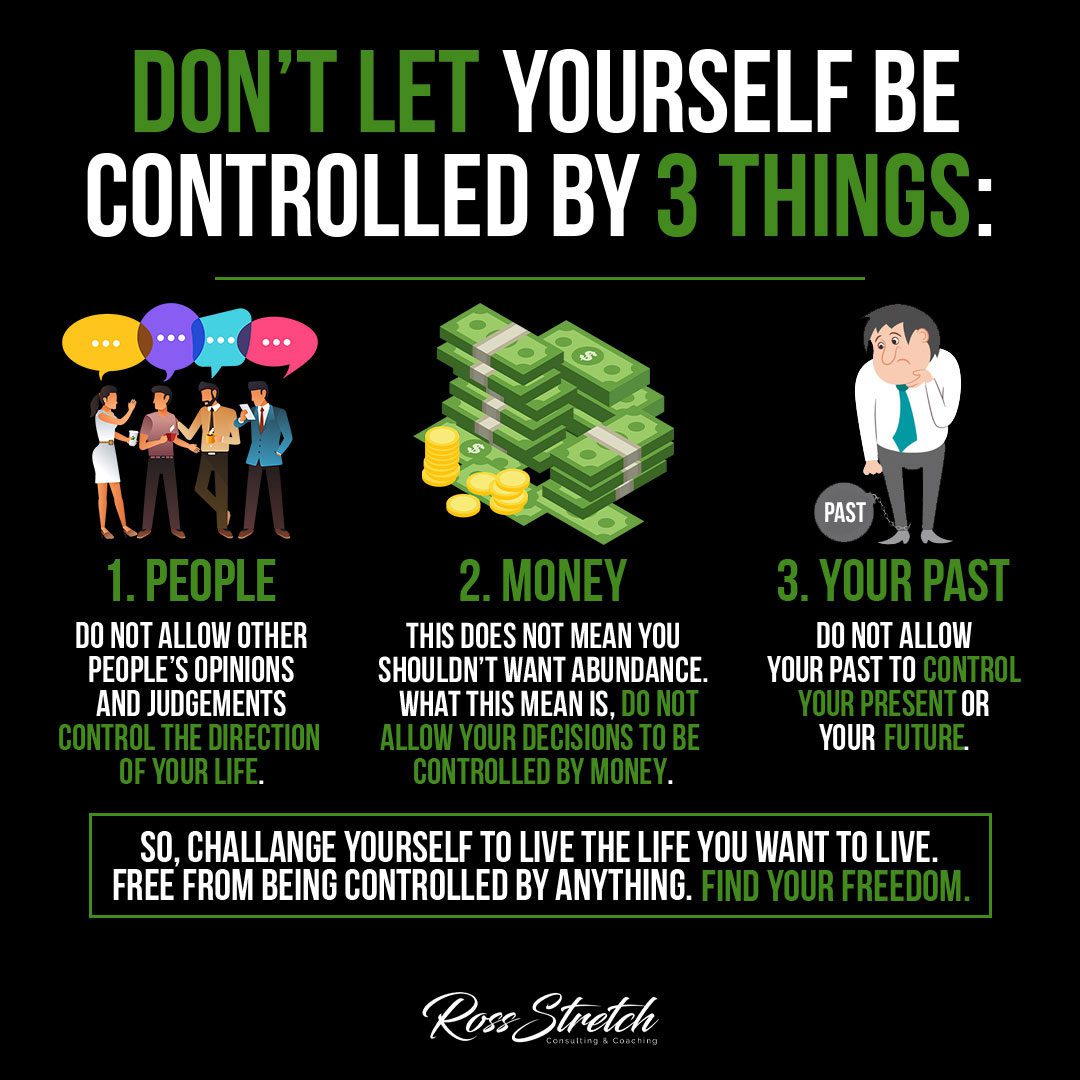
Most people spend years trying to improve their lives without addressing the forces that are quietly limiting them. They optimize their schedules, read productivity books, and pursue new opportunities — while remaining fundamentally constrained by patterns they have never examined. The three most common sources of that constraint are other people’s opinions, an unhealthy relationship with money, and the accumulated weight of past experiences. Breaking free from these is not a self-help cliche. It is the necessary foundation for any sustained progress.
The goal is not to become invulnerable to others, indifferent to money, or oblivious to your history. It is to stop allowing these forces to make decisions for you. The moment you move from reactive to intentional — when you choose your relationships, your financial behavior, and your relationship to the past deliberately — is the moment your life genuinely becomes your own.
The Hidden Chains: How Control Operates in Your Life
Control rarely announces itself. It operates through familiar patterns: the career path you stayed on because leaving would disappoint your family, the purchases you made to signal success to people whose approval you don’t actually need, the opportunities you declined because a past failure made you doubt your capabilities. These patterns feel like personal decisions — and they are, in a sense — but they are decisions made from a position of external pressure rather than internal clarity.
Recognizing these patterns requires a level of honest self-examination that is genuinely uncomfortable. Most people prefer the explanation that external circumstances are responsible for their position in life, because it removes the burden of agency. But that same absence of agency is exactly what keeps people stuck. Accepting that you have more control over your situation than you have exercised is the beginning of actually exercising it.
Breaking Free from Other People’s Expectations
Setting boundaries is not an act of aggression toward others — it is an act of clarity about who you are and what you will accept. People who control others through guilt, obligation, or persistent criticism often do so without fully realizing it. They have benefited from your compliance long enough that setting a limit feels, to them, like a change in your character. It is not. It is a correction toward authenticity that serves both parties in the long run, even when it is uncomfortable in the short term.
Surround yourself deliberately. The people who occupy your time and energy have a disproportionate influence on your decisions, your self-image, and your sense of what is possible. A social environment made up of people who are building, growing, and taking their lives seriously will produce very different thinking than one defined by complaint, comparison, and complacency. You do not need to cut people off dramatically — but you do need to be honest about whether the relationships in your life are expanding your thinking or limiting it.
Trust your instincts about your own direction. You have information about your values, goals, and capabilities that no one else has. Other people’s advice reflects their experience, not yours. Their caution reflects their risk tolerance, not yours. Take input seriously, but treat it as data rather than instruction. The life you want to build is yours to define, and no one else can do that work for you.
Redefining Your Relationship with Money
Money controls people in two opposite ways: through scarcity and through status. Those experiencing financial difficulty often make decisions from fear — avoiding risks that could improve their situation, staying in jobs or relationships that feel secure, and accepting options that are merely tolerable rather than right. Those with adequate resources sometimes fall into a different trap: using money to perform a version of success for others rather than building a financial life that reflects their actual values.
Defining your relationship with money requires understanding what it is actually for in your life. Is it security? Freedom? Options? A means to pursue meaningful work without being constrained by necessity? The answer shapes every financial decision you make. Without that clarity, you are spending, saving, and investing in response to social norms, inherited beliefs, and emotional reactions rather than a coherent personal strategy.
Financial independence — having enough assets and income to cover your needs without requiring any single income source — is the most concrete form of breaking free from money’s control. It is not achieved all at once, but it is built through consistent behavior over time: living below your means, investing the difference, and resisting the lifestyle inflation that consumes most of what professionals earn as their income grows.
Releasing the Weight of Your Past
Past experiences do not have inherent meaning — they have the meaning you assign to them. Two people can experience the same failure, the same rejection, the same difficult circumstances and emerge with completely different beliefs about themselves and their possibilities. The difference is not in what happened but in how it was interpreted and integrated. The past only controls your future when you allow its interpretation to become a fixed truth rather than one data point among many.
Releasing regret is not about pretending the past did not happen or that it did not matter. It is about distinguishing between the lesson a past experience contains — which is useful — and the story you have been telling about what it means — which may be limiting you. A past mistake was not evidence of permanent inadequacy. A failed business was not proof that entrepreneurship is not for you. A difficult relationship was not confirmation that you do not deserve better. These interpretations are optional, and choosing different ones is available to you at any point.
Rewriting your story is an active process, not a passive one. It involves deliberately creating new evidence — taking actions that contradict the limiting narrative, building new relationships that reflect who you are becoming rather than who you were, and measuring your current capabilities rather than relying on outdated self-assessments formed under different circumstances. You are not the person who failed several years ago. That person learned things and changed. Act accordingly.
Building a Life on Your Own Terms
Breaking free from the influence of people, money, and the past is not a single decision — it is a practice. Each week presents new opportunities to defer to others, to let financial anxiety drive decisions, or to allow old stories to limit new actions. The goal is not to eliminate these pressures entirely but to notice them and choose differently, consistently, until intentional behavior becomes the default rather than the exception.
The practical steps are less complicated than the emotional work that precedes them. Set specific boundaries with the people in your life who undermine your direction. Build a written financial plan that reflects your actual values rather than social defaults. Identify one belief from your past that is currently limiting a decision and examine whether it is actually still true. These are not grand gestures — they are the small, repeated acts of autonomy that accumulate into a life genuinely lived on your own terms.
Conclusion
Regaining control of your life is not about becoming isolated, indifferent, or disconnected from your history. It is about refusing to be managed by forces you have not consciously chosen. The people around you, your relationship with money, and your interpretation of your past all carry influence — but only as much as you allow. Claim the authority to decide how much influence each of these forces gets, build systems that support those decisions, and keep acting from that place of intentional self-determination. The freedom that comes from that practice is more durable than any external change in circumstance.
Resources


 Ross Stretch