In a world engineered to fragment your attention, the ability to focus deeply is one of the most valuable professional skills you can develop. Every app, notification, and open browser tab competes for the limited cognitive bandwidth you have each day. The professionals who learn to protect and direct that bandwidth gain a compounding advantage — not just in productivity, but in the quality of their thinking, their decisions, and ultimately their career and financial outcomes. This article outlines evidence-based strategies to train your brain for sustained, high-performance concentration.
The Biological Foundation of Focus
Understanding how focus works biologically gives you a significant advantage in training it. The prefrontal cortex — the brain region responsible for executive function, planning, and sustained attention — is metabolically expensive and fatigues over time. This is why it becomes progressively harder to concentrate on demanding tasks as the day progresses, and why the habits that support prefrontal function have outsized leverage on everything else you do professionally.
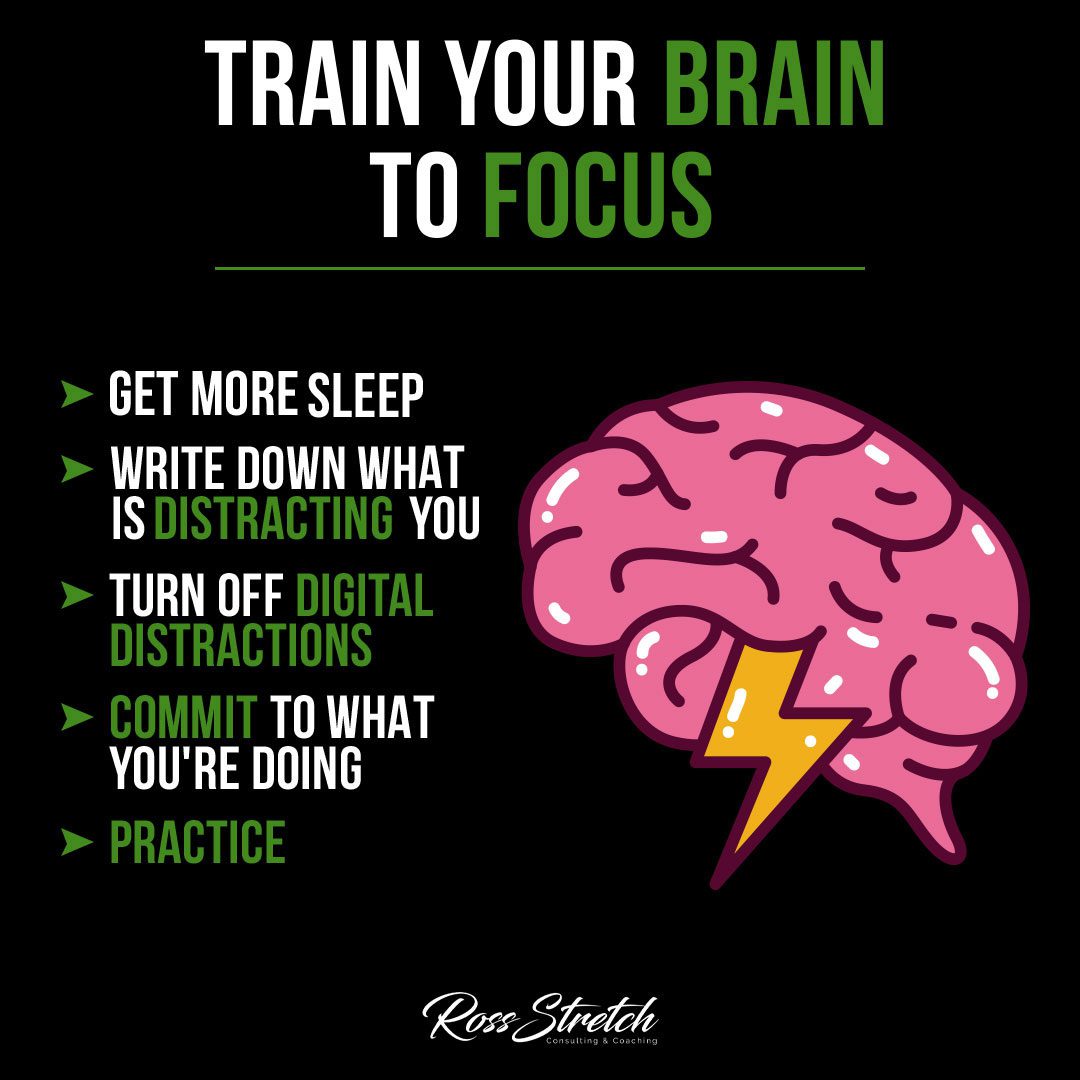
Sleep is the most powerful cognitive performance tool available to you. Research from the University of Pennsylvania found that reducing sleep from eight hours to six hours per night impairs cognitive performance as severely as total sleep deprivation after ten days — while most people fail to notice the decline because subjective awareness of impairment also diminishes. Seven to nine hours of quality sleep isn’t a lifestyle preference; it’s a biological prerequisite for peak concentration and sound decision-making.
Physical exercise is the second major lever. Regular aerobic activity increases levels of BDNF — brain-derived neurotrophic factor — a protein that supports the growth of new neurons and synaptic connections in regions responsible for learning and attention. Even a 20-minute walk has been shown in peer-reviewed research to improve focus for the following two hours. The relationship between physical health and mental performance is not metaphorical — it’s neurobiological and well-documented.
Identifying and Eliminating Distractions
Before you can improve your focus, you need to understand precisely what’s breaking it. Most people dramatically underestimate the number of interruptions they experience each day. Research by Gloria Mark at the University of California, Irvine found that it takes an average of 23 minutes to fully return to deep focus after an interruption. In a workday filled with Slack messages, email alerts, and social media notifications, many professionals spend their entire day in a state of shallow, fragmented attention — busy but rarely productive at their highest level.
A distraction audit is a simple but powerful diagnostic. For one full workday, keep a notepad nearby and note every time your attention is pulled away from the task at hand — whether by a notification, an impulse to check your phone, or a colleague interrupting you. Most people are surprised by both the frequency and the patterns. Once you see the data clearly, you can address root causes systematically rather than relying on willpower to fight invisible forces all day.
Digital distractions are the most controllable category. Apps like Freedom and Cold Turkey allow you to block distracting websites and applications during designated work windows. Turning off all non-essential push notifications, keeping your phone face-down or in another room during focus blocks, and establishing clear communication norms with colleagues — these are high-ROI behavioral changes that require initial discipline but quickly become habitual and self-reinforcing.
Single-Tasking and the Myth of Multitasking
Multitasking is not a productivity strategy — it’s a productivity myth. Neuroscience has repeatedly demonstrated that the human brain cannot simultaneously process two cognitively demanding tasks at the same level of quality. What people call multitasking is actually rapid task-switching, which incurs significant cognitive overhead with each transition. Stanford researcher Clifford Nass found that heavy multitaskers performed worse on virtually every cognitive measure compared to people who focused on one task at a time.
Single-tasking requires deliberate scheduling. The practical approach is to batch similar work into dedicated time blocks: creative and analytical work in the morning when prefrontal function is typically strongest, email and administrative tasks in the afternoon, and meetings clustered together rather than scattered throughout the day. This kind of intentional time architecture protects your best cognitive hours for your most demanding work — the work that actually moves the needle.
The Pomodoro Technique offers useful structure for those building their concentration capacity. Work in 25-minute focused intervals, then take a 5-minute break. After four intervals, take a longer 20-30 minute break. The scheduled breaks prevent mental fatigue from accumulating and allow the brain to consolidate what it has processed. Many practitioners find they can gradually extend their focused intervals to 50 or 90 minutes as their concentration endurance improves over weeks of consistent practice.
Training Focus Like a Skill
Concentration is trainable. Research on neuroplasticity has established that deliberate practice changes the brain’s structure and function — including regions responsible for attention and working memory. The key ingredients are consistency and progressive challenge applied over weeks and months, not days. Like physical fitness, cognitive fitness responds to training and atrophies with neglect.
Mindfulness meditation is the most rigorously researched focus training practice available. A study published in Psychological Science found that just two weeks of mindfulness training improved participants’ working memory capacity and standardized test performance. The mechanism is straightforward: meditation trains you to notice when your attention has wandered and to return it to the chosen point of focus — the identical cognitive action required for sustained concentration during demanding work. Even 10-15 minutes of daily practice produces measurable neurological changes within several weeks.
Long-form reading is an underrated focus training tool that most people overlook. Following a complex argument or narrative for an extended period exercises the same attentional circuits used in deep cognitive work. In contrast to social media consumption — which delivers information in fragments specifically optimized to trigger rapid dopamine responses — reading books and long-form essays requires and progressively builds the capacity for sustained intellectual engagement. Committing to 20-30 minutes of focused reading daily is one of the most accessible and effective focus training practices available.
Environmental Design for Deep Concentration
Your environment shapes your behavior more powerfully than most people realize. Designing a workspace that supports focus is one of the highest-leverage investments you can make in your cognitive performance. The goal is to reduce friction for focused work and increase friction for distraction — making it structurally easier to do the right thing and harder to do the wrong one.
Noise management is a critical variable. For many people, complete silence is not optimal — background noise at around 70 decibels, similar to a busy coffee shop, can support certain types of creative thinking. Apps like Brain.fm and Endel generate focus-optimized soundscapes using neuroscience research. For analytical work requiring precise concentration, noise-canceling headphones combined with instrumental music or white noise can significantly reduce auditory distraction and signal to your brain that focused work is beginning.
Visual environment matters equally. A cluttered, disorganized workspace creates background cognitive load that competes continuously with your primary task. A clean desk, minimal open browser tabs, and an organized digital workspace reduce micro-decisions and ambient distractions throughout the workday. The environment you work in is a system — and well-designed systems produce consistent results without requiring deliberate willpower every time you sit down to work.
Conclusion
The capacity for deep focus is not fixed — it’s a trainable skill that responds directly to deliberate practice and intelligent environmental design. In an economy where the most valuable outputs are cognitive, the professionals who protect and continuously develop their concentration ability gain a compounding advantage over those who allow their attention to be perpetually fragmented. Start with the fundamentals: prioritize sleep, audit your distractions, adopt single-tasking, and build a consistent practice of mindfulness or dedicated deep work. The improvements compound over time in the same way sound financial habits do — slowly at first, then decisively.
Resources

 Ross Stretch