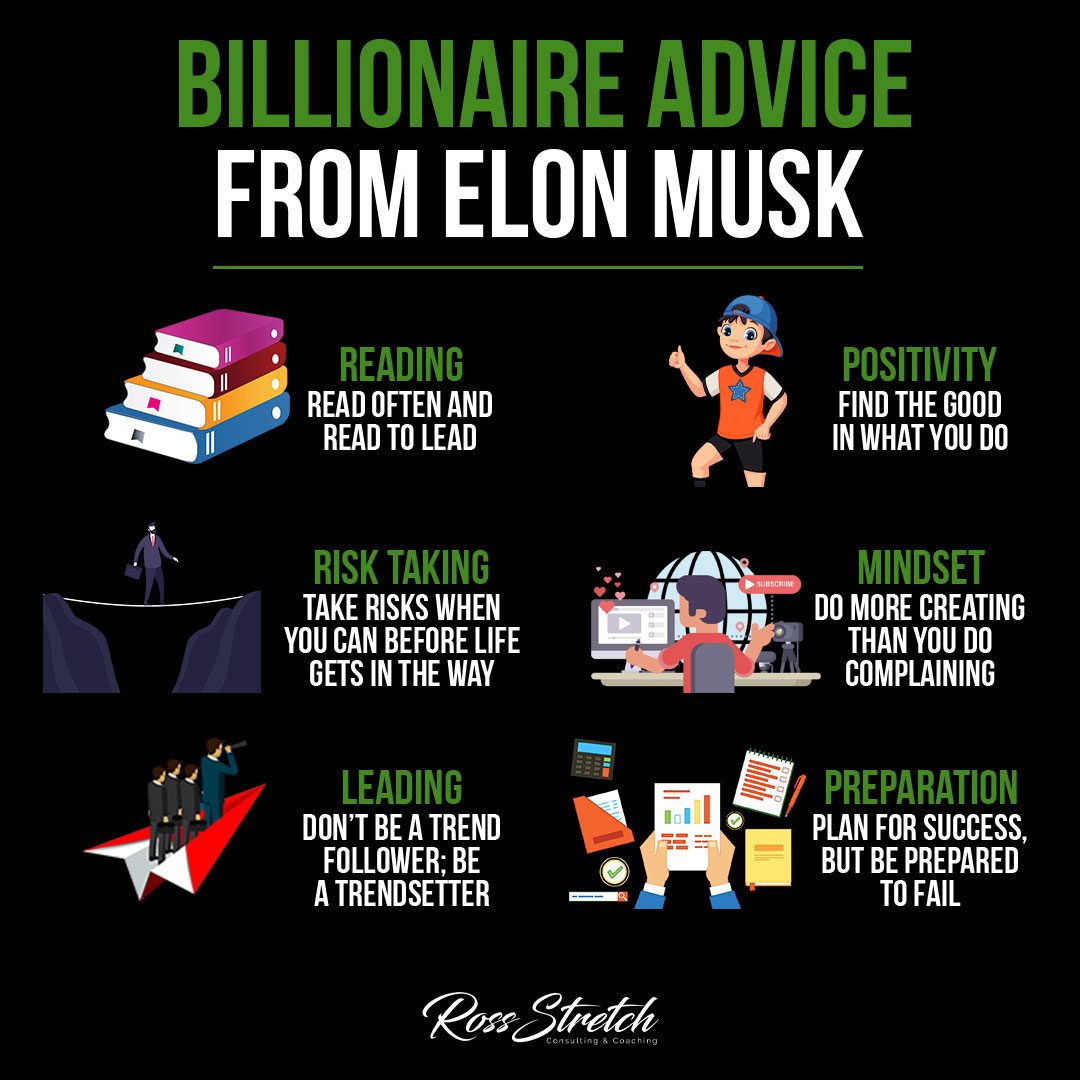
Few entrepreneurs have built multiple large-scale companies across as many different industries as Elon Musk. Whatever your views on his public persona, the entrepreneurial principles he has articulated over the years offer genuinely useful frameworks for anyone serious about building something significant. From his emphasis on relentless self-education to his willingness to take outsized risks at pivotal moments, his operating philosophy challenges conventional career thinking in ways worth examining carefully. Here are six principles from his publicly shared advice that apply to any ambitious person navigating business and life.
Read Constantly — Knowledge Is Your Foundation
Musk is famously self-taught in fields including rocket science, electrical engineering, and energy systems. His learning method was direct: read extensively, ask domain experts sharp questions, and apply knowledge immediately to real problems. He has described reading as the primary way he built technical competence in SpaceX’s early years — working through aerospace engineering textbooks and then interrogating industry veterans to fill in the gaps that books could not cover.
For entrepreneurs and professionals, this points to a simple but underutilized strategy: treat reading as a core professional responsibility rather than a leisure activity. Business books, technical literature, industry publications, and biographies of people who have solved problems similar to yours all compound over time. The person who reads one substantive non-fiction book per week for ten years develops a knowledge base that is genuinely difficult to replicate through experience alone.
The discipline is less about raw volume and more about deliberate application. Read with intention. Take notes. Connect what you are learning to the specific challenges you are facing right now. Most importantly, act on what you learn rather than treating books as a passive entertainment category.
Cultivate Optimism as a Competitive Advantage
Entrepreneurship involves sustained exposure to failure, rejection, and uncertainty. The people who survive and thrive in that environment are not typically those who feel the least doubt — they are those who have developed reliable mechanisms for managing doubt and returning quickly to a constructive mindset. Positivity, in this context, is not naivety. It is a trained operational skill.
Musk has spoken about the importance of finding the positive in difficult situations as a pragmatic orientation that keeps you problem-solving when pessimists have already quit. When SpaceX suffered three consecutive launch failures in its early years and faced the real prospect of company failure, maintaining conviction that success was still achievable was not a passive emotional state — it was an active daily choice made under significant pressure.
Cultivating this kind of optimism is trainable. Daily reflection on progress and what is working, surrounding yourself with people who balance honest assessment with forward momentum, and reframing setbacks as data rather than verdicts — these habits build the psychological infrastructure that long-term ambition requires.
Take Risks While the Stakes Are Still Lower
One of Musk’s most consistent pieces of advice to young people is to take significant risks early — before mortgages, family obligations, and accumulated lifestyle costs narrow the options available to you. This is not encouragement toward recklessness. It is a recognition that risk tolerance is finite and that time genuinely changes the financial and personal calculus of any major bet.
When you are in your mid-twenties with limited obligations, a failed business venture costs you time and some money. When you are in your mid-forties with dependents and a mortgage, the same failure can have consequences that extend far beyond yourself. Taking bigger career bets earlier — trying to start the company, pursue the unconventional path, or relocate to where the opportunity actually is — is mathematically lower-stakes than attempting the same thing a decade later.
Calculated risk also means doing enough research to understand the real probabilities involved. Musk’s bets were not random — they were informed by deep analysis of markets he was entering and honest assessments of his competitive advantages. The lesson is not to gamble on impulse — it is to be willing to back yourself decisively when you have genuine reason to believe the odds favor your success.
Create More Than You Complain
There is a meaningful difference between identifying a problem and solving one. The operating culture at Musk’s companies — which is demanding and not without controversy — consistently returns to action over analysis and solutions over complaints. His organizations are oriented around speed of iteration: build something, test it, learn from what breaks, and build again. The emphasis is always on forward motion.
For individuals, this principle translates into a useful personal audit. How much time in a given week do you spend discussing what is broken, unfair, or frustrating versus generating ideas, testing approaches, or actively building something? Neither mode is wrong in isolation — problems need to be acknowledged and understood. But the ratio matters enormously. A strong default orientation toward creating is one of the characteristics that most reliably distinguishes people who build things from people who observe others building them.
This also applies to how you respond to setbacks. When something goes wrong, the productive response is to understand why it went wrong and adjust your approach. Relitigating the decision, assigning blame, or dwelling on the outcome beyond what is necessary to extract the lesson — these are expensive uses of cognitive energy that could be redirected toward the next iteration.
Lead with Vision, Not Consensus
Truly innovative outcomes rarely emerge from consensus-building exercises. They come from a small number of people with a clear, ambitious vision who are willing to pursue it even when the mainstream view is skepticism or outright dismissal. Musk’s companies have consistently aimed at goals that most industry incumbents dismissed as technically impossible — and then delivered on them, imperfectly but at scale.
For most people, this principle applies at a much smaller scale: the courage to pursue the business idea your network thinks is unlikely to work, the willingness to make a hiring or product decision that diverges from industry convention, or the discipline to hold a long-term vision while managing short-term pressures that argue for compromise. Leadership is not about popularity — it is about being right about the future often enough to justify the trust of the people who follow your direction.
Developing your leadership capacity means getting better at pattern recognition across industries, communicating a compelling picture of what is possible in language others can act on, and being the person who initiates rather than waits for someone else to move first. That last habit — initiating — is more uncommon and more valuable than most people realize.
Prepare Thoroughly, Then Adapt Without Attachment
Musk plans with considerable rigor. SpaceX and Tesla were not launched as improvised experiments — they were built on detailed engineering analysis, market research, and financial modeling that accounted for multiple failure scenarios. Preparation at this level is what distinguishes entrepreneurs who survive early setbacks from those who do not. You cannot adapt intelligently from a position of ignorance.
But what distinguishes Musk’s approach from conventional planning is the willingness to abandon a specific plan rapidly when reality diverges from projections. The plans are not sacred — they are working hypotheses. When the evidence says the hypothesis is wrong, the response is to update the hypothesis quickly rather than defend it. This balance between thorough preparation and genuine adaptability is one of the most important competencies in any entrepreneurial context.
In practice, this means entering major initiatives with clearly articulated assumptions, building feedback loops that tell you quickly when those assumptions are failing, and making decisive adjustments when the evidence demands it. The goal is not to be right on the first attempt — it is to learn faster than your competition and correct course before the errors become fatal.
Conclusion
The principles described here — read voraciously, maintain optimism, embrace calculated risk, bias toward action, lead with vision, and balance preparation with adaptability — are not exclusive to billionaires. They are operating principles that any ambitious person can apply at whatever scale they are currently working. The context changes; the underlying logic does not. Pick the principle that challenges you most today and apply it concretely this week. That is where the real value of any advice lives — not in reading it, but in acting on it.
Resources

 Ross Stretch