Managing money well is less about sophisticated financial instruments and more about following a handful of timeless principles — consistently. The difference between someone who builds lasting wealth and someone who perpetually struggles financially rarely comes down to income level. It comes down to financial discipline, evidence-based decision-making, and the refusal to break the core rules that protect long-term security. These are the essential financial rules you should never break — and why each one matters far more than you might expect.
Never Borrow Money to Invest
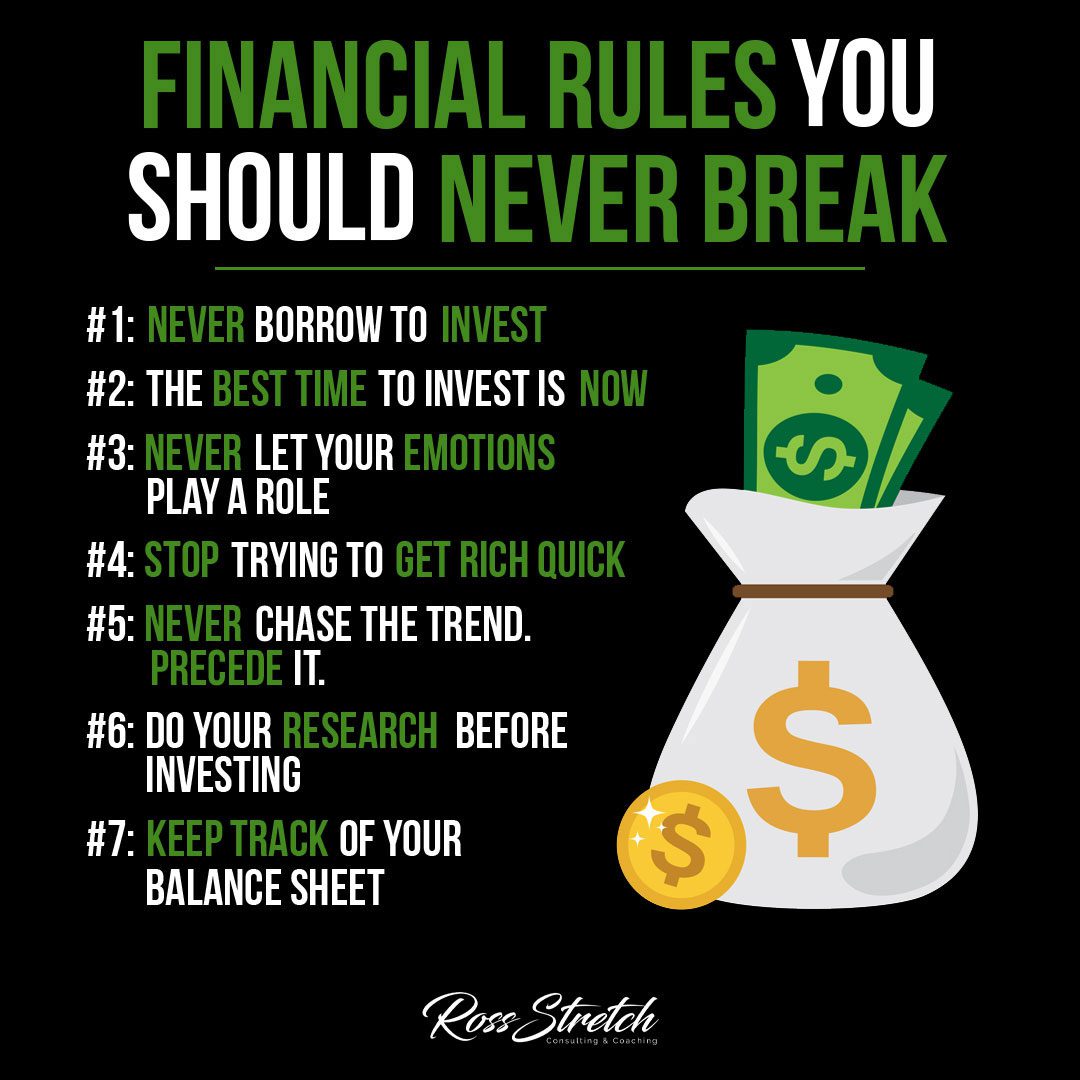
One of the cardinal rules of personal finance is to never use borrowed money to fund investments. While leverage can amplify gains in a rising market, it magnifies losses equally — and when you’re investing borrowed capital, those losses must be repaid regardless of market performance. The 2008 financial crisis devastated thousands of retail investors who had taken out home equity loans or margin accounts to invest in assets that subsequently crashed by 50% or more.
The mathematics are straightforward but brutal: if you borrow at 8% interest and your investment returns 6%, you’ve lost money even when the market performs reasonably well. Investing should be done with capital you own outright and can afford to lose without jeopardizing your financial stability. Build your investment base from savings, not debt. The only exception most financial professionals acknowledge is a mortgage on a primary residence — an appreciating asset with tax advantages and a fixed cost of living.
The Best Time to Invest Is Now
Waiting for the “perfect time” to invest is one of the most expensive mistakes you can make. Market timing — the attempt to buy at the bottom and sell at the top — has been shown repeatedly to underperform a simple buy-and-hold strategy. A landmark Fidelity study found that the top-performing accounts belonged to investors who had forgotten they had an account, or had died — because they simply never touched their investments.
The power of compounding rewards early action above nearly everything else. A 25-year-old who invests $5,000 per year at a 7% average annual return will accumulate approximately $1.1 million by age 65. A 35-year-old making the same annual contribution ends up with roughly $540,000 — less than half — simply by starting 10 years later. Time in the market consistently beats timing the market. Start now with whatever you have, and increase contributions as your income grows.
Never Let Your Emotions Drive Financial Decisions
Emotional decision-making is the single greatest destroyer of investment returns. Fear causes investors to sell at market bottoms — locking in losses at exactly the wrong moment. Greed causes them to buy at market peaks — chasing momentum just before reversals. Nobel laureate Daniel Kahneman’s research on behavioral economics demonstrates that the pain of financial loss is psychologically twice as powerful as the pleasure of equivalent gain, which is precisely why emotional investors almost always act against their own best interests.
The most effective solution is a written investment policy — a document that defines your strategy, asset allocation, and decision rules before emotions come into play. When markets crash, your policy tells you to rebalance, not panic-sell. When a hot stock captures your attention, your policy reminds you of your long-term strategy. Remove emotion from the equation by making your rules in advance and committing to them in writing.
Stop Chasing Get-Rich-Quick Schemes
The financial landscape is littered with schemes promising extraordinary returns with minimal effort — from penny stock newsletters to crypto pump-and-dumps to MLM income claims. These schemes prey on the entirely human desire for shortcuts. The problem is not that wealth can’t be built with speed; it’s that high returns always come with proportionally high risk, and most get-rich-quick products are specifically designed to enrich their creators at your expense.
The SEC receives tens of thousands of investment fraud complaints annually, with losses running into the billions. Real wealth is built through consistent, disciplined investing over time, developing high-value skills, and owning assets that generate income. Warren Buffett became one of the world’s wealthiest people not through a single windfall but through more than 60 years of disciplined, compounding investment. The boring path — index funds, consistent savings, skill development — is often the fastest path when measured over a lifetime.
Never Chase Trends — Anticipate Them
Following financial trends blindly is a reliable way to buy high and sell low. By the time a trend is covered extensively in mainstream media, sophisticated investors have already positioned themselves — and you’re buying what they’re selling. This doesn’t mean you should ignore market trends; it means you need to develop the analytical discipline to identify them early, based on fundamentals rather than headlines and social media buzz.
Before acting on any investment thesis, ask: why is this opportunity available to me right now? If the answer is because everyone is talking about it, you’re probably late. Look for situations where rigorous research uncovers value that the market hasn’t yet fully priced in. This requires reading financial statements, understanding industry dynamics, and developing independent judgment — skills that take time to build but pay dividends for life.
Do Your Research, Diversify, and Build Reserves
Three rules that work together to create genuine financial security: thorough research before every investment decision; diversification across asset classes, industries, and geographies to ensure no single position can destroy your portfolio; and a fully funded emergency reserve of three to six months of living expenses. These aren’t optional extras — they are the structural foundation of a resilient financial life.
Diversification is especially important because correlation patterns between assets shift during market stress — assets that appear uncorrelated in normal conditions often move together during crashes. A well-diversified portfolio across equities, fixed income, real assets, and cash provides genuine protection. Your emergency fund should be held in a high-yield savings account that you never touch except for genuine emergencies — not market dips, not investment opportunities, not large purchases. It exists solely to prevent a bad month from forcing you to sell long-term investments at the worst possible time.
Prioritize Debt Repayment and Seek Expert Guidance
High-interest debt is a guaranteed negative return on your net worth, compounding against you every single month. Paying off a 20% APR credit card balance is mathematically equivalent to earning a guaranteed 20% return — something no legitimate investment can reliably offer over time. Make it a non-negotiable priority to eliminate any debt above 7-8% interest before significantly increasing your investment contributions.
At the same time, recognize the limits of what you can learn alone. Financial advisors, tax professionals, and estate planning attorneys provide expertise that typically pays for itself many times over. A good financial planner can help you optimize your investment strategy, minimize your tax burden, and avoid costly mistakes that compound negatively over decades. Financial education is a lifelong endeavor — invest in it through books, courses, and qualified professionals who have a fiduciary duty to act in your interest.
Conclusion
The financial rules outlined here aren’t exciting — they don’t promise overnight riches or revolutionary shortcuts. What they promise is something far more valuable: a systematic, evidence-backed approach to building lasting wealth over time. Financial success is not a product of brilliant market timing or getting lucky on a hot stock tip. It is the cumulative result of disciplined habits applied consistently across decades.
Start with the fundamentals. Invest early and consistently with your own money. Keep emotions out of financial decisions. Avoid debt-fueled speculation. Diversify, build reserves, and attack high-interest debt first. These principles have stood the test of time across every market cycle in modern history — and they will continue to work long after the latest financial trend has faded into memory.
Resources
- Investopedia — How to Start Investing: A Beginner’s Guide
- U.S. Securities and Exchange Commission — Ten Things to Consider Before You Make Investing Decisions
- Forbes Advisor — How Compound Interest Works and Why It Matters
- Harvard Business Review — The Psychology of Money and Financial Decision-Making


 Ross Stretch