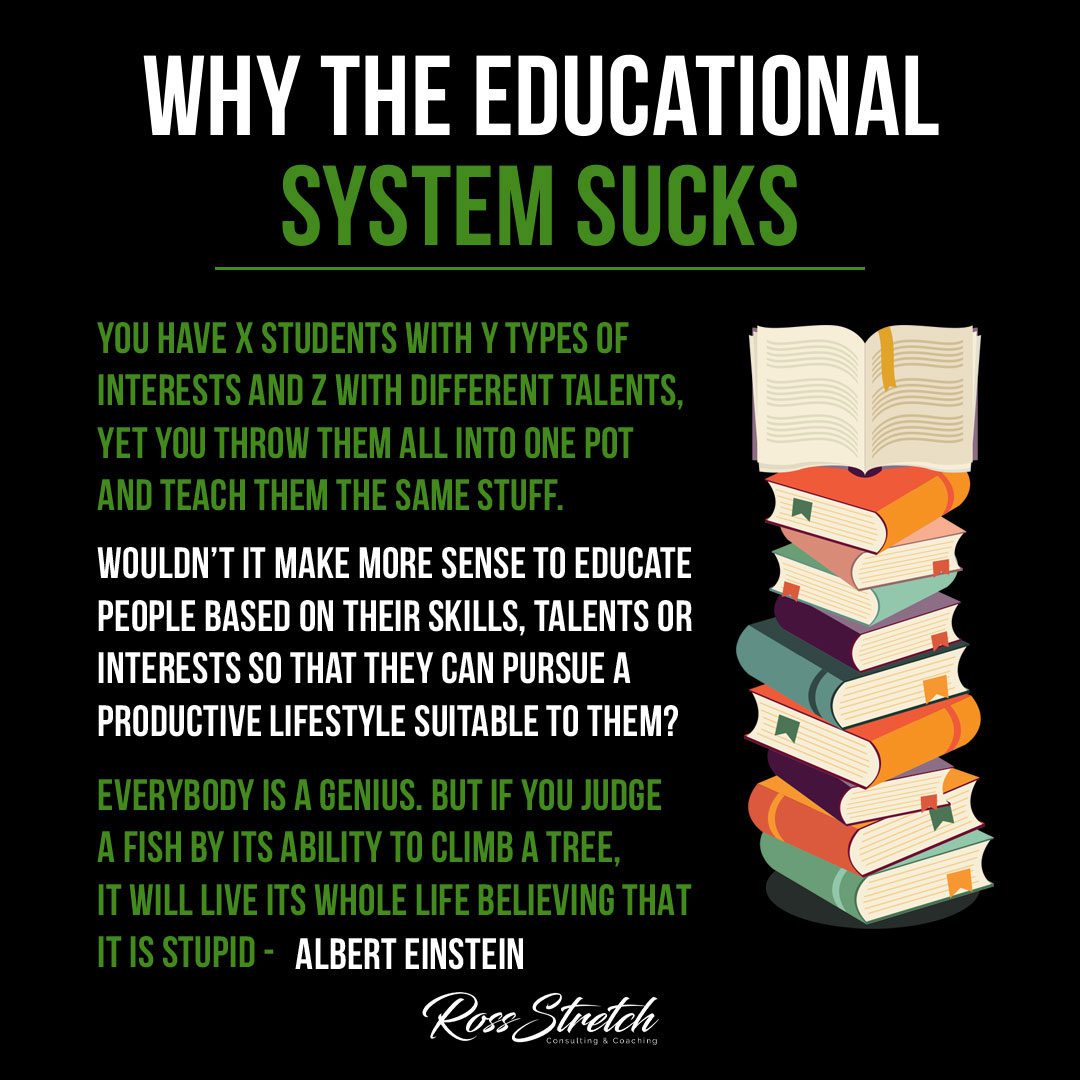
The traditional education system was built for a different era — one that needed workers who could follow instructions, perform standardized tasks, and fit neatly into industrial hierarchies. But in today’s economy, driven by individual creativity, entrepreneurial thinking, and personalized expertise, treating every student as identical is not just inefficient — it is actively harmful. Albert Einstein said it plainly: “Everybody is a genius. But if you judge a fish by its ability to climb a tree, it will live its whole life believing it is stupid.” Our education system has been judging fish by their tree-climbing ability for over a century.
Why This Matters More Than You Think
The stakes of an inflexible education system are enormous. When students who learn differently, think creatively, or excel in non-academic domains are forced into a standardized mold, they don’t just underperform — they often internalize the failure. Research from Harvard’s Graduate School of Education shows that students who are disengaged from school are significantly more likely to experience negative long-term outcomes: lower lifetime earnings, higher rates of unemployment, and diminished self-confidence that persists well into adulthood.
The one-size-fits-all model fails students on both ends of the spectrum. Academically strong students are fast-tracked into conventional success, while students who might become exceptional artists, athletes, builders, or entrepreneurs are told — directly or indirectly — that their strengths don’t count. The rigid structure of the education system focuses predominantly on academic subjects and neglects areas where students can truly shine. This oversight deprives them of opportunities to develop their genuine talents and pursue fulfilling careers in fields where they would naturally excel.
Consider the world’s most successful innovators — from Steve Jobs to Richard Branson to Oprah Winfrey — many of whom were not products of conventional academic success. What they shared was a relentless focus on their unique strengths, the willingness to pursue what others called impractical, and the resilience to operate outside systems that didn’t recognize their particular genius. The question worth asking is: how many potential geniuses never discover their genius because the system told them too early that they didn’t have any?
What This Really Means: Embracing Diverse Intelligences
Harvard psychologist Howard Gardner’s theory of multiple intelligences, introduced in 1983, proposed that human cognitive ability is far more diverse than a single IQ score can capture. Gardner identified at least eight distinct types of intelligence: linguistic, logical-mathematical, spatial, musical, bodily-kinesthetic, interpersonal, intrapersonal, and naturalistic. Traditional schooling rewards primarily the first two while largely ignoring the rest — an arrangement that advantages a narrow slice of students and disadvantages everyone whose genius lives in a different domain.
When we design an education system that only recognizes one or two forms of intelligence as legitimate, we don’t just waste potential — we create generations of people who have been told they’re average when they are, in fact, exceptional in ways the system never measured. By embracing and nurturing diverse intelligences, we can build an education model that allows every individual to contribute their unique strengths to a richer, more innovative society. Personalized education for individual growth isn’t a luxury — it is the logical response to the actual diversity of human capability.
How to Apply This in Your Life
Step 1: Identify Your Authentic Strengths
Most people have a deep awareness of what comes naturally to them — they’ve simply been conditioned to discount it because the school system didn’t value it. Start by taking stock of activities where you lose track of time, skills others regularly seek you out for, and subjects you pursue voluntarily without external pressure. These are signals pointing toward your authentic intelligence profile. Tools like StrengthsFinder, the VIA Character Strengths survey, or even consistent journaling can surface these patterns clearly. By identifying your skills, talents, and interests, you can tailor your own development to meet your unique potential.
Step 2: Pursue Skills That Align With Your Strengths
Once you’ve identified your strengths, deliberately invest in developing them to a genuinely high level. Deep skill in any domain creates value and opens opportunities that generic competence never will. Whether that means mastering a craft, building a business, developing technical expertise, or cultivating interpersonal influence — committed, sustained development in an area of natural aptitude produces extraordinary results. Students who are educated based on their skills and interests are more likely to feel a sense of purpose and motivation, leading to improved performance and a greater likelihood of long-term success.
Step 3: Build a Learning Environment That Works for You
If traditional education didn’t fully work for you, that’s not a verdict on your intelligence — it’s information about your learning style. Visual learners, kinesthetic learners, self-directed autodidacts, and project-based thinkers all have rich ecosystems of alternative education available: online courses, apprenticeships, bootcamps, mentorships, and self-designed learning curricula. Platforms like Coursera, Skillshare, MasterClass, and YouTube have democratized access to world-class instruction in virtually every domain. Build the education the system didn’t provide you.
Step 4: Advocate for Better Systems
Individual adaptation is essential, but so is systemic change. To address the shortcomings of the current education system, a shift toward a holistic approach is needed — one that acknowledges intelligence and abilities come in various forms and tailors educational experiences accordingly. Parents, educators, and community members all have roles to play in pushing for schools that value diverse intelligences, offer meaningful vocational and entrepreneurial pathways, and measure success through multiple lenses rather than standardized tests alone. Countries like Finland, which consistently rank among the world’s top education systems, have embraced personalized learning and dramatically expanded the breadth of skills schools are designed to develop.
Step 5: Reframe Your Own Educational Story
If you struggled in school, you may be carrying a narrative that limits your potential today — one that says you’re not smart, not capable, not destined for significant achievement. That narrative needs to be examined and rewritten. The education system’s inability to recognize your genius was a failure of the system, not of you. Many of the world’s most successful entrepreneurs, artists, athletes, and innovators share histories of academic struggle — not because they weren’t intelligent, but because their intelligence didn’t fit the narrow mold the system was measuring. Everybody is a genius. The work is discovering which kind.
Common Mistakes People Make
- Confusing credentials with competence. A degree signals exposure to information — it doesn’t guarantee mastery or capability. Focus on building demonstrated skills and real-world results, not just collecting certificates that look impressive on paper.
- Abandoning strengths to chase prestige. Many people spend their careers in fields chosen for status or parental approval rather than genuine aptitude, and pay the price in engagement, performance, and fulfillment throughout their working lives.
- Assuming the education system’s verdict is final. Being told you’re average at 16 says nothing about what you can become at 30, 40, or 50 with focused effort, the right environment, and deliberate investment in your authentic strengths.
- Ignoring self-directed learning opportunities. The most valuable education available today — from world-class business schools, scientists, and entrepreneurs — is often free or low-cost online. Not using it is a choice, not a constraint imposed by circumstance.
The Bottom Line
The flaws in our education system are real, significant, and consequential — but they don’t have to define your trajectory. The one-size-fits-all model fails students who learn differently, think creatively, or excel in domains the system doesn’t measure. Moving away from this approach and embracing holistic, personalized education can create an environment where every student is empowered to pursue their unique talents and interests. It is time to reimagine what education means and who it serves.
Embracing your individual talents and pursuing education that aligns with your genuine strengths isn’t a consolation prize — it’s the most direct path to excellence and a fulfilling, productive life. As Einstein’s words remind us, every person is a genius in their own right. The challenge is to stop measuring fish by their ability to climb trees, and to start building environments — and personal development strategies — that allow every form of intelligence to reach its full potential.
Resources

 Ross Stretch