
The question of how to build valuable knowledge and skills has never had a single answer — but today it has more options than ever. Formal education and self-directed learning represent two distinct paths to acquiring expertise, and both carry real advantages and real limitations. The right choice depends on your specific career goals, financial situation, learning style, and how much time you are willing to invest. This article breaks down both paths honestly so you can make the decision that actually fits your life.
What Formal Education Offers
Formal education — universities, colleges, trade schools, and professional certification programs — provides a structured curriculum designed by subject-matter experts. Students follow a defined sequence of courses, receive feedback from instructors, and earn credentials recognized by employers and professional licensing bodies. For many careers, this credential is not optional: medicine, law, engineering, and teaching all require specific degrees as a baseline condition of entry.
The practical value of formal education extends beyond the degree itself. Campus environments connect students with peers, mentors, and professional networks that can be difficult to replicate independently. Many employers use a degree as a basic screening filter, regardless of whether the specific coursework is directly applicable to the role. In credential-gated industries, formal education is not one of several paths — it is the path.
Structured accountability is another underrated benefit. When you are enrolled in a program with class schedules, assignment deadlines, and graded assessments, the external structure keeps you moving. Many people who begin self-directed learning with excellent intentions discover that motivation without accountability erodes over weeks or months.
The Real Costs of a Traditional Degree
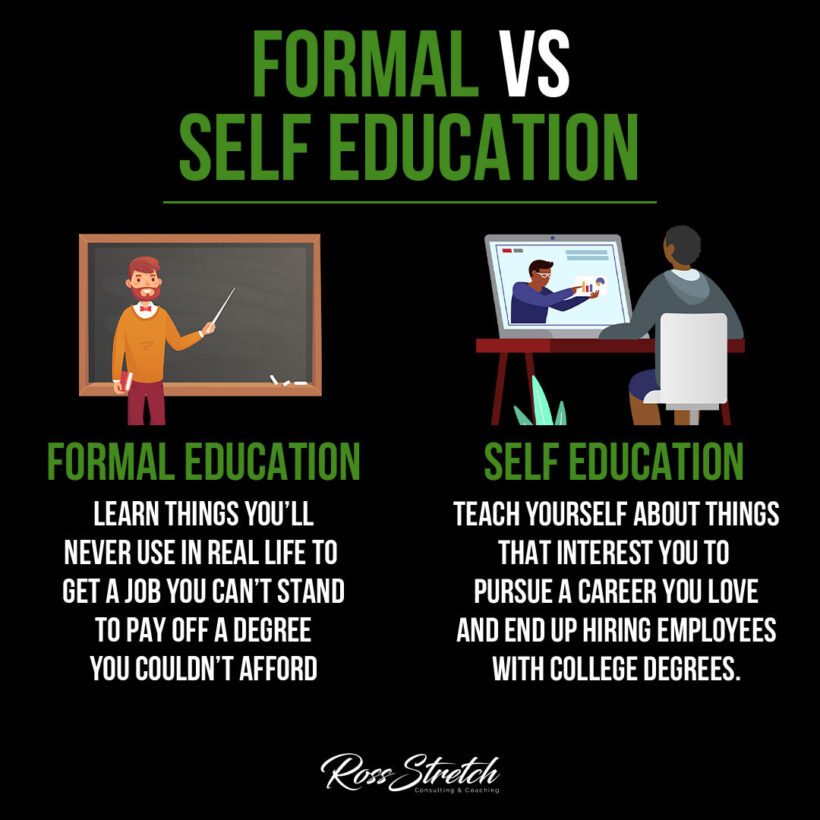
Formal education comes with significant financial costs that must be weighed honestly. Tuition at a four-year university can range from $20,000 to over $200,000 depending on the institution and program. Add in housing, textbooks, living expenses, and foregone income during those years, and the total cost of a degree is considerably higher than the published tuition number suggests.
Student loan debt has become a defining financial burden for millions of graduates. According to the Federal Reserve’s Survey of Consumer Finances, the median student loan borrower in the United States carries over $25,000 in debt. Monthly loan payments after graduation can delay other major financial milestones — building an emergency fund, saving for retirement, buying a home, or starting a business — for years or even decades.
There is also the cost of rigidity. Degree programs require you to commit to a field of study, often before you have real-world experience in it. Changing direction mid-program can mean losing credits, time, and tuition dollars. The structure that provides accountability can also create constraints that do not fit everyone’s learning style or life circumstances.
What Self-Education Makes Possible
Self-directed learning has never been more powerful or accessible. Platforms like Coursera, edX, Khan Academy, and Udemy offer courses taught by university professors and industry practitioners, often for free or at a fraction of the cost of formal education. YouTube alone contains more instructional content than most physical libraries could hold. The barrier to acquiring high-quality knowledge has essentially collapsed for anyone with an internet connection.
For entrepreneurship, technology, marketing, creative work, and many other fields, self-education combined with a demonstrable portfolio can be more compelling to employers and clients than a formal degree. A software developer who has built and shipped multiple applications has a track record that speaks for itself, regardless of how they learned to code. A marketer who has grown an audience or managed successful campaigns has real proof of ability that classroom grades cannot replicate.
Self-education also allows for rapid course correction. If you invest three months learning a skill and discover it is not what you want to pursue, you pivot without losing credits, without administrative processes, and without sunk costs beyond the time you spent. The speed and flexibility of self-directed learning is genuinely difficult for formal institutions to replicate.
Where Self-Education Falls Short
Self-education is not a universal substitute for formal credentials. In regulated professions — medicine, dentistry, law, nursing, engineering, and others — no amount of self-directed learning replaces the licensed qualifications that these fields legally require. Attempting to practice in these areas without the appropriate credentials is not just difficult; it is in many cases illegal, and for good reason.
The absence of structured feedback is also a genuine limitation. When you learn independently, you may develop blind spots or reinforce incorrect understanding without realizing it. Professors, tutors, and peers provide a corrective function that is harder to replicate on your own. Online communities and accountability partners can partially fill this gap, but they require intentional effort to build and maintain.
Finally, self-education places full responsibility for motivation and pacing on the learner. Without deadlines, grades, or social accountability, many people start strong and gradually lose momentum. The freedom that makes self-education attractive is the same quality that makes it challenging to sustain over months or years without strong internal discipline.
How to Choose the Right Path
The decision between formal and self-directed education is rarely binary. Many of the most effective learners combine both approaches — earning a degree in a field that requires credentials while simultaneously self-educating in adjacent skills that make them more effective and adaptable. A business graduate who self-studies digital marketing, data analysis, and personal finance is significantly better positioned than one who simply completes the degree and stops there.
If your target career requires a specific license or credential, formal education in that area is not optional. Pursue it with a clear financial plan to minimize debt — community college, scholarships, co-op programs, and employer tuition assistance are all worth exploring before taking on loans. If your goals are in entrepreneurship, technology, or creative fields, self-education paired with real projects and a strong portfolio can be equally effective as a degree, and at a fraction of the cost.
The most important question is not which path is better in general — it is which path is better for your specific goals. Define what success looks like for you in five to ten years, research what credentials or skills that outcome actually requires, and then choose the most direct, cost-effective route to get there. Clarity about the destination makes the path much easier to choose.
Conclusion
Both formal education and self-directed learning produce genuinely successful people across every field. The path matters less than the quality and consistency of your effort. What matters most is that you are deliberate about the investment you are making — in time, money, and focus — and that your learning strategy is directly connected to your actual goals. Choose the approach that serves your future, not the one that simply feels safer or more familiar.
Resources

 Ross Stretch