Most parents want to raise children who can handle setbacks, manage their emotions, and grow into confident, capable adults. But resilience, emotional strength, and independent thinking are not traits children are simply born with — they are skills developed through experience, guidance, and a specific kind of parenting that is harder than it sounds. The challenge is that many of the instincts parents rely on — shielding kids from failure, solving problems for them, minimizing discomfort — actually work against the very qualities they are trying to build.
Why This Matters
Children who develop emotional resilience early are better equipped to handle academic pressure, social conflict, disappointment, and the unpredictable challenges of adult life. Research from the Harvard Center on the Developing Child shows that the foundation for lifelong resilience is built in the early years through consistent, responsive relationships and opportunities to practice coping. Children who do not develop these foundations by adolescence often struggle with anxiety, poor frustration tolerance, and difficulty functioning independently.
The stakes extend beyond individual wellbeing. Emotionally resilient children tend to perform better in school, sustain healthier friendships, and recover more quickly from adversity. The investment parents make in emotional coaching during childhood pays dividends across every domain of a child’s future life. This is not about being a “tough” parent — it is about being a deliberate one, making choices that prioritize long-term strength over short-term comfort.
How to Raise Strong, Resilient Kids
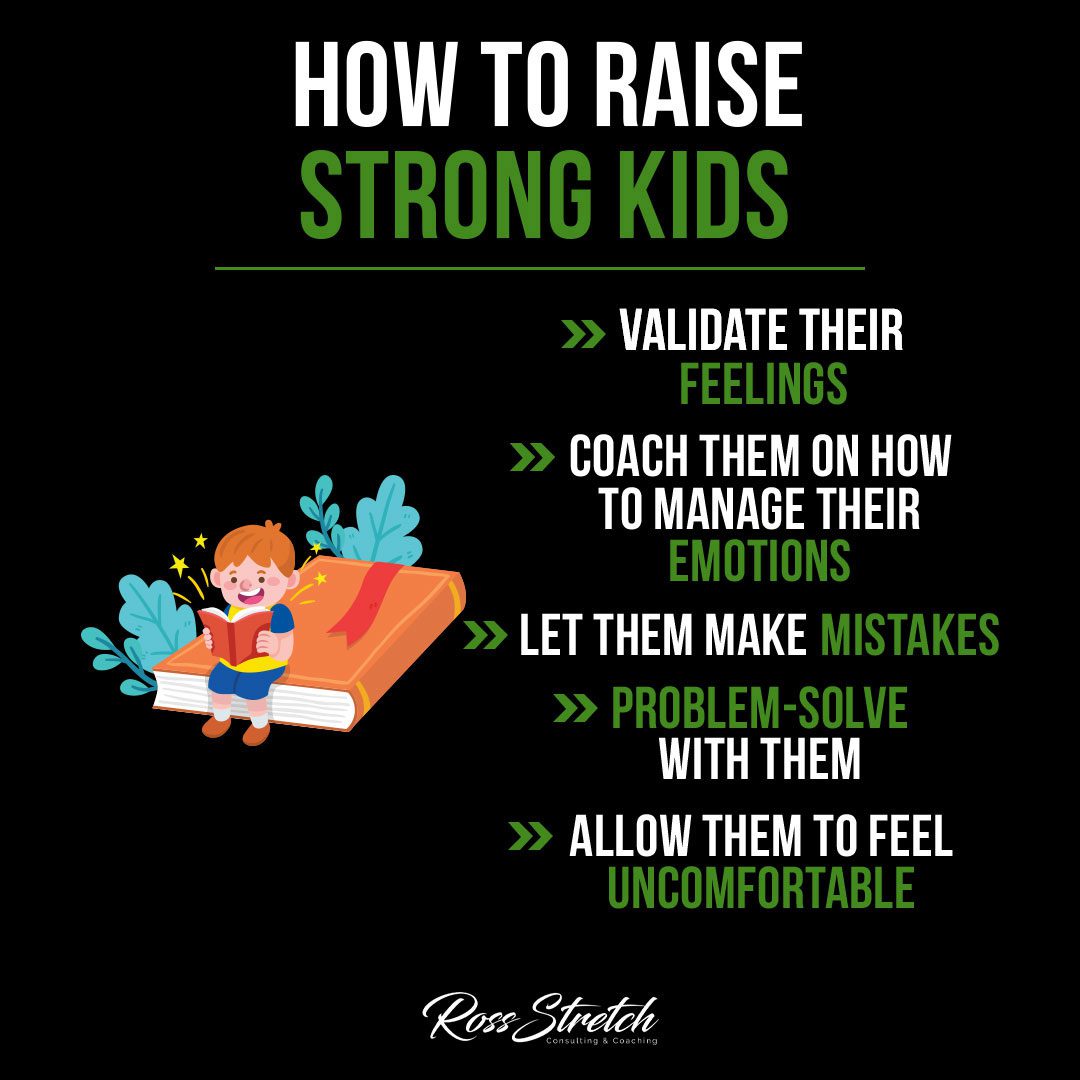
Step 1: Validate Their Feelings Without Rescuing Them From the Emotion
Emotional validation is the foundation of everything else. When a child feels heard and understood, they develop the security needed to manage difficult feelings rather than be overwhelmed by them. The key distinction is between validating an emotion and immediately solving the problem that caused it. Saying “I can see you’re really frustrated” is powerful. Instantly fixing the source of the frustration teaches the child they cannot handle it themselves.
- Get down to your child’s eye level and acknowledge what they are feeling by naming it specifically.
- Avoid dismissive phrases like “You’re fine” or “It’s not a big deal” — even minor upsets matter to children.
- Reflect feelings back before moving to solutions: “That sounds really disappointing. What do you think you want to do?”
- Do not reward emotional outbursts with immediate capitulation — validation is not the same as giving in.
Step 2: Teach Concrete Emotional Regulation Techniques
Emotional regulation does not develop automatically — it is taught and practiced. Young children’s brains are still developing the prefrontal cortex, the region responsible for managing impulses and emotions. They need adults to actively coach them through the process repeatedly before it becomes internalized. Simple, concrete techniques work best at younger ages and can grow in sophistication as children mature.
- Teach “belly breathing” — slow, deep breaths that activate the parasympathetic nervous system and calm the stress response.
- Create a feelings vocabulary together using charts, books, or apps so children can label emotions precisely rather than acting them out.
- Establish a designated calm-down space at home stocked with items that help self-regulation (fidgets, drawing materials, a comfort object).
- Model your own regulation out loud: “I’m feeling frustrated right now, so I’m going to take a few deep breaths before I respond.”
Step 3: Allow Mistakes and Resist the Urge to Fix Everything
Mistakes are the primary vehicle through which children develop competence and confidence. When parents consistently intervene before a child fails — finishing projects, smoothing over conflicts, doing homework — the child learns that they are not capable of handling difficulty on their own. The discomfort of watching your child struggle is one of the hardest parts of parenting deliberately, but it is one of the most important.
- Let age-appropriate mistakes happen without immediate correction — wait to see if your child self-corrects first.
- After a mistake, ask open-ended questions: “What happened? What would you do differently next time?”
- Avoid tying a child’s identity to their performance — praise the effort and strategy, not just the outcome.
- Normalize your own mistakes in front of your children and narrate how you recover from them.
Step 4: Problem-Solve Together Rather Than For Them
Collaborative problem-solving builds critical thinking, confidence, and the ability to tolerate uncertainty. When a child brings you a problem, the goal is not to hand them an answer but to walk alongside them through the process of finding one. This approach, developed by psychologist Ross W. Greene, treats children as partners in solving difficulties rather than subjects of adult decisions — and it dramatically reduces power struggles in the process.
- Use a simple framework: identify the problem, brainstorm multiple possible solutions, evaluate each, and choose one to try.
- Accept imperfect solutions — a plan the child chose and owns is more valuable than a perfect plan imposed on them.
- Revisit problems that were not solved and try again without shame: “That didn’t work. What else could we try?”
- Involve children in age-appropriate family decisions to practice real-stakes problem-solving in a safe environment.
Step 5: Gradually Expand Their Comfort Zone With Your Support
Resilience is built through repeated experiences of moving through discomfort and coming out the other side intact. This does not mean throwing children into situations that overwhelm them — it means thoughtfully stretching the edge of what feels manageable in a steady, scaffolded way. Camps, new activities, unfamiliar social situations, and even physically challenging experiences all build the evidence base children need to believe in their own capacity.
- Identify one area per season where your child could safely stretch — a new club, a longer hike, an independent task.
- Prepare them with information and role-playing before the challenge, then step back during it.
- Debrief afterward: “That seemed hard at first. How did it feel when you got through it?”
- Avoid over-scheduling in ways that eliminate unstructured challenge — free play involves its own critical problem-solving and conflict resolution.
Common Mistakes to Avoid
- Confusing validation with permissiveness. Acknowledging a child’s emotion does not mean accepting all behavior that flows from it. Children need both emotional acceptance and clear behavioral limits.
- Intervening too quickly in peer conflicts. Social problem-solving is a critical skill. Unless a child is being harmed or bullied, give them space to navigate ordinary disagreements before stepping in.
- Modeling emotional suppression. If you tell children to “be strong” and hide their own distress, you teach them that emotions are shameful, not manageable.
- Praising ability over effort. Telling a child they are “so smart” ties their self-worth to fixed traits. Praising persistence and strategy teaches them that growth is within their control.
- Expecting resilience without modeling it. Children learn far more from watching how you handle adversity than from any advice you give about how they should.
Conclusion
Raising strong kids requires a willingness to be uncomfortable as a parent. It means holding back when every instinct says to fix, rescue, or protect. It means trusting that your child has more capacity than they sometimes show — and more than is visible in any single hard moment. The children who grow into resilient, emotionally intelligent adults are not those who never struggled. They are the ones whose parents believed in their ability to struggle well, and stayed close enough to coach them through it.
Start small. Pick one area this week where you can step back and let your child work through something on their own. Notice what happens when you validate without rescuing, or ask a question instead of offering a solution. Resilience is built one small moment at a time — and so is the trust between a parent and child that makes all of it possible.
Resources
- Harvard Center on the Developing Child — Resilience: Research-backed frameworks on how resilience develops in children and what caregivers can do to support it.
- CASEL — Collaborative for Academic, Social, and Emotional Learning: Evidence-based resources for social-emotional learning, including tools parents can use at home.
- Greater Good Science Center — Parenting: Articles and practical guides on raising emotionally healthy, compassionate children grounded in positive psychology research.
- Zero to Three: Expert guidance on early childhood social-emotional development, including age-by-age breakdowns of what to expect and how to respond.

 Ross Stretch