
When building an investment portfolio, one of the most fundamental decisions you’ll face is whether to focus on growth stocks, value stocks, or some combination of both. These two investment philosophies have defined market debates for decades, and understanding their differences can significantly shape your long-term financial outcomes.
What Are Growth Stocks?
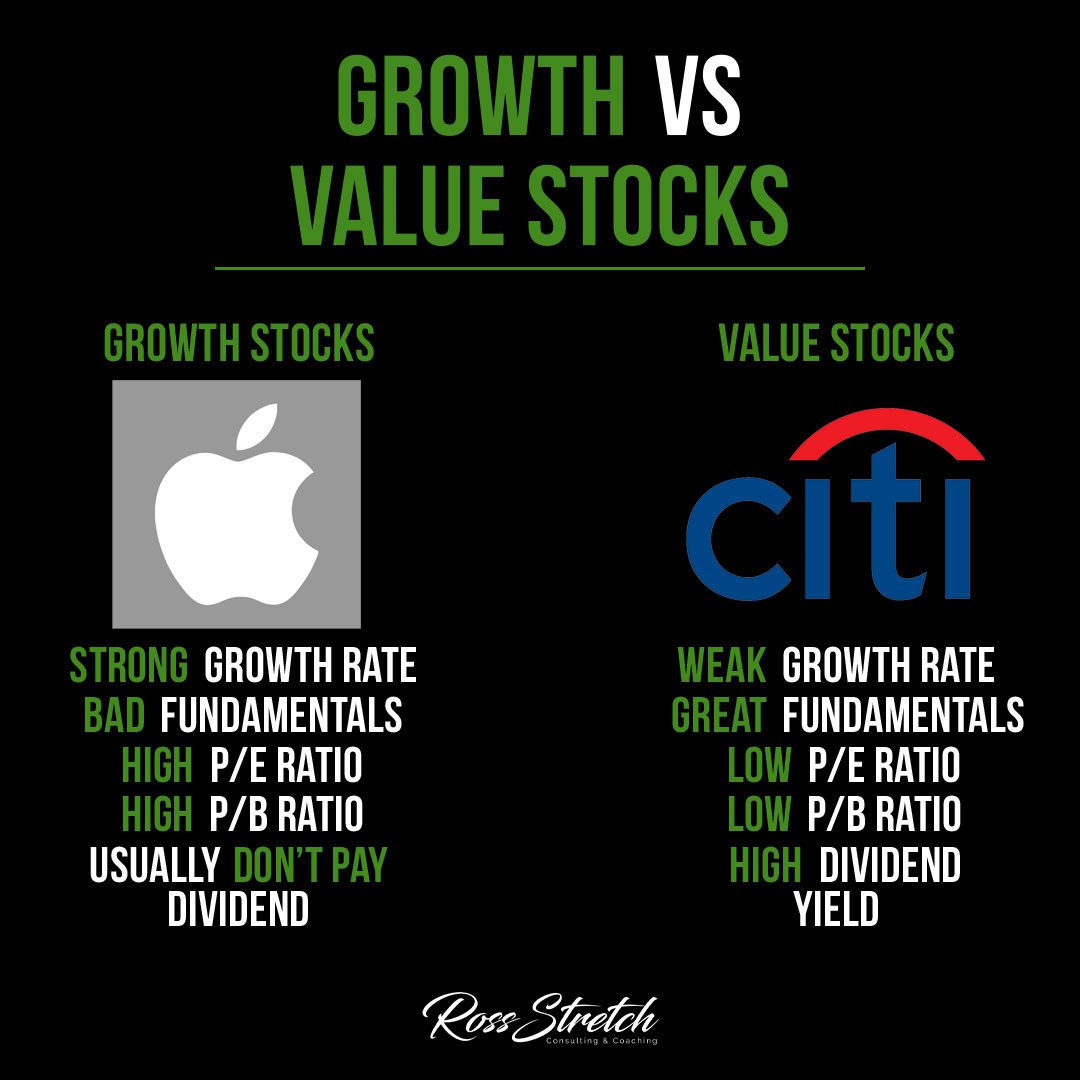
Growth stocks are shares in companies expected to increase their revenues and earnings at a substantially faster rate than the broader market. Think of companies in technology, biotech, or emerging consumer brands that are aggressively expanding their market share. These businesses typically reinvest all profits back into the company rather than distributing them as dividends — the logic being that reinvested capital generates better long-term returns than a payout would.
The appeal of growth stocks lies in capital appreciation. Investors are betting that the company’s future earnings will be substantially higher than today’s, justifying a premium price right now. This is why growth stocks tend to carry high price-to-earnings (P/E) ratios — sometimes 30x, 50x, or even higher. Companies like Nvidia, Shopify, and Amazon during their early expansion phases are classic examples of the category.
The risk is equally significant. When a growth company misses earnings expectations or its growth trajectory slows, the stock can drop sharply. Because so much of the valuation is built on future expectations, any shift in sentiment can be punishing. Growth stocks are also particularly sensitive to rising interest rates, which mathematically reduce the present value of future cash flows — making those distant earnings projections worth less today.
What Are Value Stocks?
Value stocks are shares that appear underpriced relative to their fundamentals — things like earnings, book value, dividends, or free cash flow. Value investors, following the philosophy pioneered by Benjamin Graham and popularized by Warren Buffett, look for companies trading below what they believe the business is intrinsically worth. The idea is simple: buy a dollar of value for fifty cents and wait for the market to correct the mispricing.
These companies often operate in mature industries: banking, insurance, energy, consumer staples, or utilities. They may not be growing rapidly, but they generate consistent cash flows and often return capital to shareholders through dividends or buybacks. A low price-to-earnings ratio or a price-to-book ratio below 1.0 can signal a potential value opportunity worth investigating further.
Value stocks tend to shine in specific market environments — particularly during economic recoveries or periods of rising interest rates, when investors rotate away from speculative assets and toward fundamentals. The challenge for value investors is distinguishing between a genuinely undervalued stock and a value trap — a company that’s cheap because its business model is in structural decline with no realistic path to recovery.
Key Differences Between Growth and Value Investing
The most visible difference is valuation. Growth investors willingly pay a premium today for tomorrow’s potential. Value investors insist on buying at a discount to intrinsic worth. This creates fundamentally different risk profiles: growth stocks offer higher upside but steeper drawdowns during corrections, while value stocks provide more cushion through their existing earnings and tangible assets.
Dividends are another clear dividing line. Growth companies rarely pay them — every dollar of profit is earmarked for expansion. Value companies, by contrast, often yield 2–5% or more annually, making them attractive to income-focused investors, retirees, or anyone building a passive income stream that doesn’t require selling shares.
- P/E Ratio: Growth stocks carry high P/E ratios (future-oriented); value stocks carry low P/E ratios (current fundamentals-oriented).
- Dividends: Growth stocks rarely pay dividends; value stocks often offer consistent yields.
- Risk Profile: Growth is higher volatility, higher upside; value offers more stability and downside cushion.
- Best Environment: Growth thrives in low-rate expansions; value tends to outperform during rate rises and recoveries.
Historical Performance: Which Has Done Better?
The historical performance debate between growth and value is genuinely nuanced. Academic research — particularly the Fama-French three-factor model — long showed that value stocks outperformed over multi-decade periods. However, the decade from 2010 to 2020 was a historic stretch of growth dominance, driven by near-zero interest rates and the extraordinary expansion of technology sector companies.
When rates rose sharply in 2022, growth stocks were punished severely — many high-flying tech names dropped 50–80% from peak levels — while value stocks held up comparatively well. This cycle reinforces a key lesson: no single style dominates forever, and prevailing economic conditions heavily influence which approach wins in any given period.
Which Strategy Is Right for You?
The right choice depends on your risk tolerance, time horizon, and financial goals. If you’re decades from retirement and comfortable riding out volatility, a growth-tilted portfolio may serve you well over the long run. If you need income from your investments today, or if capital preservation is a priority, value stocks offer more predictable cash flows and dividend income to live on.
Many investors find a blended approach most practical — allocating a portion of their portfolio to high-conviction growth plays while maintaining a core of solid, undervalued businesses. Broad index funds like those tracking the S&P 500 naturally contain both growth and value components, offering built-in diversification without requiring you to pick one philosophical camp.
- High risk tolerance and long horizon: consider a growth tilt.
- Need for income or capital preservation: lean toward value and dividend payers.
- Uncertain which suits you: a blended index fund approach gives you both.
- Revisit your allocation periodically as your financial goals evolve.
Conclusion
Growth and value investing are two valid, time-tested approaches to building wealth through the stock market. Growth investors bet on future potential; value investors bet on present underappreciation. Both carry real risk, both have delivered strong long-term returns in the right environment, and both require patience and discipline to execute well. The most important thing is to understand what you own, why you own it, and how it fits into your broader financial plan.
Resources


 Ross Stretch