
Most people think budgeting is about restriction — cutting lattes and canceling subscriptions until there’s a little more money at the end of the month. Wealthy people think about budgeting completely differently. For them, a budget isn’t a constraint; it’s a system for building wealth deliberately. The gap between financial struggle and financial freedom isn’t usually income — it’s how that income gets allocated. Understanding how millionaires approach money management is the first step toward replicating their results, regardless of where you’re starting from.
The Core Difference: Spending vs. Investing Priorities
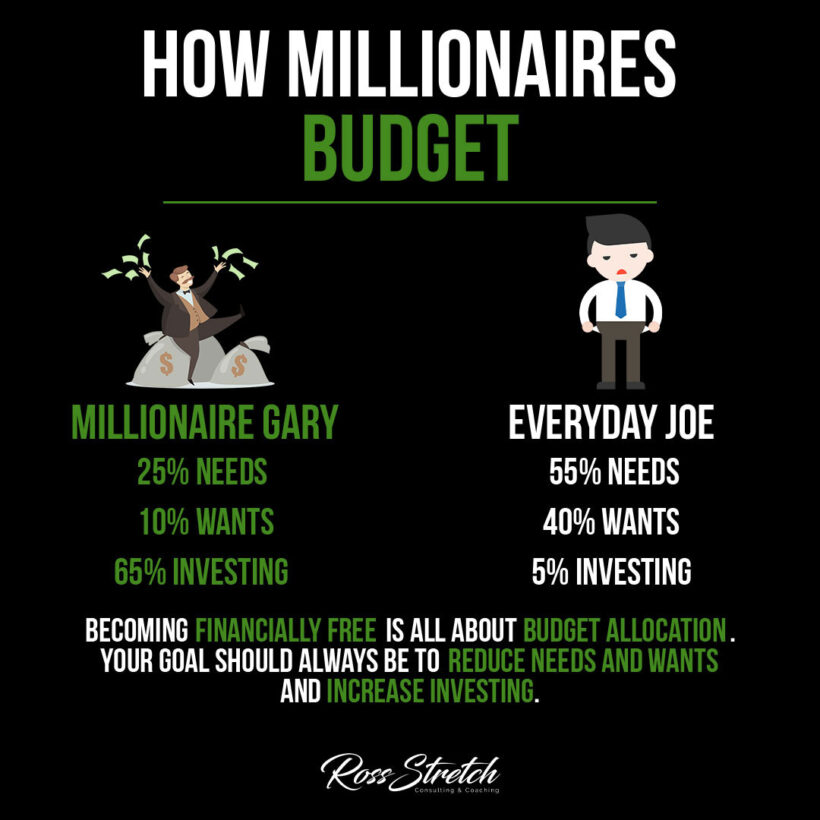
The most striking difference between how wealthy people and average earners budget is where the money actually goes. A typical millionaire — even one who started with a modest income — allocates roughly 25 percent of their income to needs (housing, food, transportation, utilities), limits discretionary spending to around 10 percent, and directs the remaining 65 percent toward investments and wealth-building assets. By contrast, many average earners spend upward of 55 percent on needs, another 35 to 40 percent on wants, and invest whatever is left over — which is often very little.
This isn’t a coincidence. Wealthy people consciously design their budgets around investment first. They pay themselves first by automating transfers to investment accounts on payday, before spending on anything else. This forces their lifestyle to adapt to what remains, rather than investing whatever their lifestyle happens to leave behind. The result is compounding returns that grow exponentially over time, while average earners remain stuck in a cycle of spending without building.
It’s worth emphasizing that this approach doesn’t require a six-figure income to start. The percentage matters far more than the dollar amount. A person earning $50,000 per year who saves and invests 30 percent is building wealth more effectively than someone earning $150,000 who saves only 5 percent. The habit comes before the income level — not the other way around.
Living Below Your Means Is Not the Same as Being Cheap
One of the most pervasive myths about wealthy people is that they live lavishly. Research consistently shows the opposite. Thomas J. Stanley’s landmark study published in The Millionaire Next Door found that most American millionaires live in modest neighborhoods, drive used cars, and rarely spend on designer goods. They don’t live below their means because they have to — they do it because they understand the math. Every dollar spent on a depreciating liability is a dollar not working for them in the market.
Living below your means isn’t about deprivation — it’s about intentionality. It means spending generously on things that genuinely improve your life and ruthlessly cutting things that don’t. Millionaires are often extremely willing to invest in health, education, quality tools, and experiences that create lasting value. What they avoid is unconscious spending: unused subscriptions, impulse purchases, and keeping up with neighbors who are also living paycheck to paycheck. The goal is alignment between your spending and your actual priorities — not minimalism for its own sake.
The Investment Mindset: Assets Over Expenses
Wealthy budgeters think in terms of assets and liabilities, not income and expenses. Every significant financial decision runs through a filter: does this purchase put money into my pocket over time, or take money out? A car is a liability — it costs money every month and depreciates. An index fund is an asset — it generates returns without requiring active management. A rental property is an asset — it produces monthly income while potentially appreciating in value over decades.
This framework extends beyond financial products. Education and skill development are assets — they increase earning potential. A side business is an asset if it generates profit. Even time is treated as an asset by wealthy people, who aggressively eliminate low-value tasks from their schedules to protect their highest-leverage hours. The question isn’t “can I afford this?” — it’s “does this move me closer to or further from financial independence?”
Practically, building this mindset means contributing to investments or a retirement account before making any discretionary purchases. Automate your investment contributions on payday so the decision is made before temptation arises. Over time, as your investment balance grows, the compounding returns become increasingly motivating — and the lifestyle trade-offs that once felt difficult start to feel straightforward.
Practical Steps to Shift Your Budget Toward the Millionaire Model
You don’t need to overhaul your entire financial life overnight. Incremental improvements compound just like investment returns do. Start by tracking every dollar you spend for 30 days — not to judge yourself, but to see clearly where your money is actually going. Most people are genuinely surprised by the gap between what they think they spend and what they actually spend. This awareness alone often motivates meaningful change without requiring willpower or rigid rules.
From there, identify your three largest non-essential expense categories and reduce each by 10 to 20 percent. Redirect that money to an investment account — even a basic index fund through a platform like Vanguard, Fidelity, or a workplace retirement plan. Set the contribution to automatic so it happens before you have a chance to redirect it elsewhere. Then review your budget quarterly rather than monthly: quarterly reviews reveal meaningful trends and build momentum in ways that monthly check-ins often don’t.
As your income grows — through raises, side income, or business revenue — resist the urge to inflate your lifestyle proportionally. This pattern is called lifestyle creep, and it’s one of the primary reasons people with high incomes still struggle to build wealth. A simple rule: for every dollar increase in income, invest at least 50 cents and allow yourself to spend only the remainder. This single habit, applied consistently over a career, produces dramatically different financial outcomes than the alternative.
Tracking and Adjusting: The Ongoing Work of Wealth Building
A budget is not a set-it-and-forget-it document. Life changes — income fluctuates, expenses shift, goals evolve — and your budget needs to adapt accordingly. Wealthy people treat their personal finances the way a business treats its financials: with regular reviews, honest assessments, and adjustments based on what the data actually shows. This doesn’t mean obsessing over every purchase — it means maintaining a clear picture of your financial trajectory at all times.
Use simple tools to make tracking effortless. Apps like YNAB (You Need a Budget) or Monarch Money connect to your bank accounts and automatically categorize transactions, giving you a real-time view of your spending patterns. The easier you make tracking, the more consistently you’ll do it — and consistency is what separates people who talk about building wealth from people who actually do it.
Conclusion
The difference between a millionaire’s budget and an average earner’s budget comes down to one fundamental principle: wealthy people prioritize investment over consumption. They live on less than they earn, direct the surplus toward assets, and let compounding do the heavy lifting over time. You don’t need a high income to start — you need a shift in priorities. Start small, automate consistently, and increase your investment rate every time your income grows. Financial freedom is built incrementally, one intentional budget decision at a time.
Resources
- The Millionaire Next Door by Thomas J. Stanley — Research-backed insights into the spending and saving habits of America’s wealthy.
- Your Money or Your Life by Vicki Robin — A practical guide to transforming your relationship with money and pursuing financial independence.
- YNAB (You Need a Budget) — Budgeting software built around the principle of giving every dollar a deliberate job.
- Investopedia’s Guide to Budgeting — Clear, practical overview of budgeting fundamentals and strategies for every income level.
- Vanguard — Low-cost index fund investing platform widely used for long-term wealth building.


 Ross Stretch