Escaping the rat race is one of the most common aspirations among ambitious professionals — and for good reason. The cycle of trading time for money, spending what you earn, and repeating indefinitely is genuinely exhausting. Breaking free requires more than wishful thinking; it demands strategic financial planning, a commitment to building multiple income streams, and a fundamental shift in how you think about money, time, and freedom. The path exists, and this article maps it step by step.
Why This Matters
The term “rat race” describes the relentless cycle of trading time for money, spending what you earn, and never gaining enough financial ground to opt out. According to the Federal Reserve, nearly 40% of Americans cannot cover an unexpected $400 expense without borrowing — a statistic that reveals how many people are one bad month away from financial crisis, regardless of their income level. High income without financial intelligence still leads directly back to the rat race.
Financial independence — the point at which your passive income covers your living expenses — is achievable for anyone who applies a disciplined strategy consistently over time. It doesn’t require becoming a millionaire overnight. It requires understanding how money works, building income-producing assets, and gradually reducing your dependence on a single employer’s paycheck. The five strategies below create a proven roadmap for doing exactly that.
Step-by-Step: How to Escape the Rat Race
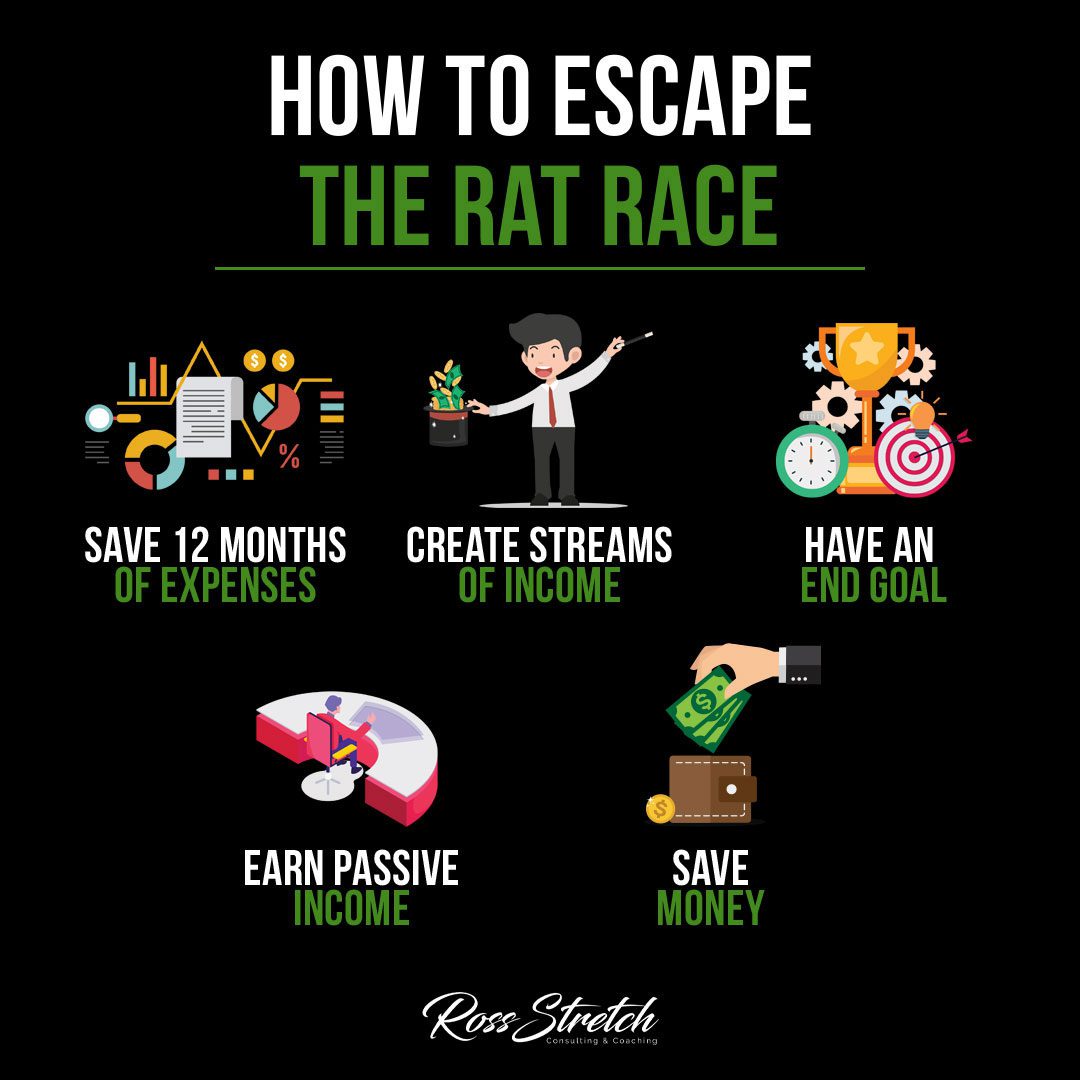
Step 1: Save 12 Months of Expenses — Build Your Safety Net
Having a solid financial foundation is the prerequisite for everything that follows. Most people attempt to escape the rat race without first building a meaningful safety net — and the moment an unexpected expense hits, they’re forced to abandon their wealth-building efforts entirely and return to survival mode. Saving 12 months of essential expenses provides a long enough runway to take calculated risks, transition between opportunities, and navigate economic uncertainty without panic-driven decisions.
- Calculate your true monthly essential expenses — housing, food, utilities, insurance, and minimum debt payments — and multiply by 12 to establish your target fund amount
- Open a dedicated high-yield savings account (currently paying 4-5% APY at many online banks) and automate a fixed monthly transfer to it before spending anything else
- Temporarily reduce or eliminate one major discretionary expense category until your emergency fund reaches full funding
- Keep this fund entirely separate from your checking account — out of sight reduces the temptation to raid it for non-emergencies
Step 2: Create Multiple Streams of Revenue
Relying solely on a single income source is the defining characteristic of the rat race. True financial security — and ultimately financial independence — comes from diversifying your income so that no single source controls your livelihood or your options. The IRS reports that the average millionaire has seven income streams. You don’t need seven from day one; start with two and build systematically from there.
- Identify 2-3 potential income streams based on your existing skills, interests, and available time: freelancing, consulting, content creation, selling digital products, dividend investing, or real estate
- Launch one side income stream while maintaining your current employment — prove the concept and build early revenue before making any major changes to your primary income
- Reinvest all early side income back into growing that stream rather than treating it as spending money
- Set a target: when your side income reaches 50% of your primary income, you have real optionality and significant negotiating power in every aspect of your professional life
Step 3: Define Your End Goal
To effectively escape the rat race, you need a clear, specific destination — not a vague desire to “be free someday.” Financial independence means different things to different people: retiring at 45, building a self-sustaining business, generating enough passive income to fund extended travel, or simply having the security to walk away from a toxic job without financial fear. Without a specific number and timeline, you’re wandering rather than advancing toward a defined target.
- Calculate your FIRE (Financial Independence, Retire Early) number: annual living expenses multiplied by 25 gives you the portfolio size from which you can sustainably withdraw 4% annually without depleting your capital over 30+ years
- Set specific milestone dates: fully funded emergency fund, first $10k in investment accounts, first $1,000/month in passive income — milestones create momentum
- Write your goals down — research from Dominican University found that people who write their goals are 42% more likely to achieve them than those who merely think about them
- Review and adjust your goals quarterly as your income, expenses, and life priorities naturally evolve
Step 4: Learn to Earn Passively
Passive income is the engine of escape from the rat race. Unlike active income, which stops the moment you stop working, passive income continues flowing whether you’re working, sleeping, or traveling. The goal is to gradually replace your active income with passive income — the moment these two lines cross is the mathematical definition of financial independence. Building passive income requires upfront time, capital, or both, but the long-term leverage it creates is transformative.
- Start with the lowest-barrier passive income streams: high-yield savings accounts, dividend-paying ETFs, and low-cost index funds that require minimal ongoing management and can be started with small amounts
- As capital accumulates, explore higher-yield options: rental real estate, REITs, creating digital products (courses, templates, software tools), or licensing your expertise
- Reinvest all passive income for the first several years — compounding your returns rather than spending them dramatically compresses your timeline to financial independence
- Track your “passive income coverage ratio” monthly: what percentage of your monthly expenses does your passive income currently cover? Growing this number is your real measure of progress
Step 5: Save Your Money — Cultivate Lasting Financial Discipline
Saving money is not about deprivation — it’s about maximizing the gap between what you earn and what you spend, and directing that gap toward income-producing assets instead of consumption. Financial discipline is the most underrated wealth-building tool. Many people earn high incomes but spend equivalently, making no real progress toward escape. Lifestyle inflation — the tendency to increase spending as income rises — is the primary trap keeping high earners in the rat race despite their salaries.
- Implement “pay yourself first”: automate transfers to savings and investment accounts before you have the opportunity to spend that money on anything else
- Apply the 50/30/20 framework as a starting point (50% needs, 30% wants, 20% savings and investment) and deliberately increase the savings percentage each time your income grows
- Conduct a quarterly spending audit — review bank and credit card statements for subscriptions, services, and habits that no longer serve your financial goals
- Resist lifestyle inflation fiercely: when your income increases, direct at least 80% of the increase toward savings and investments rather than upgraded expenses
Common Mistakes to Avoid
- Trying to escape the rat race while carrying high-interest consumer debt — aggressively pay off credit cards at 20%+ APR before investing in anything beyond employer-matched retirement accounts
- Chasing “get rich quick” schemes or high-risk speculative investments before establishing a solid financial foundation of savings and diversified assets
- Treating windfalls — bonuses, inheritances, or tax refunds — as spending money rather than as wealth-building catalysts that can compress your timeline significantly
- Expecting overnight results and abandoning sound strategies too early — building genuine financial independence takes 5-15 years of consistent, disciplined execution; the people who succeed are those who stay the course
Conclusion
Escaping the rat race requires deliberate action, sustained commitment, and a willingness to think differently about money than the mainstream culture encourages. By building your financial safety net, diversifying your income, defining a specific end goal, pursuing passive income systematically, and cultivating genuine financial discipline, you create the conditions for a real exit from financial dependency — not just a temporary reprieve.
The gap between where you are now and where you want to be is bridged by daily decisions made consistently over time. Start today — even with one small action: opening a high-yield savings account, launching that side project, or making your first investment. Each step builds momentum, and momentum, compounded over years, builds freedom.
Resources


 Ross Stretch