In the seconds before you say a word, people are already forming impressions of you. Research from Princeton University found that judgments about competence, trustworthiness, and likability can form within the first 100 milliseconds of meeting someone — and those judgments prove surprisingly durable. Whether you’re walking into a job interview, meeting a potential client, or introducing yourself at a social event, the ability to make a strong first impression is one of the most transferable skills you can develop. This guide gives you a concrete, actionable framework for doing it consistently.
\
\
\
\
Why This Matters
\
\
First impressions don’t just shape how someone feels about you in the moment — they create a perceptual filter that influences how everything you do afterward gets interpreted. Psychologists call this the “halo effect”: when someone forms a positive initial impression, they’re more likely to interpret your subsequent actions charitably. Conversely, a poor first impression creates a negative filter that makes it hard to recover, even when your actual performance or behavior is strong. This is why two candidates with identical qualifications can receive dramatically different evaluations based on how they enter the room and carry themselves.
\
\
The stakes extend far beyond job interviews. First impressions affect who gets introduced to whom at networking events, which clients choose which professionals, and how quickly new relationships develop into genuine trust. In a world where people have more options and less time than ever, standing out positively in that first interaction isn’t just a soft skill — it’s a strategic advantage with measurable consequences for your career and social life. The good news is that it’s entirely learnable.
\
\
\
\
How to Make a Great First Impression
\
\
Step 1: Arrive on Time and Prepared
\
\
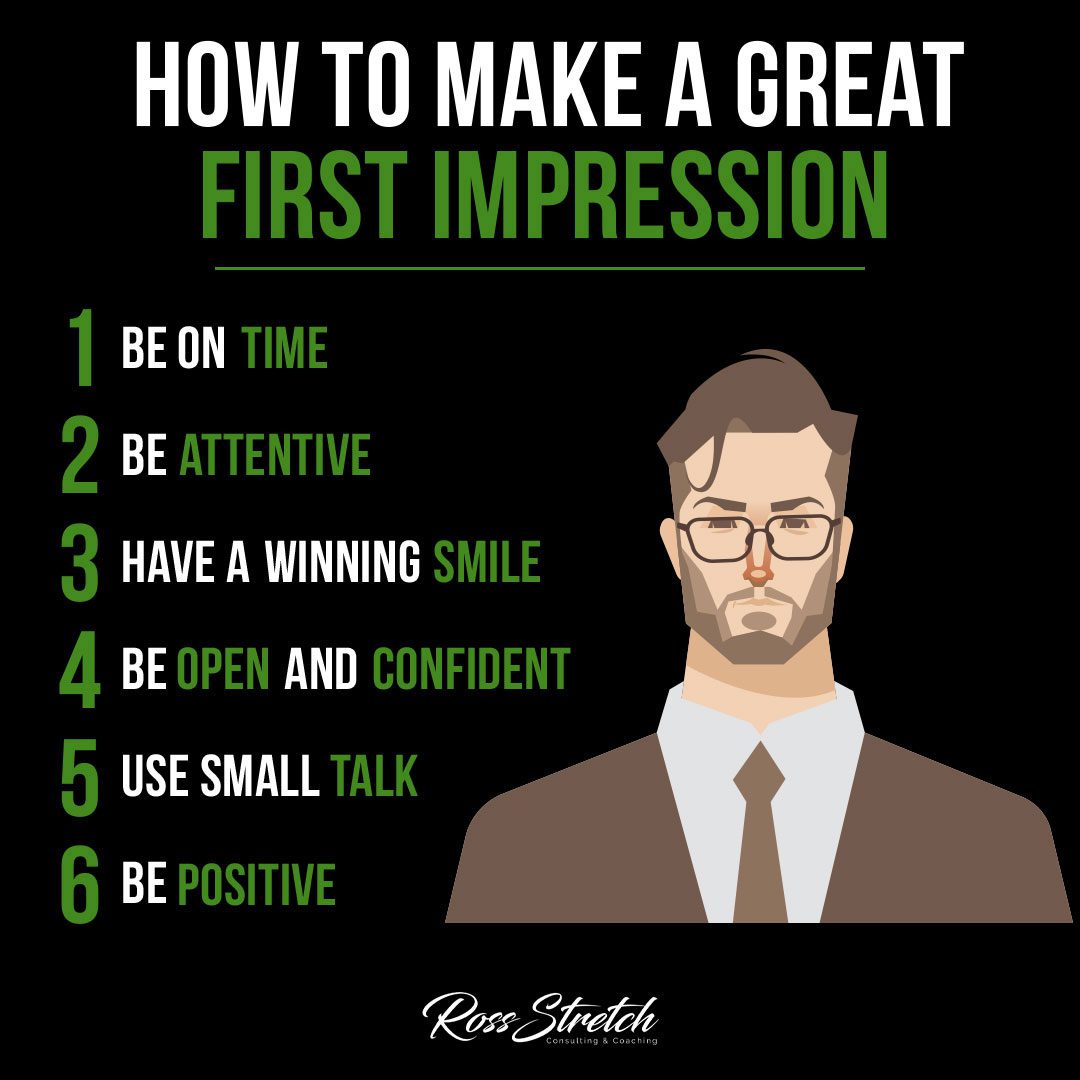
Punctuality is the most fundamental signal of respect you can send before you’ve said a single word. Arriving late communicates — fairly or not — that the other person’s time is less valuable than your own. For high-stakes meetings, aim to arrive 10 to 15 minutes early, use the buffer to compose yourself, and walk in calm rather than rushed. Preparation matters equally: know who you’re meeting, review their background or the context of the interaction, and have any materials organized and accessible. Nothing undermines confidence faster than fumbling through a bag for a business card or asking someone to repeat their name because you forgot it immediately after introduction.
\
\
- \
- Research the person or organization thoroughly before any significant professional meeting
- Prepare two or three thoughtful, open-ended questions you genuinely want to ask them
- Avoid: arriving less than five minutes early for professional meetings — it leaves no recovery margin
- Avoid: checking your phone in the waiting area — it sets a distracted mental state before you’ve even begun
\
\
\
\
\
\
Step 2: Own Your Body Language
\
\
Non-verbal cues — posture, eye contact, facial expressions, gestures — account for a substantial portion of how people read your confidence and competence, often before you’ve spoken. Stand or sit with your spine upright and shoulders relaxed back. Make natural eye contact roughly 60 to 70 percent of the time during conversation, breaking occasionally so it doesn’t feel like a stare. Offer a handshake that is firm but not crushing. Avoid crossed arms, which signal defensiveness, or hands buried in pockets, which reads as disengagement. The goal is an open, grounded physical presence that communicates you are comfortable and fully present in the situation.
\
\
- \
- Practice your handshake and ask a trusted friend for honest feedback on how it lands
- Notice your default posture under stress — hunching and tension are common — and consciously correct before important meetings
- Avoid: forcing rigid “power poses” — natural and relaxed consistently outperforms performative confidence
\
\
\
\
\
Step 3: Use Your Greeting to Set the Tone
\
\
Your first ten seconds of interaction — greeting, handshake or equivalent, and opening words — establish the emotional tone of the entire encounter. A warm, genuine smile is more powerful than most people appreciate: it signals approachability, reduces tension in both parties, and triggers a reciprocal response. Use the person’s name in your greeting and once more in the early part of the conversation. People respond positively to hearing their own name, and using it demonstrates attentiveness. Keep your opening words simple, confident, and positive — you’re setting a mood, not delivering a pitch.
\
\
- \
- Practice your greeting out loud: your name, a warm expression of how pleased you are to meet them, and a question directed at them
- Repeat the person’s name once in the first minute to cement it in your memory and signal attention
- Avoid: opening with complaints, self-deprecating humor, or negative framing — these create a poor emotional anchor for the rest of the interaction
\
\
\
\
\
Step 4: Listen More Than You Talk
\
\
One of the most counterintuitive truths about first impressions is that people who listen attentively are perceived as more intelligent, more interesting, and more trustworthy than those who dominate the conversation. Active listening — genuinely processing what the other person says, asking follow-up questions, and reflecting back what you’ve heard — makes people feel understood and valued. Resist the impulse to redirect the conversation toward yourself. Ask questions that invite the other person to go deeper on something they’ve mentioned. The impression you should aim to leave is that they had a great conversation — not that they heard a great performance.
\
\
- \
- Set a personal rule: ask at least two genuine follow-up questions before sharing your own perspective on any topic
- Nod and use brief affirmations to signal active engagement without interrupting the other person’s train of thought
- Avoid: planning what you’ll say next while the other person is still talking — they can often sense when you’ve mentally departed
\
\
\
\
\
Step 5: Navigate Small Talk with Intention
\
\
Small talk is often dismissed as trivial, but it serves a critical function: it establishes social safety before substantive conversation can begin. Effective small talk is light, reciprocal, and curiosity-driven. Start with open-ended questions relevant to the setting — how someone knows the host at an event, what’s keeping them busy this week, what they’re most excited about in their work. Steer toward topics that are genuinely interesting to both parties. Avoid three reliable conversation killers in introductory settings: politics, personal grievances, and unsolicited complaints. The goal of small talk isn’t to say something impressive — it’s to make the other person comfortable enough to engage authentically.
\
\
- \
- Prepare two or three open-ended small talk questions specific to the context of the meeting or event
- Listen for cues that the other person wants to go deeper on a topic and follow their lead when they appear
- Avoid: controversial or emotionally heavy topics until genuine rapport has been established over time
\
\
\
\
\
Step 6: Follow Up Within 24 Hours
\
\
The first impression doesn’t end when you leave the room. A thoughtful follow-up — a brief email, a LinkedIn connection with a personalized note, or a simple text in a social context — extends and reinforces the positive impression you made. Reference something specific from the conversation to show you were genuinely engaged, not just going through the motions. The speed of the follow-up matters: reaching out within 24 hours while the exchange is still fresh signals that you mean it. Most people don’t bother. Doing so immediately differentiates you from the crowd in a way that requires almost no effort.
\
\
- \
- Send a follow-up message within 24 hours that references one specific, memorable detail from your conversation
- Keep it short — two to three sentences is appropriate in most contexts; brevity signals confidence
- Avoid: generic follow-ups that could have been sent to anyone — specificity is what makes them memorable
\
\
\
\
\
\
\
Common Mistakes to Avoid
\
\
- \
- Checking your phone during the meeting: Even a single glance signals that something is more important than the person in front of you. Put it away completely and leave it there.
- Talking too much about yourself: People remember conversations where they felt heard, not conversations where they heard a lot. Lead with genuine curiosity, not personal narrative.
- Forgetting names immediately after hearing them: Use the person’s name within the first 30 seconds of meeting them — it lodges the name in short-term memory and demonstrates real attention.
- Trying too hard to impress: Overproducing — excessive name-dropping, aggressive self-promotion, constant qualifying statements — reads as insecurity rather than confidence. Understatement earns more respect.
- Neglecting the follow-up: Even a strong first meeting fades quickly without follow-up. The follow-up is what converts a first impression into an ongoing relationship — skip it and the moment is lost.
\
\
\
\
\
\
\
\
\
Conclusion
\
\
A great first impression is not a performance — it’s a genuine expression of your best, most present self, delivered reliably through preparation, awareness, and a few consistent habits. The skills covered in this guide — punctuality, body language, a warm greeting, active listening, intentional small talk, and a timely follow-up — are not complicated. What separates people who make reliably strong first impressions from those who don’t is consistent practice and genuine attention to the other person in the room.
\
\
Before your next important meeting, run through this short checklist: Am I prepared and on time? Do I know how to pronounce their name? Have I put my phone away? Do I have two genuine questions ready to ask them? These small preparation steps, done consistently, build a reputation for being someone worth knowing — and that reputation becomes one of your most valuable professional assets over time.
\
\
\
\
Resources
\
\
- \
- American Psychological Association: First Impressions Research — Overview of psychological research on how and how quickly people form impressions of others.
- Harvard Business Review: Making a Good Impression Quickly — Research-backed strategies from organizational psychology on first impression management in professional settings.
- MindTools: Making a Great First Impression — Practical guide with specific, actionable techniques for professional and networking situations.
- The Charisma Myth by Olivia Fox Cabane — Evidence-based book on developing presence, warmth, and confidence in social and professional situations.
\
\
\
\

 Ross Stretch