Starting your own agency and reaching the $100,000 revenue milestone is one of the most accessible paths to financial independence available to skilled professionals today. Unlike raising venture capital or building a product from scratch, an agency business can launch quickly with minimal upfront investment — using skills you already possess. But without a deliberate strategy, most new agencies stall or plateau well below that threshold. This guide walks you through the essential steps to build and scale a $100k agency, from identifying your niche to creating a client acquisition engine that compounds over time.
Why This Matters
The agency model is one of the most accessible business structures for ambitious professionals. With remote work now normalized globally, geographic barriers have largely disappeared — you can serve clients anywhere in the world from your home office. And while many aspiring entrepreneurs wait for the perfect product idea, service-based businesses can generate revenue within days of launch, before you’ve built a single piece of proprietary technology.
The $100k mark isn’t just an arbitrary milestone — it represents the point at which your agency becomes a sustainable business rather than an extended freelance hustle. At $100k annual revenue with healthy margins, you can hire your first support staff, invest in systems and tools, and begin transitioning from operator to owner. Getting there requires executing the right steps in the right sequence — which is exactly what this guide provides.
Step-by-Step: How to Start a $100k Agency
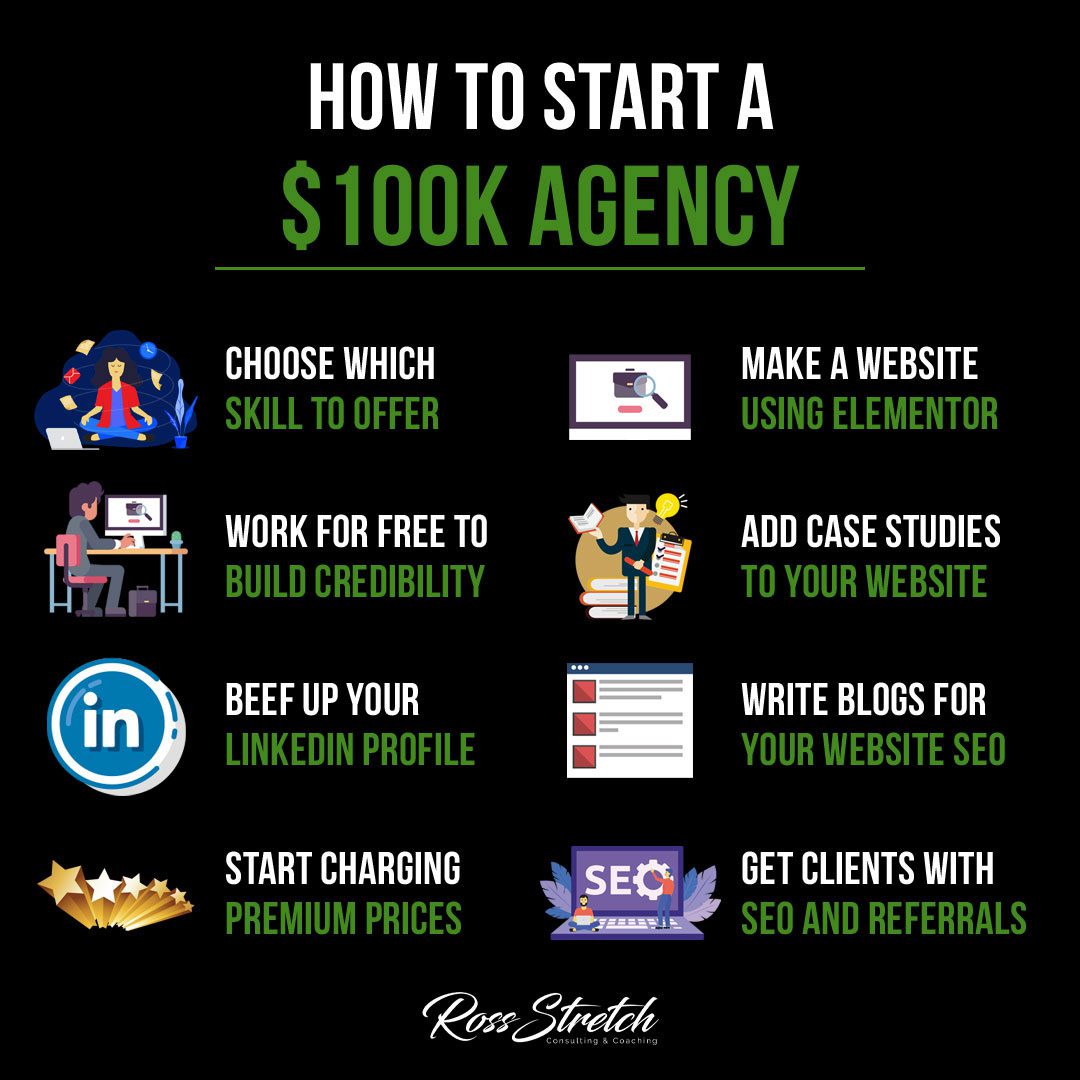
Step 1: Choose Your Specialized Skill
The first and most important decision in starting a successful agency is identifying your niche skill or area of expertise. The more specialized your offering, the higher you can charge and the less direct competition you face. Generalist agencies compete on price; specialist agencies compete on expertise — and expertise commands premium pricing that makes the $100k goal achievable with a relatively small number of clients.
- Audit your professional skills and identify your strongest: copywriting, SEO, paid media, web design, video production, social media management, data analytics, or email marketing
- Validate market demand by searching Upwork, LinkedIn job postings, and agency directories for the volume of companies actively seeking your skill set
- Choose a specific niche industry to serve — “Facebook ads for e-commerce brands” is far more compelling and scalable than “social media marketing for any business”
- Research what established agencies charge for your service in your niche; this anchors your pricing and confirms the revenue opportunity is real
Step 2: Build a Professional Website
A professional website is non-negotiable for establishing credibility and attracting clients who are willing to pay premium prices. Your website is your 24/7 sales representative — it should clearly communicate who you help, what specific results you deliver, and why you are the obvious choice over every alternative. Use Elementor or a similar no-code website builder to create a polished, conversion-optimized site without needing to hire a developer.
- Select a clean, mobile-responsive template and customize it with consistent brand colors, typography, and professional photography or graphics
- Structure your homepage around your ideal client’s problem — lead with the outcome you deliver, not your biography or company history
- Include a prominent, specific call-to-action on every page (“Book a Free Strategy Call” outperforms generic “Contact Us” by a wide margin)
- Ensure your site loads in under 3 seconds — use Google’s PageSpeed Insights to identify and fix performance issues, as page speed affects both user experience and Google rankings
Step 3: Work for Free (Strategically) to Build Credibility
In the early stages of your agency, offering services pro bono to a select few clients is a strategic investment, not a sacrifice. The objective is to generate compelling case studies, specific testimonials, and real-world proof that converts skeptical prospects into paying clients. Choose your free clients wisely — select businesses that match the profile of your ideal paying client so your case studies resonate directly with the audience you want to serve.
- Approach 2-3 businesses in your target market and offer a free project with a clearly defined scope, timeline, and mutual expectations
- Establish the exchange explicitly upfront: in return for your work, you receive a detailed testimonial and permission to publish a data-driven case study
- Measure everything — track the specific metrics you influence (traffic growth, lead volume, conversion rate, revenue) to make your case studies compelling with concrete numbers
- Set a firm limit of 60 days for pro bono work before transitioning entirely to a paid model
Step 4: Build and Publish Case Studies
Case studies are the most persuasive content you can publish — they demonstrate that you’ve solved the exact problem your prospect is currently facing, for a real client, with measurable results. A great case study follows a clear narrative structure: the client’s situation before working with you, your process and strategy, and the quantified outcome you delivered. These should be prominently featured on your website and referenced in every sales conversation.
- Use a consistent format: Client Background → Challenge → Strategy Applied → Results → Client Quote
- Lead with a results-focused headline (“How We Generated 312% More Organic Traffic for [Client] in 6 Months”)
- Quantify results wherever possible — percentages, dollar amounts, and time frames are far more convincing than qualitative descriptions
- Add 2-3 strong case studies before launching outreach, and update them continuously as you produce new results for clients
Step 5: Optimize Your LinkedIn Profile
LinkedIn is the highest-quality lead generation platform available for B2B agency services — and its organic reach remains largely free. A fully optimized LinkedIn profile positions you as an industry authority and generates inbound inquiries from precisely the type of clients you want to work with. Treat your LinkedIn profile as a landing page designed to convert profile visitors into booked calls, not as a static resume.
- Write a keyword-rich headline that describes what you do and specifically who you serve (“I help SaaS companies scale pipeline with content marketing | Founder of [Agency Name]”)
- Use the About section to articulate your methodology, the specific results you create, and a clear call to action directing readers to book a call or visit your website
- Post valuable content 3-5 times per week — case study snippets, industry insights, client wins, and actionable frameworks that demonstrate expertise without requiring a sales call
- Connect proactively with 10-15 ideal client profiles weekly and engage meaningfully with their content for 1-2 weeks before initiating any outreach
Step 6: Write SEO-Optimized Blog Content
Blogging is a compounding asset — every post you publish can generate organic traffic for years after it’s written. By consistently publishing well-researched, keyword-targeted content, you build domain authority and attract clients who are actively searching for the exact services you offer. Unlike paid advertising that stops the moment you stop spending, SEO-driven content delivers returns indefinitely, making it one of the most capital-efficient client acquisition strategies available to a growing agency.
- Research keywords using free tools like Google Search Console, Ubersuggest, or the free tier of Semrush — focus on buyer-intent searches (“best [service] agency for [industry]”)
- Write comprehensive posts of 1,500-2,500 words that thoroughly answer the searcher’s question better than any competing result on page one
- Publish one well-researched post per week consistently — within 6-12 months, this cadence produces meaningful organic traffic and inbound leads
- Interlink your posts strategically and build external backlinks through guest posts, podcast appearances, and media mentions to accelerate rankings
Step 7: Charge Premium Prices
The most important mindset shift in building a $100k agency is recognizing that underpricing destroys your business. Low prices attract price-sensitive clients who demand the most time and deliver the least revenue. Premium pricing — grounded in the value you deliver rather than the hours you work — attracts better clients, funds higher-quality work, and creates the margins required to invest in growth and systems. Confidence in your pricing communicates confidence in your results.
- Work backward from your revenue target: $100k annually requires 10 clients at $10k/year, 5 clients at $20k/year, or 4 clients at $25k/year — choose the model that matches your service delivery capacity
- Price based on value delivered, not hours worked — if your service generates $200k in revenue for a client, charging $20,000 (10% of value created) is entirely defensible
- Present three pricing tiers to anchor your preferred middle option as the most attractive choice for most clients
- Never lead with your lowest price in a sales conversation — always present your premium package first and let clients negotiate down if needed
Step 8: Build Client Acquisition Through SEO and Referrals
Once your credibility infrastructure is in place — a professional website, compelling case studies, an optimized LinkedIn profile, and growing content — focus on building two client acquisition channels that compound over time: organic search and referrals. These channels generate higher-quality, higher-converting leads than paid advertising, at a fraction of the cost, and they strengthen rather than diminish with time.
- For SEO: target niche-specific and location-specific keywords, build backlinks through guest posting and media appearances, and publish original data that earns citations from other sites in your industry
- For referrals: proactively ask every satisfied client for specific introductions to colleagues who could benefit from your services; create a formal referral incentive — cash, service credit, or reciprocal referrals
- Build relationships with complementary agencies that serve your ideal clients — web designers regularly need SEO agencies, copywriters frequently need paid media specialists, and these partnerships generate consistent warm introductions
- Attend 1-2 industry events per quarter to maintain visibility and plant referral seeds that often take months to convert into client relationships
Common Mistakes to Avoid
- Accepting any client who can pay regardless of fit — bad-fit clients consume disproportionate time and energy that should be directed toward attracting and serving ideal clients
- Underpricing to win competitive pitches, then resenting both the work and the client relationship that results
- Neglecting to track key business metrics: client acquisition cost, average project value, monthly recurring revenue, and churn rate — you cannot manage what you don’t measure
- Failing to systematize and document your processes — without clear workflows, every project starts from scratch and your growth is permanently capped at what you alone can manage
Conclusion
Starting a $100k agency requires careful planning, strategic execution, and the patience to build credibility before aggressively pursuing clients. By choosing your specialized skill, creating a professional website, establishing social proof through case studies, optimizing your LinkedIn presence, producing SEO-driven content, charging premium prices, and building systematic client acquisition through organic and referral channels, you create a repeatable blueprint that works regardless of your specific expertise.
Most agencies fail not because the founder lacked skill, but because they lacked a system. Execute these steps in sequence, invest your early revenue back into tools and systems rather than lifestyle expenses, and measure your progress rigorously. The $100k milestone is not a ceiling — it’s a launching pad for everything that comes next.
Resources


 Ross Stretch