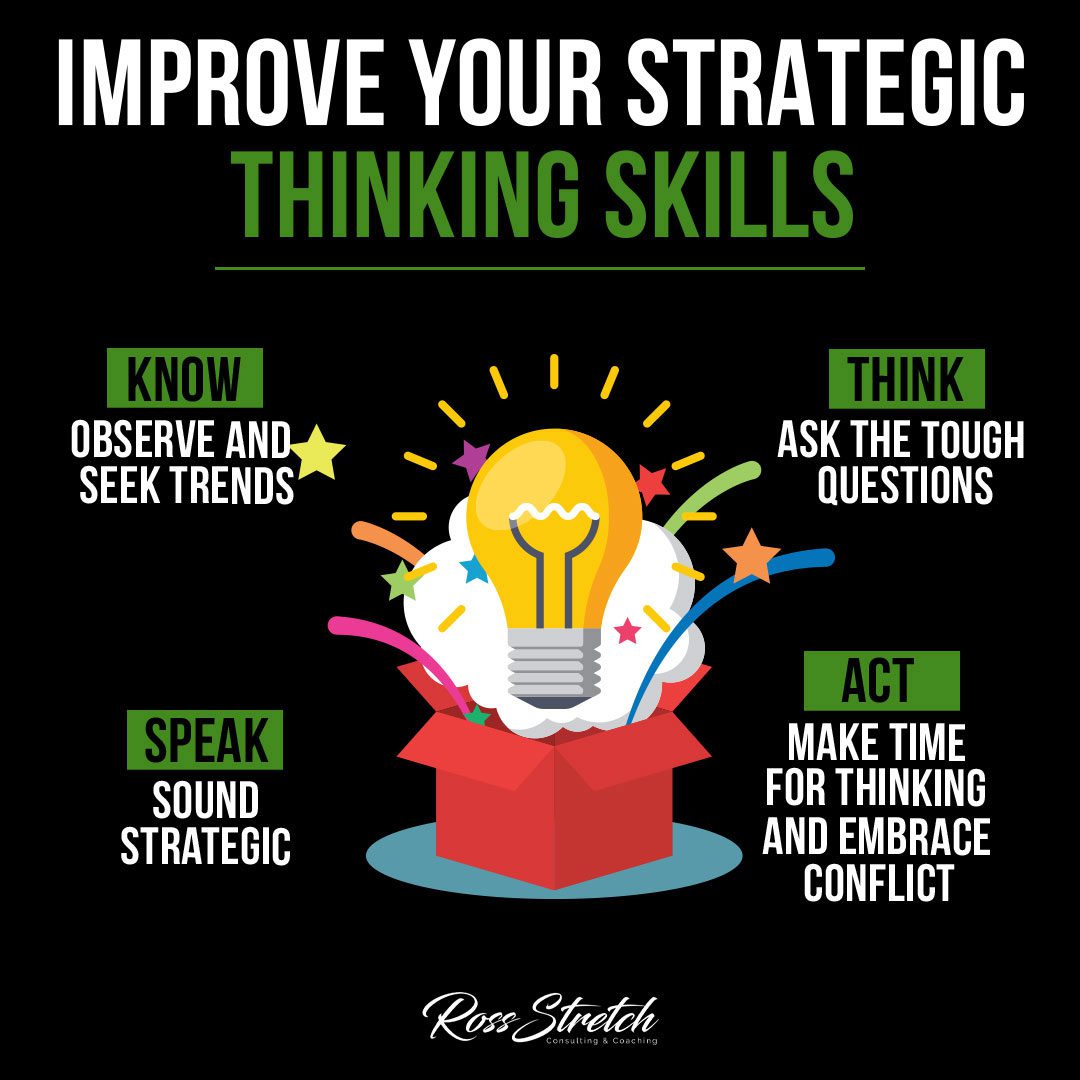
Strategic thinking is the skill that separates people who react to circumstances from those who shape them. It’s the ability to see patterns before they become obvious, ask better questions, communicate ideas with clarity and influence, and protect mental space for deep thinking rather than just rapid action. In business, entrepreneurship, and personal finance, strategic thinking is the foundation of every high-leverage decision. This article breaks down four essential skills to develop your strategic thinking abilities — with practical steps you can apply immediately.
1. Observe and Seek Trends
Stay Ahead of the Curve Through Deliberate Observation
Strategic thinkers don’t just react to the present — they scan the horizon. Observing trends means developing a structured practice of monitoring what’s changing in your industry, your market, and the broader environment that shapes both. This isn’t passive news consumption. It’s deliberate pattern recognition: identifying which signals matter and what they imply for the decisions you’ll face in six, twelve, or twenty-four months.
The most effective trend-watchers have curated information environments. They follow a mix of industry-specific publications, macro-level sources, and adjacent-field thinkers who surface ideas before they go mainstream. They attend conferences not just to network, but to absorb what’s dominating the conversation and what questions people are struggling to answer. Over time, this practice builds a calibrated intuition for what matters and what’s noise — and that intuition is one of the most valuable assets a strategic thinker can possess.
- Actionable Tip: Set aside 30 minutes each week for deliberate trend scanning. Choose two or three high-quality sources — industry journals, thought leader newsletters, or category-specific podcasts — and look specifically for patterns across multiple signals, not just individual data points.
- Why It Works: Regular, structured observation builds mental models that make it easier to recognize meaningful signals quickly. The more you practice noticing patterns across time, the faster and more accurate your pattern recognition becomes — giving you a consistent edge over those who only pay attention when something is already obvious.
Pro Tip: Keep a Trend Log
Start a simple document or notebook where you record interesting trends, shifts, or signals you notice each week. Revisit it quarterly. You’ll often find that patterns you noted months ago are now obviously important — and that exercise builds genuine confidence in your ability to read the environment earlier than others do. Over time, your trend log becomes a record of your developing strategic intuition.
2. Ask the Tough Questions
Challenge Assumptions Before They Become Liabilities
Most poor strategic decisions trace back to an assumption that was never examined. Effective strategic thinkers make a habit of surfacing and interrogating assumptions — including the ones that are so widely shared that questioning them feels unnecessary or even inappropriate. The willingness to ask “is this actually true?” or “why are we doing it this way?” is one of the most valuable capabilities a leader or entrepreneur can develop.
This means approaching situations with genuine intellectual curiosity rather than the pressure to appear decisive. Before committing to a strategy or major decision, effective strategic thinkers run it through a set of critical questions: What assumptions is this plan resting on? What would have to be true for this to work? What’s the most likely way this fails? What are we not seeing? These questions don’t slow good decisions — they prevent bad ones from ever being made.
- Actionable Tip: Before any major decision, write down the three most critical assumptions your plan depends on — then pressure-test each one. Ask yourself what evidence supports the assumption and what piece of information would change your view if you found it.
- Why It Works: Externalizing assumptions makes them visible and testable. The act of writing them down often reveals gaps in logic that were invisible when the thinking stayed internal. Most strategic errors are obvious in retrospect — this practice makes them visible in advance, when you can still do something about them.
Pro Tip: Assign a Devil’s Advocate
Give someone the explicit role of challenging your plan before you execute it. This doesn’t require a formal process — it can be as simple as asking a trusted colleague to spend ten minutes poking holes in your reasoning. The best strategic teams create environments where critical questions are expected and welcomed, not interpreted as personal attacks on the people who generated the ideas. That psychological safety is what allows honest, productive scrutiny to happen.
3. Communicate Strategically
Turn Good Thinking Into Aligned Action Through Clear Communication
A strategy that exists only in your head has no leverage. Strategic thinking becomes truly powerful when it’s communicated in a way that creates understanding, alignment, and action in others. This is a distinct skill from the thinking itself — and many people who think clearly struggle to convey their ideas in a way that actually moves people to act.
Strategic communication means more than being articulate. It means framing ideas in the context that matters to your audience — understanding what they care about, what questions they’ll have, and what they need to feel confident in a decision. A pitch to a potential investor requires different framing than a direction-setting conversation with your team, which is different again from a client proposal. Skilled strategic communicators adapt their message to the audience without changing the substance of what they’re saying.
- Actionable Tip: Before any important communication, write a single paragraph summarizing what you want the other person to understand and do after the conversation. If you can’t summarize it that clearly, you’re not ready to communicate it — and the conversation will likely meander without producing the result you need.
- Why It Works: Forcing yourself to articulate the core message before you speak ensures your communication is purposeful rather than exploratory. It dramatically reduces the chances of being misunderstood or failing to land the key point with the people whose alignment you need.
Pro Tip: Lead With the Conclusion
Most people build to their point — they walk through context, analysis, and reasoning before arriving at what they actually think. Strategic communicators invert this. Lead with your recommendation or conclusion, then provide the supporting rationale for those who want it. This is especially effective with senior stakeholders and busy decision-makers who want to know immediately whether they agree before investing time in the details that led you there.
4. Make Time to Think and Embrace Constructive Conflict
Protect Space for Deep Thinking and Productive Disagreement
In fast-moving work environments, the default is action. Meetings, messages, tasks, and decisions fill every available hour. Strategic thinking requires something that feels almost counterproductive in this context: doing less in the moment so you can think more clearly about what actually matters. Deliberately protecting time for reflection isn’t indulgent — it’s one of the highest-leverage investments a busy professional can make in their own effectiveness.
The other element of this skill is the willingness to engage with constructive conflict rather than avoid it. The best strategies are almost always improved through honest disagreement. When smart people with different perspectives push back on a plan, they surface weaknesses and blind spots that would otherwise become problems after the decision is made. Leaders and entrepreneurs who surround themselves only with agreement miss this benefit entirely — and their strategies are weaker for it.
- Actionable Tip: Block one 60 to 90 minute slot each week in your calendar for strategic thinking — no tasks, no email, no meetings. Use it to review where you’re going, whether your current priorities reflect your actual strategy, and whether anything important has changed in your environment that warrants a change in direction.
- Why It Works: Most important strategic thinking doesn’t happen in the middle of execution. It happens in quiet moments when you step back from the day-to-day. Scheduling those moments ensures they actually occur rather than being perpetually crowded out by whatever feels urgent right now but isn’t actually important.
Pro Tip: Actively Invite Dissent
Make it a practice to explicitly ask people you trust to disagree with you. Rather than asking “does this plan make sense?” ask “what’s the strongest argument against this approach?” That framing gives people permission to challenge ideas without feeling like they’re criticizing you personally — and the resulting conversations are almost always more valuable than ones where everyone nods along and real problems stay hidden until it’s too late to address them.
Conclusion
Strategic thinking isn’t an innate talent — it’s a practice. The four skills covered here — observing trends, asking hard questions, communicating with clarity, and protecting time for genuine reflection — are all learnable, and all improve with deliberate application. The leaders and entrepreneurs who consistently make better decisions than those around them aren’t necessarily smarter. They’ve built the habits and disciplines that allow them to think more clearly, more often, and about the things that matter most. Start with one skill, build consistency, and then layer in the others.
Resources
- Good Strategy Bad Strategy by Richard Rumelt — One of the best books written on what real strategy looks like and why so much of what passes for strategy is not
- Harvard Business Review: Strategy — Research-based articles and frameworks on strategic thinking from leading business academics and practitioners
- Thinking Strategically by Avinash Dixit and Barry Nalebuff — An accessible introduction to game theory and how strategic thinking applies to competitive real-world situations
- McKinsey Strategy Insights — Free articles and research on corporate strategy, planning, and decision-making from McKinsey’s global practice

 Ross Stretch