In today’s fast-paced and interconnected world, technical expertise opens doors — but soft skills determine how far you go once you’re inside. A LinkedIn survey of 2,000 business leaders found that 57 percent said soft skills are more important than hard skills, yet consistently harder to find in candidates. Soft skills encompass the interpersonal and behavioral competencies that enable effective communication, leadership, collaboration, and problem-solving. Developing these capabilities is not a luxury reserved for senior executives — it’s the foundation every ambitious professional needs to build, starting now.
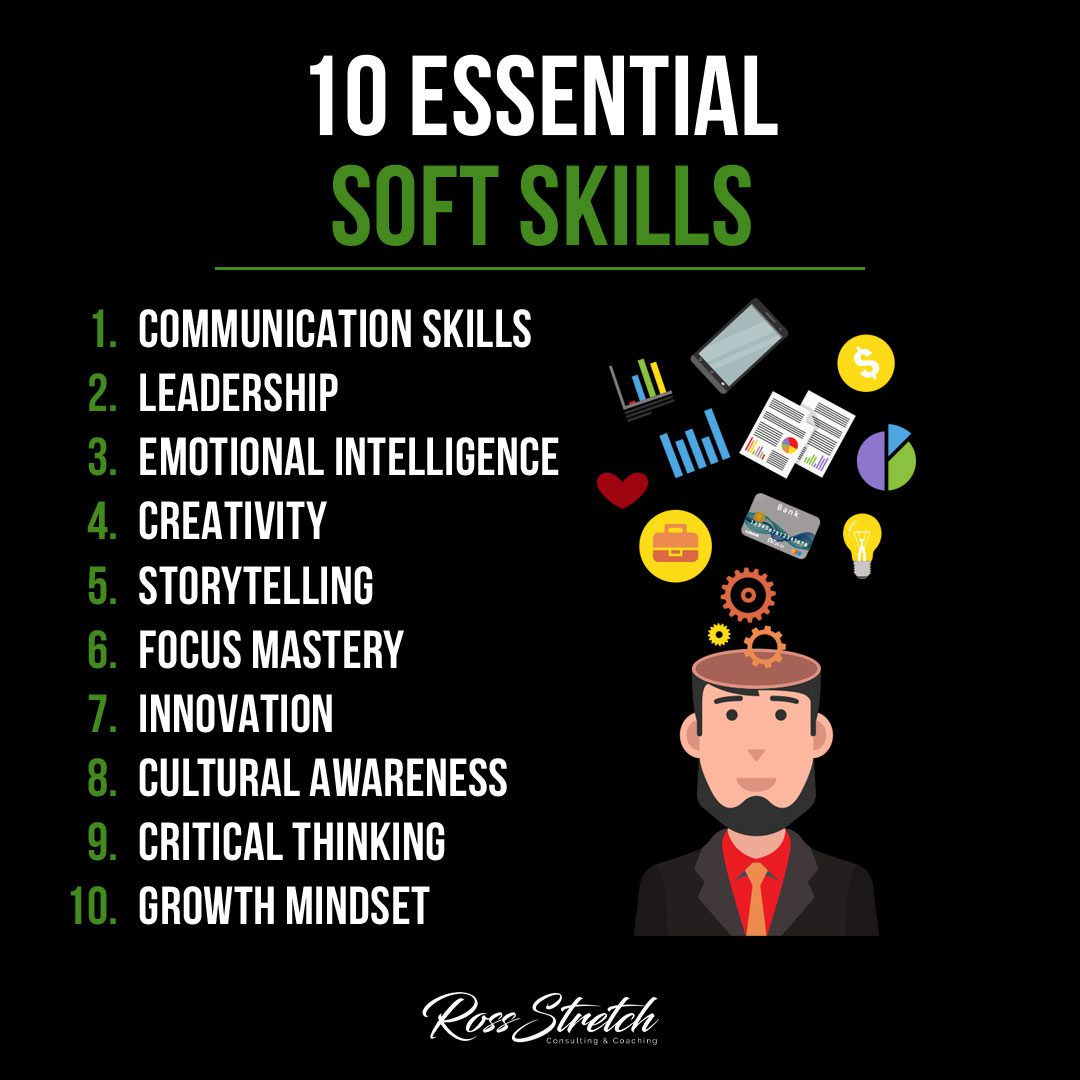
1. Communication Skills
The Foundation Every Other Skill Depends On
Effective communication is the bedrock of professional success. Research estimates that poor communication costs U.S. businesses over $1.2 trillion annually in lost productivity. Whether you’re writing an email, leading a meeting, or giving feedback, your ability to convey ideas clearly and listen actively determines how much influence you carry in any room.
- Actionable Tip: In your next three meetings, practice active listening by putting away your phone, making consistent eye contact, and summarizing what you heard before you respond.
- Why It Works: Most communication failures happen because people are mentally composing their response while the other person is still speaking — genuine listening builds trust and surfaces the real issue faster.
Pro Tip:
Record yourself on video presenting an idea or delivering feedback. Watch it first without sound to assess body language, then again with sound to catch verbal habits. You’ll discover patterns you never knew were undermining your message.
2. Leadership
Influence Without Authority
Leadership is not a title — it’s a repeatable pattern of behavior that inspires others to act toward a shared goal. Google’s Project Aristotle research found that the single most important factor in high-performing teams was psychological safety — the feeling that it’s safe to take risks and speak up. Great leaders create that environment, and that’s a skill anyone can develop regardless of their position on the org chart.
- Actionable Tip: In your next team project, explicitly invite quieter members into the conversation by name and create space for their input before the loudest voice in the room dominates the discussion.
- Why It Works: Inclusive leadership unlocks the full cognitive diversity of a team, which produces better decisions and higher engagement — especially on complex, creative problems.
Pro Tip:
Study the difference between transactional leadership (driven by rewards and punishments) and transformational leadership (driven by vision and intrinsic motivation). Transformational leaders consistently produce higher-performing, more loyal, and more innovative teams across every industry studied.
3. Emotional Intelligence
The Skill That Determines How Far You Go
Emotional intelligence (EQ) is the ability to recognize, understand, and manage your own emotions and those of others. Psychologist Daniel Goleman’s research found that EQ accounts for 67 percent of the competencies required for superior performance in leaders — nearly twice as important as IQ and technical skills combined. In every high-stakes professional situation, from negotiation to conflict resolution to crisis management, EQ is the decisive variable.
- Actionable Tip: Keep an emotional journal for two weeks. After each significant interaction, note what you felt, what triggered it, and how it influenced your behavior and decisions.
- Why It Works: Self-awareness is the foundation of all emotional intelligence. You cannot manage what you have not named, and naming your emotional patterns is the first step to changing them.
Pro Tip:
The “pause and breathe” technique — a four-second inhale followed by a six-second exhale — physiologically activates the parasympathetic nervous system and reduces cortisol levels in real time, giving you the neurological calm to respond thoughtfully rather than react impulsively in high-pressure moments.
4. Creativity
The Competitive Advantage Automation Can’t Replicate
In an era where artificial intelligence is rapidly automating routine cognitive tasks, creativity has become one of the most valuable and irreplaceable human capabilities. A IBM study of 1,500 CEOs across 33 industries identified creativity as the single most important leadership competency for navigating business complexity — ranking above discipline, integrity, and vision. Creativity isn’t about artistic talent; it’s about connecting ideas across domains to generate novel solutions to real problems.
- Actionable Tip: In your next team brainstorm, implement a strict “no judgment” phase — every idea gets written down before any evaluation begins, no matter how far-fetched it sounds in the moment.
- Why It Works: Premature evaluation is the single biggest killer of creative thinking. Separating idea generation from idea evaluation dramatically increases both the quantity and eventual quality of solutions produced.
Pro Tip:
Study adjacent industries for solutions to your current problems. Many of the most transformative business models in history — Amazon Prime’s subscription model, Netflix’s streaming pivot, Airbnb’s asset-light hospitality — were adaptations of ideas that already existed in entirely different contexts.
5. Storytelling
The Art of Making People Care
In an information-saturated world, facts alone rarely move people to action — stories do. Cognitive psychologist Jerome Bruner’s research found that people are 22 times more likely to remember a fact when it’s embedded in a story. Whether you’re pitching to investors, rallying a team through a difficult quarter, or presenting data to senior leadership, your ability to frame information as a compelling narrative determines whether your message lands or gets forgotten.
- Actionable Tip: Use the “Before-After-Bridge” structure in your next presentation: describe the problem as it exists now, paint the picture of what life looks like after solving it, then explain how your idea bridges the gap.
- Why It Works: This structure aligns with how the brain naturally processes information — it creates tension and resolution, which is the fundamental engine of all compelling narrative across every culture and medium.
Pro Tip:
The best storytellers study their audience before crafting the story. Before your next important presentation, ask: what does this person care about most? What are they afraid of? What outcome do they want? Build your narrative to speak directly to those emotional priorities, and your message will feel personally relevant rather than generically informational.
6. Focus Mastery
The Rare Ability to Do the Work That Actually Matters
In an age of constant notifications, open-plan offices, and always-on communication, the ability to sustain deep, uninterrupted focus has become simultaneously rare and extraordinarily valuable. Author Cal Newport’s research on deep work found that the ability to perform cognitively demanding tasks without distraction is growing rarer at the same time it’s growing more economically valuable — a perfect opportunity for anyone willing to develop and protect this capacity.
- Actionable Tip: Block 90-minute deep work sessions in your calendar each morning before checking email or messages, and treat them as non-negotiable appointments with your highest-priority work.
- Why It Works: Morning cortisol peaks make the first two hours of the day the window of highest cognitive performance for most people. Protecting that window and compounding it over weeks and months produces disproportionate output.
Pro Tip:
The Pomodoro Technique — 25 minutes of focused work followed by a 5-minute break — aligns with the brain’s natural ultradian rhythms and prevents the cognitive fatigue that accumulates during long, uninterrupted sessions. Many high-performing professionals use this structure for creative and analytical work where mental freshness determines output quality.
7. Innovation
Turning New Ideas Into Implemented Results
Innovation is not a brainstorming session — it’s the disciplined process of turning new ideas into real, implemented improvements. Many organizations and individuals are full of creative ideas but consistently fail to execute on them because they lack the systems and accountability structures to move from concept to action. True innovators combine creative thinking with structured iteration, clear success metrics, and a tolerance for calculated risk.
- Actionable Tip: For your next improvement idea, create a one-page innovation brief covering four elements: the problem, the proposed solution, the success metric, and the minimum viable test you could run within two weeks.
- Why It Works: Reducing an idea to its minimum testable form forces clarity and enables fast feedback loops — which is exactly how the world’s most innovative companies, including Google, Amazon, and Spotify, actually operate at scale.
Pro Tip:
Study the concept of “innovation accounting” from Eric Ries’ The Lean Startup — measuring progress not by outputs or activity, but by validated learning. This reframe transforms how you evaluate early-stage ideas and helps you kill bad ones faster while doubling down on the ones that show real signal.
8. Cultural Awareness
The Superpower of the Global Economy
As remote work and global commerce continue to eliminate geographic barriers, cultural awareness has become a critical professional competency rather than a nice-to-have. A Harvard Business Review analysis found that teams with high cultural intelligence outperform less culturally diverse teams on complex problem-solving tasks by 35 percent. Misreading cultural norms in a negotiation, a client meeting, or a hiring decision can cause more damage than a technical error — and it’s far harder to recover from.
- Actionable Tip: Before any significant interaction with someone from a different cultural background, spend 20 minutes researching the communication norms, decision-making styles, and professional customs specific to their culture.
- Why It Works: Even a basic understanding of key cultural differences — such as whether a culture values direct or indirect communication, or hierarchical versus flat decision-making — can prevent misunderstandings that derail relationships and deals before they begin.
Pro Tip:
Hofstede’s Cultural Dimensions framework, available free at hofstede-insights.com, provides one of the most rigorous tools for understanding cultural differences across six key dimensions: power distance, individualism, masculinity, uncertainty avoidance, long-term orientation, and indulgence. It’s particularly useful before international negotiations or when building globally distributed teams.
9. Critical Thinking
The Filter That Separates Signal From Noise
In a world flooded with data, competing opinions, and sophisticated misinformation, critical thinking is what separates people who make consistently good decisions from those who react to whatever they most recently encountered. Critical thinking involves questioning assumptions, evaluating evidence rigorously, recognizing cognitive biases, and reasoning toward well-founded conclusions. Employers across every major industry consistently rank it among the most demanded and most difficult-to-find skills in candidates.
- Actionable Tip: Before accepting any important claim — from a news source, a pitch, or a colleague’s recommendation — ask three questions: What is the original source? What evidence actually supports this? What are the strongest counterarguments?
- Why It Works: These three questions interrupt the fast-thinking (System 1) impulse that leads to poor decisions and engage the slow, deliberate (System 2) reasoning that produces better outcomes — a distinction Nobel Prize winner Daniel Kahneman made famous in Thinking, Fast and Slow.
Pro Tip:
Learn to identify the most common cognitive biases — confirmation bias, availability bias, sunk cost fallacy, and anchoring — and actively hunt for them in your own thinking before making significant decisions. The goal is not to eliminate intuition but to interrogate it before acting on it at high stakes.
10. Growth Mindset
The Foundation That Makes Every Other Skill Possible
Stanford psychologist Carol Dweck’s decades of research have produced one of the most important insights in modern psychology: people who believe their abilities can be developed through dedication and hard work — a growth mindset — consistently outperform those who believe their abilities are fixed, across virtually every domain studied. A growth mindset is not optimism or positive thinking. It’s a specific, evidence-based belief about the nature of ability that fundamentally changes how you respond to challenge, criticism, and failure.
- Actionable Tip: Replace the internal narrative “I’m not good at this” with “I’m not good at this yet.” This single word addition — yet — has been demonstrated in controlled studies to shift motivation, persistence, and actual performance outcomes.
- Why It Works: Language shapes cognition. The words we use to describe our situation directly influence what our brain perceives as possible. The word “yet” signals that the current state is temporary and changeable, which activates a fundamentally different response to difficulty.
Pro Tip:
Build a weekly learning log — a five-minute Friday review of what you struggled with, what you tried, and what you learned. This habit trains your brain over time to reframe difficulty as useful information rather than evidence of inadequacy, which is the precise cognitive shift that separates people who keep improving from those who plateau.
Conclusion
Developing and honing these 10 essential soft skills can significantly accelerate your personal and professional growth. By investing in your communication, leadership, emotional intelligence, creativity, critical thinking, and the other competencies in this list, you position yourself for success in a world where technical skills become obsolete but human judgment, empathy, and adaptability remain irreplaceable. These are the skills that AI cannot replicate, the skills that get people promoted into leadership, and the skills that determine the quality of every professional relationship you build.
These skills are not fixed traits — they are muscles that strengthen with deliberate, consistent practice. Pick the two or three where you have the most obvious room to grow, commit to focused development for the next 90 days, and measure the difference. Small, compounding improvements in how you communicate, lead, and think are the foundation of the kind of long-term professional edge that can never be automated or outsourced.
Resources
- Dale Carnegie Training — Communication and Leadership Development
- Daniel Goleman — Emotional Intelligence Research and Resources
- MindTools — Soft Skills Training and Career Development
- Harvard Business Review — The Business Case for Soft Skills

 Ross Stretch