Instagram has quietly become one of the most commercially powerful platforms in existence. With over two billion monthly active users and a native shopping infrastructure that rivals dedicated e-commerce platforms, it offers entrepreneurs a direct line to buyers without the overhead of traditional retail. But the gap between having an Instagram account and generating consistent revenue from it is wide — and most people trying to cross it are missing a few structural pieces.
Turning an Instagram presence into a profitable business channel is not a matter of posting more or buying followers. It requires a deliberate system: an optimized profile that attracts the right audience, a sales mechanism that converts attention into revenue, and a reinvestment strategy that compounds growth over time. This guide walks through that system step by step.
Start With a Profile That Works For You
Your Instagram profile is your storefront. Someone landing on it for the first time should understand within seconds who you are, who you serve, and what they gain by following you. A cluttered bio, an unclear niche, or a highlight reel with no coherent theme signals amateur hour — even if the content itself is strong.
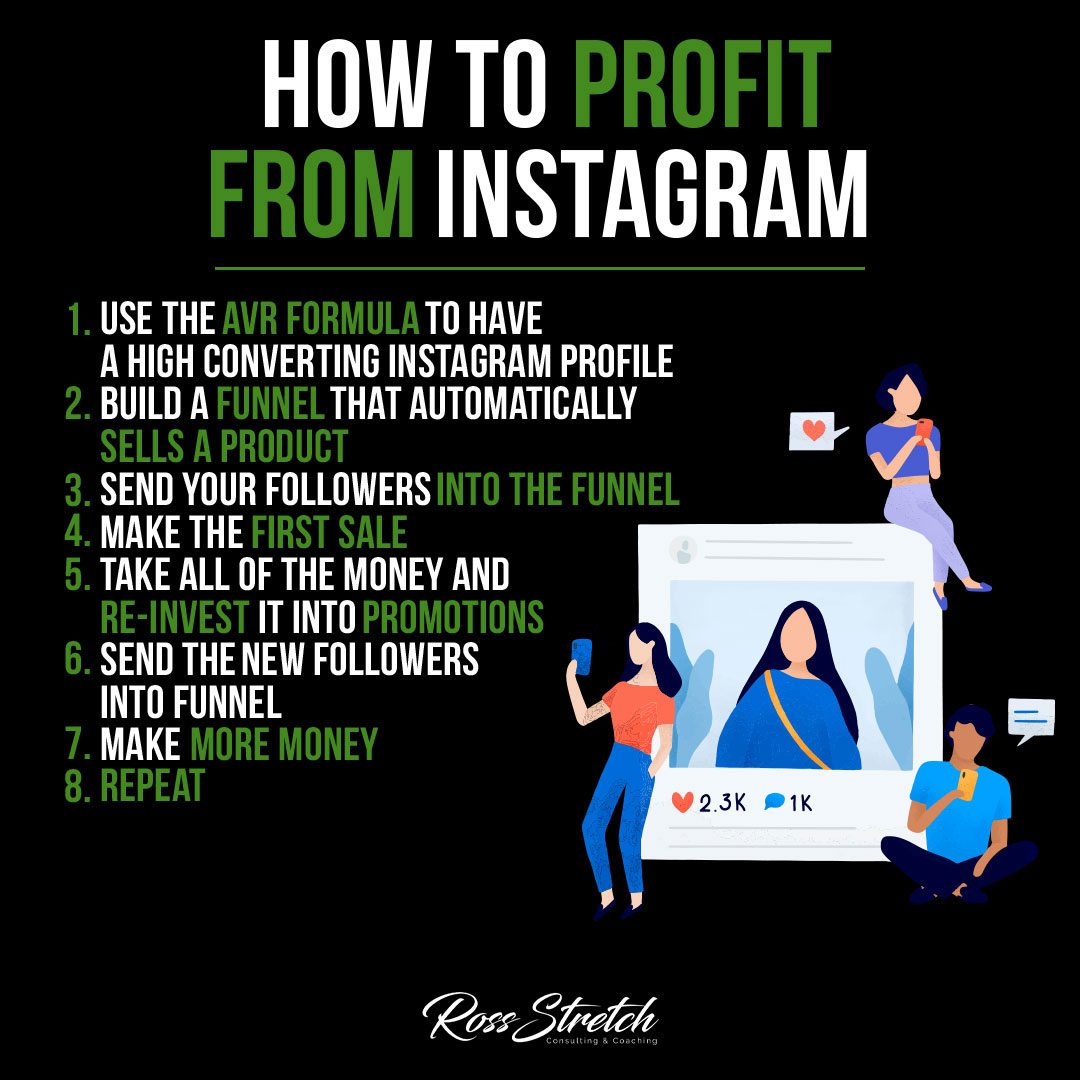
The AVR framework — Attraction, Value, Retention — is a useful lens for auditing your profile. Attraction covers everything that makes a new visitor decide to follow: a clear niche, a consistent visual identity, and a bio that leads with benefits rather than credentials. Value is what you deliver with every post — whether that is education, entertainment, inspiration, or a combination. Retention is the depth you build over time through stories, consistent engagement, and content that rewards a loyal audience differently than it rewards a casual visitor.
Your profile link is prime real estate. Use a link-in-bio tool like Linktree, Stan Store, or Beacons to direct followers to multiple destinations — your lead magnet, your product page, your newsletter, or your booking link. Every element of your profile should serve a function. Remove anything that does not.
Build a Sales Funnel That Works While You Sleep
The difference between an Instagram account and an Instagram business is a sales funnel. A funnel is the automated or semi-automated path that takes a follower from awareness to purchase without requiring your personal involvement in every transaction. It is what separates creators who trade time for money from those who build leveraged income streams.
A basic Instagram funnel has three stages. At the top, content attracts new followers and builds awareness. In the middle, a lead magnet — a free resource, a challenge, a mini-course — captures email addresses and moves interested followers off the platform and into a channel you own. At the bottom, an email sequence or direct offer converts warm leads into paying customers. This structure means your revenue is not entirely dependent on the Instagram algorithm deciding to show your content to your audience on any given day.
Tools like Manychat allow you to automate DM conversations that respond to story replies or comment keywords, delivering lead magnets or booking links instantly. This reduces friction at the point of interest — when someone is most likely to take action — and runs without requiring you to be online.
Content Strategy That Drives Revenue
Content on Instagram exists on a spectrum from pure engagement (designed to attract new followers and generate reach) to pure conversion (designed to prompt immediate purchase). Most accounts make the mistake of posting entirely at one end of this spectrum. Posting only promotional content burns your audience. Posting only engagement content builds an audience that never buys.
A sustainable content mix runs roughly 70 percent value-based content, 20 percent community content, and 10 percent direct promotional content. Value content positions you as an authority in your niche and gives new followers a reason to stay. Community content — polls, questions, behind-the-scenes — builds the relationship that makes people willing to buy from you when the offer arrives. Promotional content, delivered sparingly and with genuine clarity about what is being offered and why, converts that relationship into revenue.
Reels continue to be the primary growth mechanism on Instagram as of 2025, reaching non-followers far more efficiently than static posts or carousels. Carousels perform best for saves and long-term discovery. Stories are the highest-conversion format for direct offers because of the personal, ephemeral nature of the format. Structure your weekly content to include all three.
From First Sale to Sustainable Growth
The first sale from Instagram is a proof of concept. It confirms that your profile attracts the right audience, your funnel works, and your offer resonates. Treat it as validation to double down, not as a finishing line. Analyze the path that customer took: which piece of content attracted them, how long they followed you before purchasing, and what specific offer language converted them. That data is the foundation for everything that scales.
Reinvestment is what separates accounts that plateau from accounts that compound. Take a portion of initial revenue and put it back into the engine — whether that means paid promotion through Instagram ads to expand your reach, better content production equipment, or a short-form video editor who can multiply your output. Each reinvestment cycle expands the top of your funnel and increases the volume of leads moving through your conversion system.
The cycle then repeats: new followers enter the funnel, a percentage converts to customers, revenue funds the next round of promotion, and the audience grows. The key discipline is treating this as a system rather than a series of one-off campaigns. Accounts that generate consistent Instagram revenue do not reinvent their approach with every post — they operate from a tested playbook and optimize specific variables over time.
Metrics That Actually Matter
Follower count is a vanity metric. The numbers that tell you whether your Instagram is performing as a business tool are engagement rate, link-in-bio click-through rate, email list growth from Instagram, and conversion rate on your offer. An account with 3,000 highly engaged followers in a specific niche will consistently out-earn an account with 50,000 passive followers in a broad one.
Track these metrics weekly and look for trends rather than individual data points. A single post with low engagement tells you nothing. A consistent decline in story views tells you something important about either your content quality or your posting frequency. Instagram’s native analytics provide most of what you need. More advanced tracking can be done by adding UTM parameters to your link-in-bio URLs and reviewing traffic sources in Google Analytics or your email service provider.
Conclusion
Instagram revenue is real, but it is not passive and it is not instant. It is the product of a clear profile, a functional sales funnel, a content strategy that builds audience and drives conversion, and a disciplined reinvestment cycle. Build the system, track the right numbers, and optimize based on what the data shows. That is the unglamorous truth behind the accounts that make it look effortless.
Resources

 Ross Stretch