Most people know what they’re obligated to do — but far fewer know what genuinely excites them. If you find yourself drifting through routines that feel mechanical and unfulfilling, the problem often isn’t your circumstances: it’s that you haven’t yet identified — or given real space to — your authentic passions. Finding and developing a passion isn’t a luxury; it’s a core driver of long-term motivation, creativity, and life satisfaction. This guide gives you a practical, step-by-step framework to uncover what drives you and turn it into something that grows alongside you.
Why This Matters
Research consistently shows that people who engage in activities they find intrinsically meaningful report higher levels of life satisfaction, stronger mental health, and greater resilience in the face of setbacks. Passion isn’t just a nice-to-have — it functions as a renewable energy source for effort and attention. When you’re working toward something that genuinely interests you, the work itself becomes rewarding, not just the outcome. That internal motivation is far more durable than external pressure or financial incentives alone, especially when things get difficult.
Beyond personal fulfillment, passions frequently evolve into professional opportunities. Skills developed through passionate pursuit often exceed those acquired through obligation, because passionate people practice longer, seek better resources, and go deeper than the minimum required. Whether your passion becomes a career pivot, a side business, or a life-enriching hobby, the act of developing it builds capabilities and confidence that transfer into every other area of your life. The investment is always worth making.
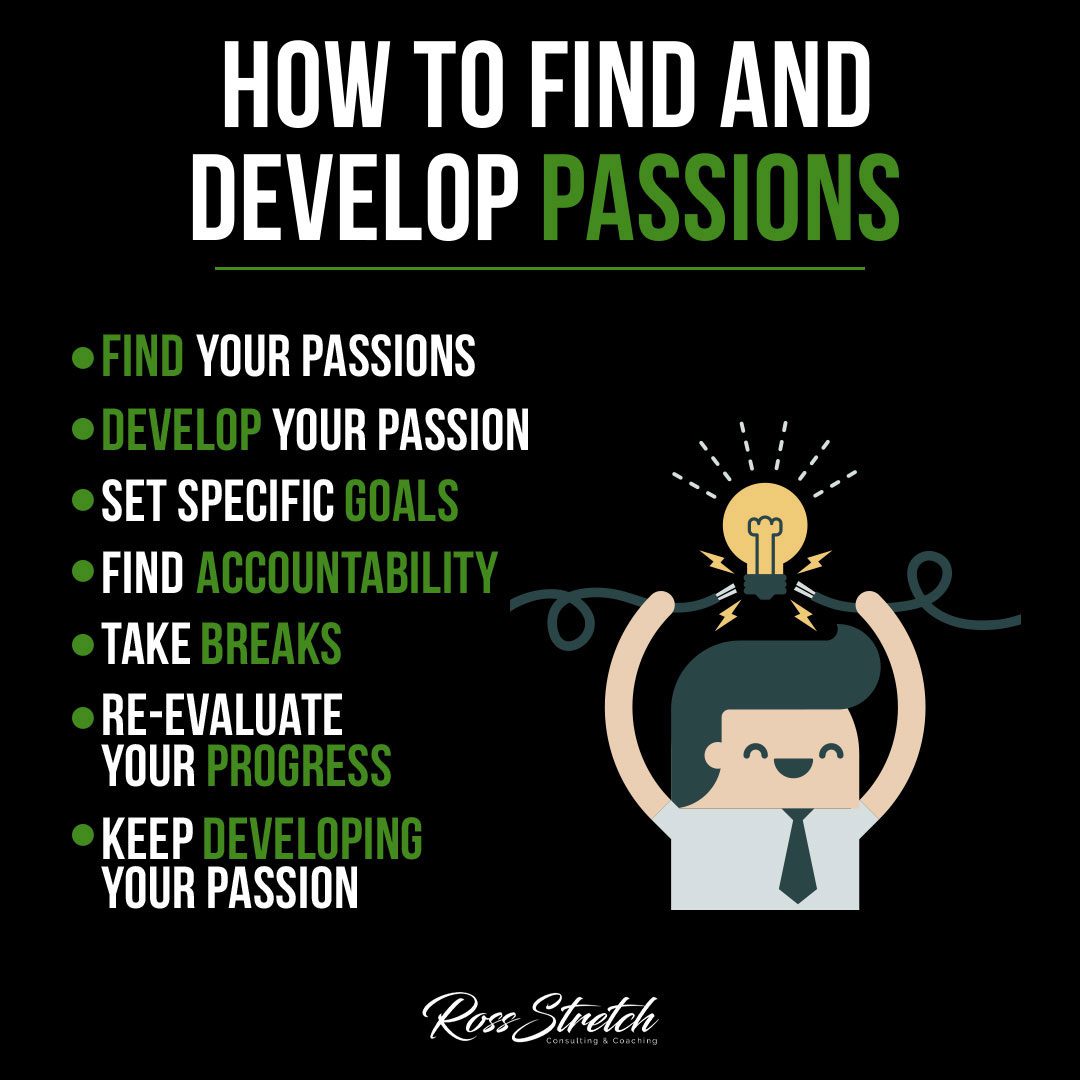
How to Find and Develop Your Passions
Step 1: Conduct a Self-Exploration Audit
Passion rarely arrives as a sudden revelation. More often, it emerges through honest reflection on your existing experiences. Set aside 30 quiet minutes to work through a few key questions: What activities make you lose track of time? What topics do you voluntarily read about or watch without anyone prompting you? What did you love doing as a child, before external expectations shaped your choices? What tasks in your current life feel energizing rather than draining? The answers won’t always point to a single obvious passion, but they reveal patterns that are worth exploring seriously.
- Write your answers to these reflection questions in a journal — patterns become visible over time when you write them down
- Review your recent search history, podcast subscriptions, or bookshelf for clues about what you’re already drawn to
- Avoid: dismissing interests as “not serious enough” or “not practical” at this stage — judgment kills exploration
Step 2: Experiment Broadly Before Committing
You cannot know if something will become a genuine passion without actually trying it. Commit to a period of deliberate experimentation — try one new activity every two to four weeks for three months. Attend a beginner class in something you’ve been mildly curious about. Volunteer in a field you’ve wondered about. Start a project in a creative medium you’ve never worked in. The goal at this stage isn’t mastery; it’s data. You’re learning what resonates at a gut level and what doesn’t. Many people discover their deepest passions through activities they nearly skipped because they assumed they wouldn’t enjoy them.
- Create a list of 10 activities you’re genuinely curious about and schedule one to try per month
- Give each activity a fair trial — at least three separate sessions before evaluating whether to continue
- Avoid: quitting an activity after one bad day or an awkward first session — early discomfort is normal, not a signal to stop
Step 3: Set SMART Goals Around Your Emerging Interests
Once something begins to pull your attention consistently, move from exploration to intentional development by setting SMART goals: Specific, Measurable, Achievable, Relevant, and Time-bound. Rather than a vague resolution to “get better at photography,” a SMART goal sounds like: “Complete an online fundamentals course by the end of next month and take 20 photos per week for 60 days.” Structure transforms interest into momentum. Goals also create natural milestones for honest evaluation — if you consistently resist doing the work, that’s information worth listening to.
- Write one SMART goal for your emerging passion this week and put it somewhere visible
- Break the goal into weekly actions so progress is visible, trackable, and achievable in small steps
- Avoid: goals so large and vague that you have no idea where to start — specificity is what makes goals actionable
Step 4: Practice Deliberately, Not Just Frequently
There’s a meaningful difference between putting in hours and actually improving. Deliberate practice — as articulated by researcher Anders Ericsson — involves working at the edge of your current ability, seeking honest feedback, and focusing on specific weaknesses rather than repeatedly doing what’s already comfortable. If you’re developing a passion for writing, that means getting your work read and critiqued, not just writing in private indefinitely. Seek out structured learning — courses, coaches, communities — that pushes you past your comfort zone at the right pace. Comfortable repetition maintains a skill; deliberate practice builds one.
- Identify the specific skill gap that currently limits your progress and focus your practice there
- Find one resource — a structured course, a coach, or a skilled community — focused on closing that gap
- Avoid: mistaking enjoyable repetition of easy tasks for actual skill development — growth lives outside your comfort zone
Step 5: Build Community and Accountability
Pursuing a passion in isolation is harder and less rewarding than doing so with others. Finding a community of people who share your interest — whether an in-person group, an online forum, or a local club — provides inspiration, feedback, accountability, and the social reinforcement that sustains long-term commitment. An accountability partner who checks in on your progress and shares their own goals with you dramatically increases follow-through. Research on habit formation consistently shows that social accountability is one of the most powerful predictors of sustained behavior change, and it costs nothing to set up.
- Search for local meetups, clubs, or online communities centered on your interest and attend once this month
- Ask one person in your life to serve as a weekly accountability partner for your passion project
- Avoid: only consuming content about your passion — watching tutorials and reading books without producing or engaging actively slows real development
Step 6: Build Rest Into Your Practice
One of the fastest ways to kill a budding passion is to overdo it. Burnout — exhaustion caused by sustained overcommitment — turns something you love into something you dread. Rest is not optional; it’s part of the development process. Scheduled breaks allow your unconscious mind to integrate what you’ve learned, reduce creative fatigue, and prevent the resentment that builds when a passion becomes an obligation. The most effective practitioners in any field treat recovery as seriously as practice itself. Watch for the warning signs: dreading your sessions, declining output quality, irritability when you think about the activity.
- Schedule at least one full day per week away from your passion activity, without guilt
- Notice early warning signs of burnout and respond by reducing intensity before it becomes a full stop
- Avoid: treating rest as laziness — deliberate recovery is a productive part of any skill-development process
Common Mistakes to Avoid
- Waiting for passion to appear spontaneously: Passion is developed through engagement, not discovered through passivity. You have to try things to find what you love — it rarely walks through the door uninvited.
- Comparing your beginning to someone else’s middle: Seeing polished experts online makes beginners feel hopeless before they’ve begun. Everyone started exactly where you are right now.
- Treating passion as all-or-nothing: You don’t have to quit your job or overhaul your life to develop a passion. Even two dedicated hours per week compounds meaningfully over months and years.
- Giving up during the plateau: Early progress is fast, then levels off. Most people quit right before a breakthrough. Persistence through the plateau is what separates people who develop genuine skill from those who don’t.
- Never scheduling time for it: If passion development isn’t on your calendar, it will always lose to urgent obligations. Protect the time explicitly or it simply won’t happen.
Conclusion
Finding and developing your passions is one of the most worthwhile investments you can make in your own life — but it requires active participation, not passive waiting. Through honest self-reflection, deliberate experimentation, structured practice, and consistent effort, you can move from feeling directionless to building a life organized around what genuinely matters to you. The path is personal, and it won’t look like anyone else’s — that’s exactly the point.
Start small and start now. Pick one activity from your curiosity list and schedule 90 minutes this week to try it. You don’t need clarity before you begin — you need action. Clarity comes from experience, not reflection alone. Take the first step, and let what you discover about yourself from there guide everything that follows.
Resources
- Psychology Today: Motivation and Passion — Research-backed explanations of intrinsic motivation and how it relates to long-term life satisfaction.
- Harvard Business Review: The Science of Developing Passion — A nuanced look at why “following your passion” is incomplete advice and what the research actually says.
- James Clear: The Beginner’s Guide to Deliberate Practice — Practical framework for developing skills in any area through intentional, focused effort.
- Meetup.com — Find local groups organized around virtually any interest or hobby for community, accountability, and real-world practice.

 Ross Stretch