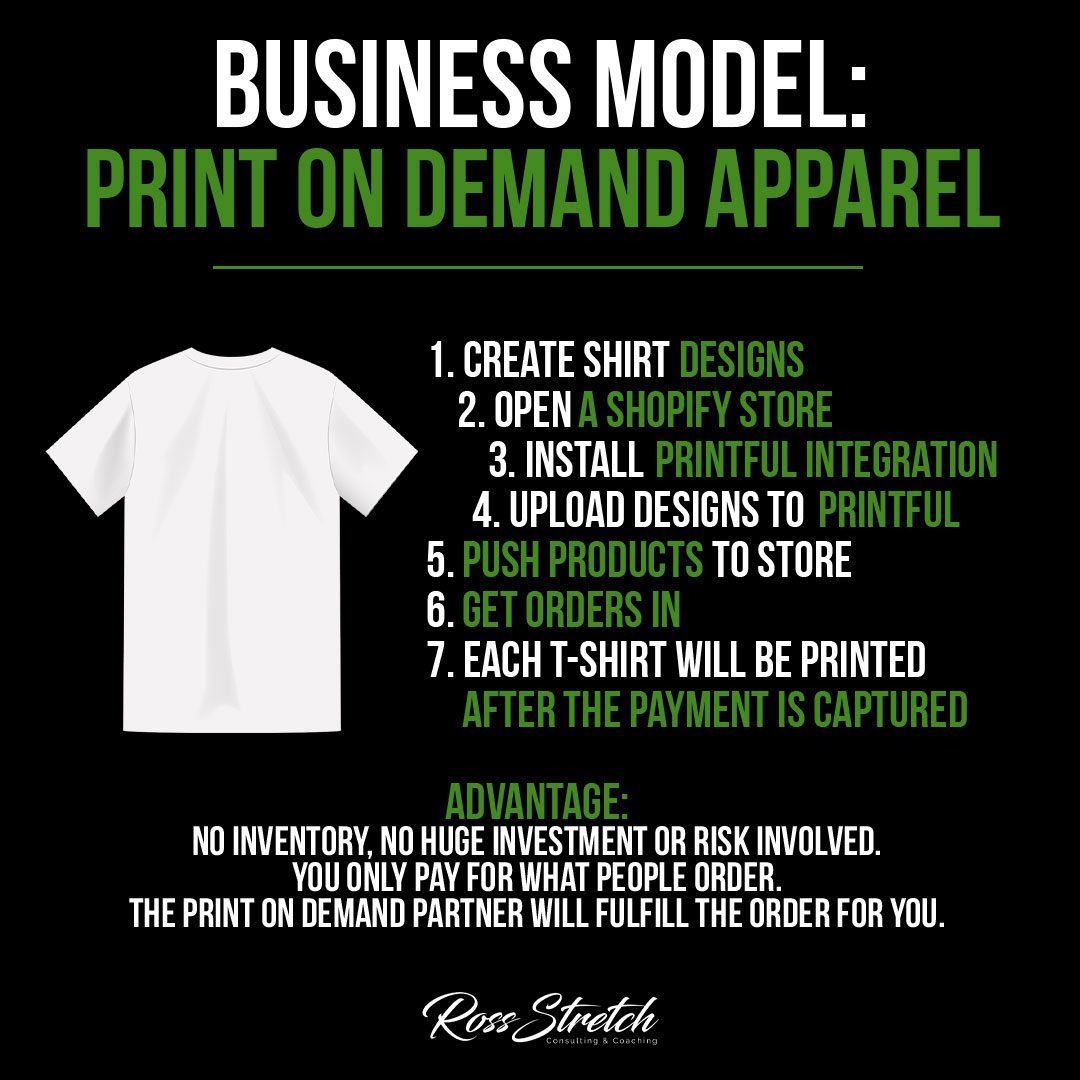
The print on demand apparel business model has fundamentally changed the economics of starting a clothing brand. What once required thousands of dollars in inventory, a warehouse, and fulfillment operations can now be launched for under one hundred dollars — with zero inventory risk. By leveraging platforms like Printful, Shopify, and targeted social media marketing, entrepreneurs can build profitable apparel brands that operate on a fully automated fulfillment model. This guide breaks down exactly how it works and what separates consistently profitable stores from those that stall out early.
What Print on Demand Is and Why It Works
Print on demand (POD) is a fulfillment model where products are manufactured one at a time, only when a customer places an order. There is no pre-production run, no minimum order quantity, and no inventory sitting at your expense. The POD provider — companies like Printful, Printify, or Gelato — handles printing, quality control, packaging, and shipping directly to the customer under your brand name and with your visual identity on the packaging.
This model has expanded rapidly because it eliminates the two biggest barriers to starting a product-based business: capital and risk. The global custom t-shirt printing market was valued at $3.9 billion in 2022 and is projected to grow at a compound annual rate of nearly 10% through 2031, according to Allied Market Research. The opportunity is significant, the barrier to entry is genuinely low, and the tools available to independent sellers have never been more powerful or affordable than they are today.
Creating Shirt Designs That Actually Sell
The foundation of any successful print on demand business is designs that resonate with a specific, passionate audience. Generic designs rarely generate consistent sales — niche designs do. The key is identifying audiences who are deeply emotionally invested in their identity or interest and creating designs that speak directly to that passion. Profitable niches include professional identities (nurses, teachers, engineers, veterans), hobbies (hiking, fishing, gaming, homesteading), pet ownership, sports fandoms, and lifestyle movements with dedicated communities.
Research trending niches using Google Trends, Etsy’s search bar (which surfaces high-demand keywords organically), and Pinterest’s search suggestions. Validate demand before investing significant design time by checking whether competitors in your niche are generating consistent sales and reviews on platforms like Amazon Merch on Demand or Redbubble. A niche with active competition is typically a positive signal — it means customers are already spending money on similar products and the market has been validated for you.
For design creation, Adobe Illustrator provides the most professional output, but Canva’s Pro plan is a fully viable starting point for entrepreneurs without a graphic design background. All designs must be submitted in high resolution — typically 300 DPI minimum — to ensure print quality that holds up on physical garments. If design is not your strength, hiring skilled designers on Fiverr or 99designs for your first collection is a worthwhile investment. A quality design that resonates with its audience and sells consistently returns its cost many times over.
Setting Up Your Shopify Store and Printful Integration
Shopify is the industry-standard platform for print on demand stores: it integrates natively with Printful, handles payment processing securely, and provides robust analytics from your first sale. The Basic plan at $39 per month is the right starting point — upgrade only as your revenue justifies additional tools. Choose a clean, fast-loading theme from the beginning. Page speed directly impacts conversion rates, and slower-loading stores lose a measurable percentage of potential customers before they ever see your products.
Installing Printful from the Shopify App Store takes under ten minutes. Once connected, you can browse Printful’s catalog of hundreds of products — from Bella+Canvas t-shirts (among the most-reviewed print substrates in the industry) to hoodies, tote bags, hats, phone cases, and home goods. Mock up your designs across multiple product types to maximize the return on each design you create. A single compelling graphic can become ten distinct products in your store with minimal additional effort, dramatically increasing your catalog without proportionally increasing your design workload.
Set your pricing based on clear margin calculations. Printful’s base cost for a standard t-shirt typically ranges from $12 to $15 depending on the product and print complexity. Market research shows that $24.99 to $34.99 is the sweet spot for independent apparel brands in most niches. Calculate your margins carefully to cover Shopify’s monthly fee, transaction fees (approximately 2.9% plus $0.30 per sale), any advertising costs, and Printful’s fulfillment charges — then set your price to generate meaningful net profit per unit sold from your very first order.
Marketing Your Store and Driving Consistent Sales
A beautifully designed store with seamless Printful integration earns nothing without traffic. Marketing is where most print on demand entrepreneurs underinvest, and it is the most direct lever you control for revenue growth. The most effective channels for POD apparel are Meta ads (Facebook and Instagram) targeting specific interest groups, TikTok organic content showcasing the story and identity behind your brand, and Pinterest for reaching lifestyle and passion communities with high purchase intent.
For paid advertising, start with a modest daily budget of ten to twenty dollars and test multiple creative formats — static lifestyle images, short video mockups, and authentic user-generated content. Use Printful’s mockup generator to create images that show your products worn in real-world contexts rather than on blank white backgrounds. Context-rich imagery consistently outperforms studio product shots in click-through rate tests across every apparel category studied.
Email marketing delivers the highest return on investment for repeat sales and should be built from your very first customer. Set up automated email flows in Klaviyo (which integrates directly with Shopify and offers a free plan for early-stage stores): a welcome sequence for new subscribers, a post-purchase sequence requesting reviews, and a re-engagement campaign for customers who have not purchased in 90 days. These automations run continuously, generating revenue without ongoing effort — the closest thing to passive income available in e-commerce.
Advantages of the Print on Demand Model
Beyond eliminating inventory risk, the print on demand model offers scalability that traditional product businesses cannot match at this price point. Whether you sell one shirt or one thousand on a given day, Printful handles fulfillment volume without requiring additional resources on your end. You never touch the product, manage shipping logistics, or coordinate warehouse staff. Your role is entirely focused on design, marketing, and customer experience — the three highest-leverage activities in any consumer brand.
This leverage allows a solo operator to compete effectively with established brands at a fraction of the operational cost. A single founder running a well-positioned POD store can generate revenue streams that would have required a full operations team just fifteen years ago. The tools are there — the constraint is execution quality, creative ambition, and marketing consistency, all of which are entirely within your control from day one.
Conclusion
The print on demand apparel business model represents one of the most accessible paths to building a profitable e-commerce brand available to independent entrepreneurs today. The barriers to entry are genuinely low, the tools are sophisticated and affordable, and the market opportunity continues to expand. The entrepreneurs who succeed are those who commit to niche focus, invest in quality design, and treat marketing as a core discipline rather than an optional afterthought.
Start with one niche, one product type, and five to ten strong designs. Get your Shopify store and Printful integration live within a week, then focus your energy on driving traffic and converting visitors into loyal customers. Every dollar earned from a print on demand sale is a dollar generated without touching a single piece of inventory — and that operational freedom is what makes this model genuinely transformational for the entrepreneur willing to execute consistently.
Resources


 Ross Stretch