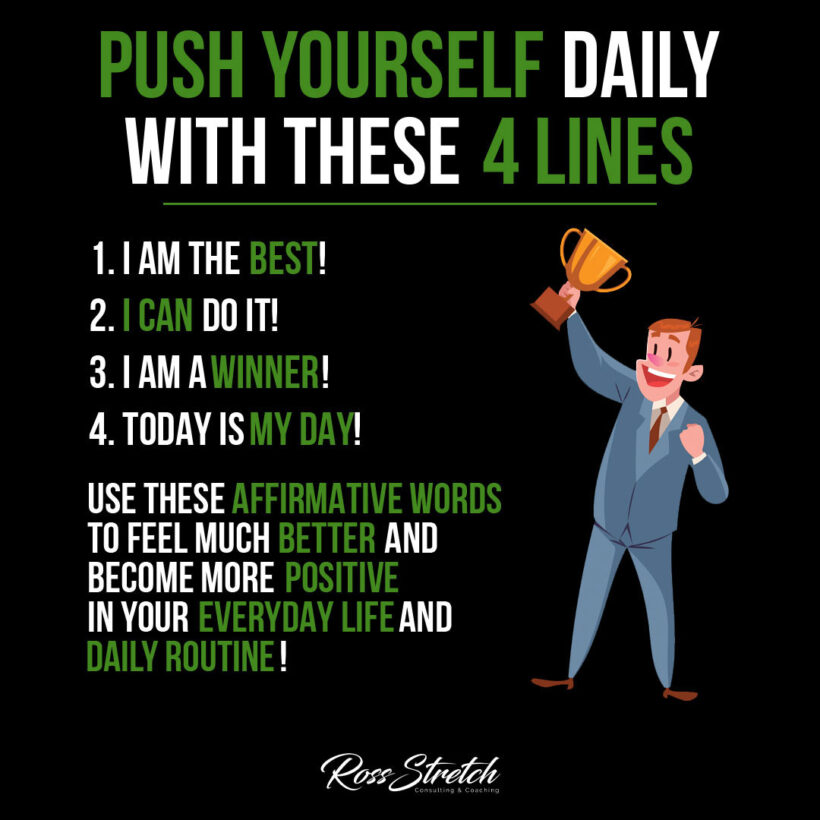

Daily affirmations are one of the most accessible and proven tools for building self-confidence, sustaining peak motivation, and training your brain to expect success. The science is real: research in neuroscience shows that positive self-statements activate the brain’s reward centers and, through neuroplasticity, gradually reshape how you think about yourself and what you’re capable of. These four affirmations — simple enough to say in under a minute — have the power to change your entire day when practiced consistently.
1. “I Am the Best!” — Building Unshakeable Self-Confidence
Start From a Place of Belief, Not Arrogance
Starting your day by saying “I am the best!” might feel awkward at first, especially if you’ve spent years second-guessing yourself. But this statement isn’t about ego — it’s about establishing a baseline of self-belief before the world starts throwing challenges at you. People who believe in their own competence take on bigger risks, persist longer through difficulty, and recover faster from failure.
- Actionable Tip: Say this affirmation out loud in front of a mirror for 60 seconds each morning. The physical act of hearing your own voice matters — silent mental repetition is less effective than vocalization.
- Why It Works: Saying “I am the best” activates self-affirmation theory — when we assert our values and capabilities, we are more likely to act in ways consistent with that identity, a concept backed by research from Carnegie Mellon University.
Pro Tip:
Pair this affirmation with a specific strength. Instead of just “I am the best,” say “I am the best at solving problems under pressure” or “I am the best at building client relationships.” Specificity anchors the affirmation to real evidence in your life, making it feel earned rather than hollow.
2. “I Can Do It!” — Rewiring Your Relationship With Challenges
The Three Words That Break Through Mental Walls
The phrase “I can do it!” targets one of the most crippling mental barriers people face: learned helplessness. Psychologist Martin Seligman’s research shows that people who habitually tell themselves they can’t handle situations eventually stop trying, even when they have the skills. Reversing that pattern takes daily, deliberate repetition of capability-affirming statements. This affirmation helps you approach challenges with a growth mindset instead of retreating from them.
- Actionable Tip: Use this affirmation specifically before a task you’ve been avoiding. Write it on a sticky note and place it where you work. Repeat it three times before starting the thing that feels hardest that day.
- Why It Works: Growth mindset research by Carol Dweck at Stanford shows that believing your abilities can improve — which is exactly what “I can do it” reinforces — leads to greater persistence, higher achievement, and better stress resilience over time.
Pro Tip:
Follow up this affirmation with one immediate concrete action. Affirmations build momentum only when paired with behavior. Say “I can do it” — then open the document, make the call, or send the email. The combination of words and action creates a feedback loop that strengthens the belief rapidly.
3. “I Am a Winner!” — Thinking Like a Success Before the Win Arrives
Identity First, Results Follow
High performers don’t wait for external validation to feel successful — they adopt the identity of a winner first, and their actions align with that identity. Saying “I am a winner” primes your reticular activating system (RAS), the part of your brain that filters information, to notice opportunities, solutions, and resources that match your self-concept. In other words, what you believe about yourself determines what you see around you.
- Actionable Tip: After saying “I am a winner,” immediately write down one specific thing you’ve succeeded at recently — a conversation that went well, a goal you hit, a habit you maintained. This grounds the affirmation in real evidence rather than wishful thinking.
- Why It Works: This affirmation keeps you oriented toward outcomes rather than obstacles, replacing the default negativity bias that the human brain defaults to when left unmanaged — and promoting positive thinking that builds on real results.
Pro Tip:
Use a “wins journal” alongside this affirmation. Each evening, write three things you did well that day, no matter how small. Over 30 days, you’ll have irrefutable evidence that you are, in fact, winning — and the affirmation will shift from aspiration to documented truth.
4. “Today Is My Day!” — Taking Full Ownership of the Present
Stop Waiting — This Moment Is the One That Counts
Most people drift through their days reactively — responding to emails, putting out fires, letting external circumstances dictate their mood and energy. Saying “Today is my day!” is a declaration of ownership. It signals to your brain that you are the author of this day, not a passenger in it. Research in behavioral psychology shows that people who begin their day with a sense of agency make better decisions, maintain higher energy levels, and accomplish more by evening.
- Actionable Tip: Say this affirmation as the very first thing you do after waking — before checking your phone, before reading news. Pair it with two minutes of intentional breathing to lock in a calm, proactive state of mind.
- Why It Works: This affirmation combats the two biggest productivity killers — regret about the past and anxiety about the future — by anchoring your attention in the present. Mindfulness research consistently shows that present-moment awareness improves focus, reduces stress, and increases daily output.
Pro Tip:
Follow this affirmation with a three-item priority list — the three things that would make today a genuine success. This bridges the gap between a positive mindset and concrete productivity, ensuring that “today is my day” becomes a day you can actually point to with pride.
The Science Behind Why Affirmations Work
Affirmations are more than motivational slogans — they are a practical application of neuroscience. The key mechanism is neuroplasticity: your brain’s ability to form new neural pathways through repeated thought patterns. Every time you repeat a positive statement with intention and emotion, you’re reinforcing a circuit. Over time, that circuit becomes the default, replacing patterns of self-doubt and negativity with patterns of confidence and possibility.
A 2016 study published in Social Cognitive and Affective Neuroscience confirmed that self-affirmation activates the ventromedial prefrontal cortex — the region associated with self-related processing and positive valuation. Critically, this activation is accompanied by reduced activity in the brain’s threat-response centers, meaning affirmations literally make you less reactive to stress and more capable of clear thinking under pressure. The catch: consistency is everything. Sporadic affirmations produce minimal results. Daily repetition is where the transformation happens.
How to Build an Affirmation Habit That Sticks
The most common reason affirmation practices fail is inconsistency. People try them for a few days, don’t feel an immediate shift, and give up. The key is to stack them onto existing habits so they require no extra willpower. Say your affirmations while brewing coffee, during your morning shower, or right before starting your first task. The routine triggers the behavior automatically, and the behavior builds the belief.
- Start in the Morning: Say your affirmations out loud when you wake up, before external inputs shape your mindset for the day.
- Write Them Down: Journaling your affirmations adds a kinesthetic dimension that reinforces the message — writing is slower and more deliberate than speaking, deepening the impression.
- Post Visual Reminders: Put sticky notes on your mirror, laptop screen, or car dashboard. Environmental cues dramatically increase the frequency of practice without requiring willpower.
- Use During Meditation: Repeat your affirmations during a quiet two-to-five minute sit. The combination of focused attention and positive self-talk accelerates neuroplastic rewiring significantly.
Conclusion
These four affirmations — “I am the best,” “I can do it,” “I am a winner,” and “Today is my day” — are not magic spells. They are daily mental reps that, over weeks and months, produce a measurable shift in how you see yourself and how you show up in the world. The people who dismiss affirmations are usually the ones who tried them once and quit. The people who commit to them consistently are the ones who look back six months later and realize they’ve become someone they didn’t think they could be.
Your mindset is not fixed. It’s a system you can train, just like a muscle. Start tomorrow morning. Say the words out loud. Mean them — or just say them until you do. The results will follow.
Resources

 Ross Stretch