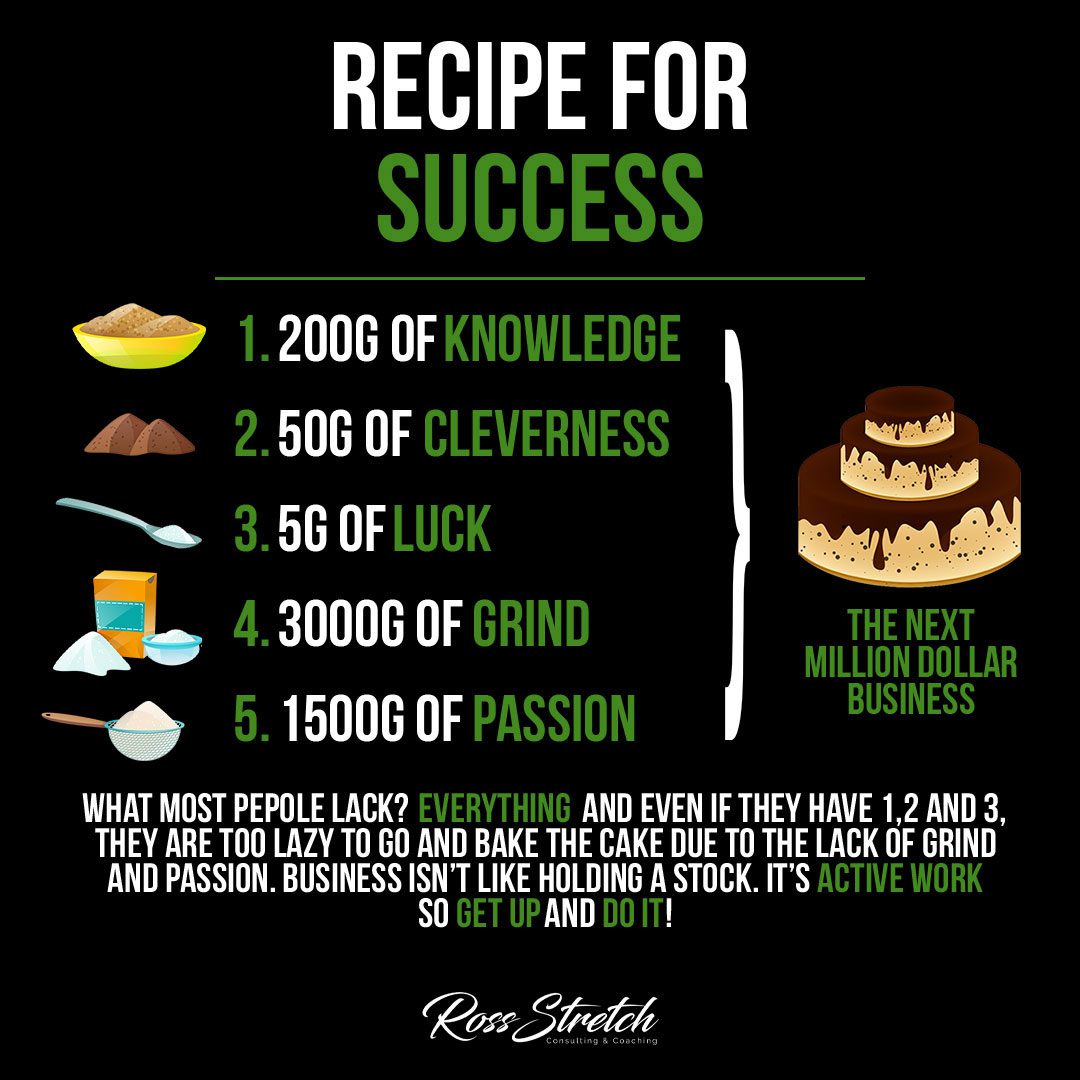
Success doesn’t happen by accident. Behind every person who has built something meaningful — a profitable business, a fulfilling career, or genuine financial independence — there’s a specific combination of ingredients working together. Think of it as a recipe: the right elements, in roughly the right proportions, applied consistently over time. This article breaks down the key ingredients for achieving your goals, why each one matters, and what most people are missing when their efforts fail to produce results. Understanding the recipe for success won’t hand you the destination, but it will make the path far clearer.
Knowledge: The Foundation You Build Everything On
No one succeeds in a vacuum. Every meaningful achievement is underpinned by a solid base of knowledge — understanding your field, your market, your competition, and yourself. This isn’t about earning a degree or collecting certifications. It’s about continuously seeking understanding and staying ahead of the curve in whatever arena you’ve chosen to compete.
The practical application of knowledge matters as much as its acquisition. Information that sits unused doesn’t compound. The most effective learners in any field apply what they know in real situations, refine their understanding through experience, and actively identify gaps in their expertise. Read widely. Study the people who have succeeded in your domain. Understand the mechanics of what you’re building before you try to scale it.
In today’s environment, ignorance is largely a choice. Books, podcasts, online courses, and mentors are more accessible than at any other point in history. The people who get ahead treat learning as a non-negotiable part of their schedule — not something they’ll get around to eventually.
Cleverness: The Problem-Solving Edge
Raw intelligence helps, but what really separates high performers is the ability to think laterally — to approach a problem from angles others overlook. Cleverness isn’t about being the smartest person in the room. It’s about pattern recognition, creative problem-solving, and the willingness to question assumptions that everyone else treats as fixed.
In business, this often shows up as identifying an underserved market, finding a more efficient process, or connecting ideas from different industries to solve a familiar problem in a novel way. Entrepreneurs who succeed long-term aren’t just hardworking — they’re resourceful. They figure out how to get more output from available inputs, and they’re always looking for a smarter path rather than just a harder one.
Cultivate this quality by exposing yourself to diverse perspectives. Read across disciplines. Spend time with people who think differently than you do. Ask “why does this have to work this way?” more often than feels comfortable — and then experiment with what you find when you challenge the default answer.
Luck: Small in Proportion, Large in Impact
Luck exists. Denying it entirely is intellectually dishonest. But the more accurate framing is that luck tends to favor the prepared, the visible, and the persistent. The person who shows up consistently, builds a wide network, and takes calculated risks simply encounters more opportunities. And when a fortunate break comes, they’re positioned to act on it.
Think of luck as a small ingredient in the recipe — a pinch of salt rather than a primary component. Its absence won’t ruin the dish if everything else is well executed. But its presence, when you’ve done the work, can accelerate results dramatically. The practical move is to position yourself to be lucky: stay active in your industry, maintain strong relationships, keep your skills sharp, and take more swings than the average person is willing to take.
The Grind: Hard Work That Cannot Be Substituted
This is where the recipe gets uncomfortable. Most people understand that hard work is required. Far fewer actually do it at the level that produces exceptional results. The difference between someone who nearly makes it and someone who does is often nothing more than sustained, disciplined effort applied over a longer time horizon than most people are willing to commit to.
Business, in particular, demands active involvement. It is not a passive endeavor like holding a stock and watching it appreciate. You’re solving problems, managing people, serving customers, adapting strategy, and showing up when results are slow to materialize. The people who build lasting businesses treat their work like a craft — something that deserves their full attention every day, not just when motivation is high.
Consistency over time is the real engine here. Not grinding yourself into the ground for three months and burning out, but building sustainable habits that allow you to show up at a high level day after day, year after year. The compound effect of consistent effort — applied to the right activities — is difficult to overstate.
Passion: The Fuel That Sustains the Long Game
Passion gets dismissed in some business circles as overly romantic — and there’s validity to that critique. Passion alone won’t pay the bills. But it matters enormously as a sustaining force. When things get difficult — and they always do — genuine care for what you’re building is what keeps you moving forward when logic alone would suggest walking away.
People who love what they do also tend to develop mastery faster. They invest more time voluntarily, obsess over details others miss, and compound expertise more rapidly than those treating the work purely as a transaction. Over a long enough period, that level of investment produces exceptional results that are difficult to replicate through effort alone.
The practical implication: don’t choose your path based purely on financial projections. Choose work where your natural curiosity and care will give you a competitive edge — then build the financial structure around it. Passion without a business model is a hobby. A business model without passion is just a job you happen to own.
What Most People Are Actually Missing
Most people have at least some of these ingredients. They have knowledge in certain areas. They have moments of creativity. They work hard sometimes. What they consistently lack is the commitment to combine all of these elements over a sustained period — not just for a week or a quarter, but for years on end, without quitting when progress slows.
The other common gap is disciplined effort in the absence of motivation. Motivated effort is easy. Disciplined effort — doing the work on the days when you don’t feel like it, maintaining your standards when no one is watching, persisting through plateaus with no obvious end in sight — is what separates outcomes. Build systems and routines that reduce your dependence on motivation, and make it structurally easier to do the work than to avoid it.
Conclusion
The recipe for success is less mysterious than it often appears. Knowledge, cleverness, a willingness to position yourself for good fortune, relentless hard work, and genuine passion — combined and sustained over time — will produce meaningful results in virtually any field. The challenge isn’t knowing the ingredients. It’s showing up every day to mix them together, especially on the days when you can’t yet taste what’s coming.
Resources
- Outliers: The Story of Success by Malcolm Gladwell — Explores the hidden factors behind exceptional achievement and why hard work alone doesn’t tell the whole story
- Grit by Angela Duckworth — Research-backed exploration of why passion and perseverance predict success better than raw talent
- Atomic Habits by James Clear — A practical framework for building the consistent habits that make long-term success inevitable
- Grit: The Power of Passion and Perseverance — Angela Duckworth TED Talk — A compelling 6-minute case for why perseverance matters more than IQ

 Ross Stretch