
Seven figures — whether as annual revenue, net worth, or a business valuation — is a goal that sounds aspirational but is achievable with a coherent, multi-year plan. The entrepreneurs who reach this milestone rarely get there through a single breakthrough. More often, it is the product of compounding decisions made over six to eight years: building credibility, reinvesting aggressively, scaling what works, and eliminating what doesn’t. The seven-year framework is not a guarantee. It is a realistic timeline for what deliberate, sustained business-building actually requires.
Why a Multi-Year Horizon Changes Everything
Most business failures occur because founders expect results in months that realistically take years. Research consistently shows that successful businesses typically require three to five years before generating meaningful, reliable profit. Knowing this upfront changes how you allocate resources, measure progress, and respond to inevitable setbacks without abandoning a viable strategy prematurely.
A seven-year roadmap does not mean working blindly toward a distant target. It means structuring each phase of your business around the specific objectives that phase requires — and resisting the temptation to skip phases because you want to reach the end faster. Skipping the foundation phase to rush into aggressive scaling is one of the most common and costly errors that ambitious entrepreneurs make. You scale what works, not what you hope will work once it’s larger.
Years 1-2: Building Your Foundation and Reputation
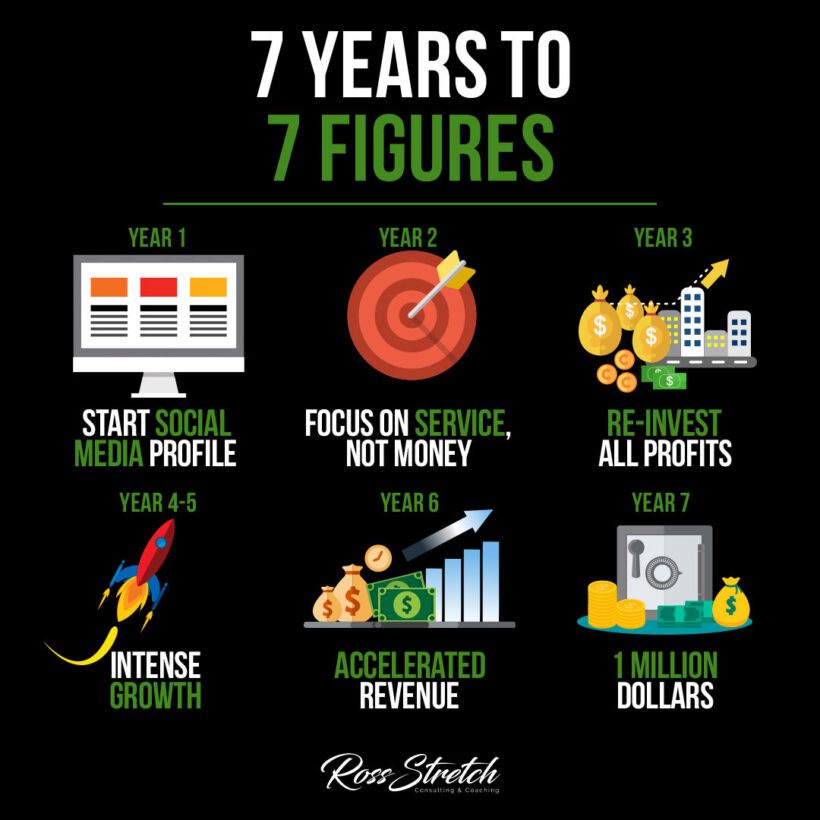
The first two years of a serious business are about establishing credibility, not generating maximum revenue. This phase is about defining who you serve, getting precise about what problem you solve, and building the reputation that makes future sales significantly easier and more efficient.
Year one is primarily about presence: creating content or delivering services consistently, serving your first clients at a high level even if they’re paying below your eventual rates, and generating the testimonials, case studies, and referrals that carry real weight in future conversations. This is also when you learn what your market actually values — which is often different from what you assumed when you started. The feedback from early clients is the most valuable market research available.
Year two shifts toward refinement. You have identified what is working, you have real client feedback, and you are beginning to see which services or products generate the most value per unit of effort. Start saying no to projects or clients that don’t fit your direction, even when the income is tempting. Every hour spent on misaligned work is an hour not spent building the business you actually want to have in year seven.
Year 3: Reinvesting Aggressively
By the third year, most entrepreneurs feel the pull to reward themselves for years of hard work — and some of that is warranted. But year three is arguably the most important investment year in the entire journey. The business has validated its model. The question is now how to scale it before competitors or changing market conditions close the window.
Reinvestment in year three looks different depending on your business type. For a service business, it might mean hiring a part-time team member or contractor to handle execution while you focus on business development and client acquisition. For a digital business, it might mean investing in paid advertising now that you have proven conversion rates and a clear cost-per-acquisition. For a product business, it might mean expanding inventory or adding a complementary product line that serves your existing customer base.
The discipline of reinvesting before lifestyle spending is what separates entrepreneurs who plateau at a comfortable income from those who continue climbing. Keep personal withdrawals minimal during this phase and route profit back into activities with the highest expected return on capital.
Years 4-5: Scaling What Works
The growth phase of years four and five is about identifying the highest-leverage channels in your business and investing in them disproportionately, while eliminating or delegating everything that doesn’t directly drive core growth. By this point you should have sufficient data to know which marketing channels produce customers at the lowest acquisition cost, which products or services generate the highest margins, and which types of clients have the highest lifetime value. Scale these deliberately and specifically.
Systems and processes become critical in this phase. A business that runs through the founder’s personal effort has a ceiling — it stalls the moment you hit the limits of your own time and energy. Document your core processes, hire to your weaknesses, and invest in the tools and infrastructure that allow your operation to grow without a proportional increase in your personal workload. Operational systems are what transform a self-employed person into a business owner.
Year 6: Multiple Revenue Streams and Margin Optimization
By year six, your primary revenue engine should be operating with genuine efficiency. The focus shifts to adding adjacent revenue streams that leverage your existing audience, reputation, or infrastructure — and to systematically improving profit margins on what you already sell rather than simply pursuing more volume.
Revenue expansion at this stage might mean adding a course or group program to a service-based business, launching a higher-priced premium offering for your most committed clients, or licensing your process or intellectual property to other businesses who want to use your system. These additions do not require building from zero. They leverage the audience, trust, and operational infrastructure you have already invested years building.
Margin optimization means reviewing your cost structure with discipline: renegotiating vendor contracts, eliminating tools and subscriptions that don’t directly contribute to revenue, and ensuring your pricing reflects the genuine value you are delivering rather than the rates you charged in year one when you were still establishing your reputation.
Year 7: The Threshold
Reaching seven figures is not an end point — it is a confirmation that your model works at scale. Many entrepreneurs who hit this milestone report that the leap from $700,000 to $1 million felt less dramatic than the earlier phase transitions, because the systems, team, and audience that made it possible were already in place well before the revenue crossed that line.
The primary focus in year seven is on making the business sustainable and resilient without requiring the founder’s constant personal involvement. This means strong standard operating procedures, a team capable of executing at a high level independently, and revenue streams that don’t depend entirely on your personal production capacity. A business that requires you to show up every day to generate revenue is not yet a business — it’s a job with more stress and less predictability.
Conclusion
Seven figures in seven years is achievable, but it is not automatic or passive. It requires a realistic understanding of what each phase demands and the discipline to execute on those demands even when the results are not yet visible. The entrepreneurs who reach this milestone are not necessarily the most talented or the most fortunate — they are the ones who stayed consistent when it would have been easier to quit, reinvested when it would have been easier to spend, and kept their focus when distractions were everywhere. Build for the long game, one compounding year at a time.
Resources

 Ross Stretch