Energy is the most finite resource you manage each day — more finite, in a practical sense, than time itself. You can make more money, build new skills, and expand your network, but you cannot manufacture more mental and physical energy beyond what your body and mind are capable of producing. Understanding what drains your energy is therefore not a wellness hobby. It is a performance imperative for any professional serious about operating consistently at their best.
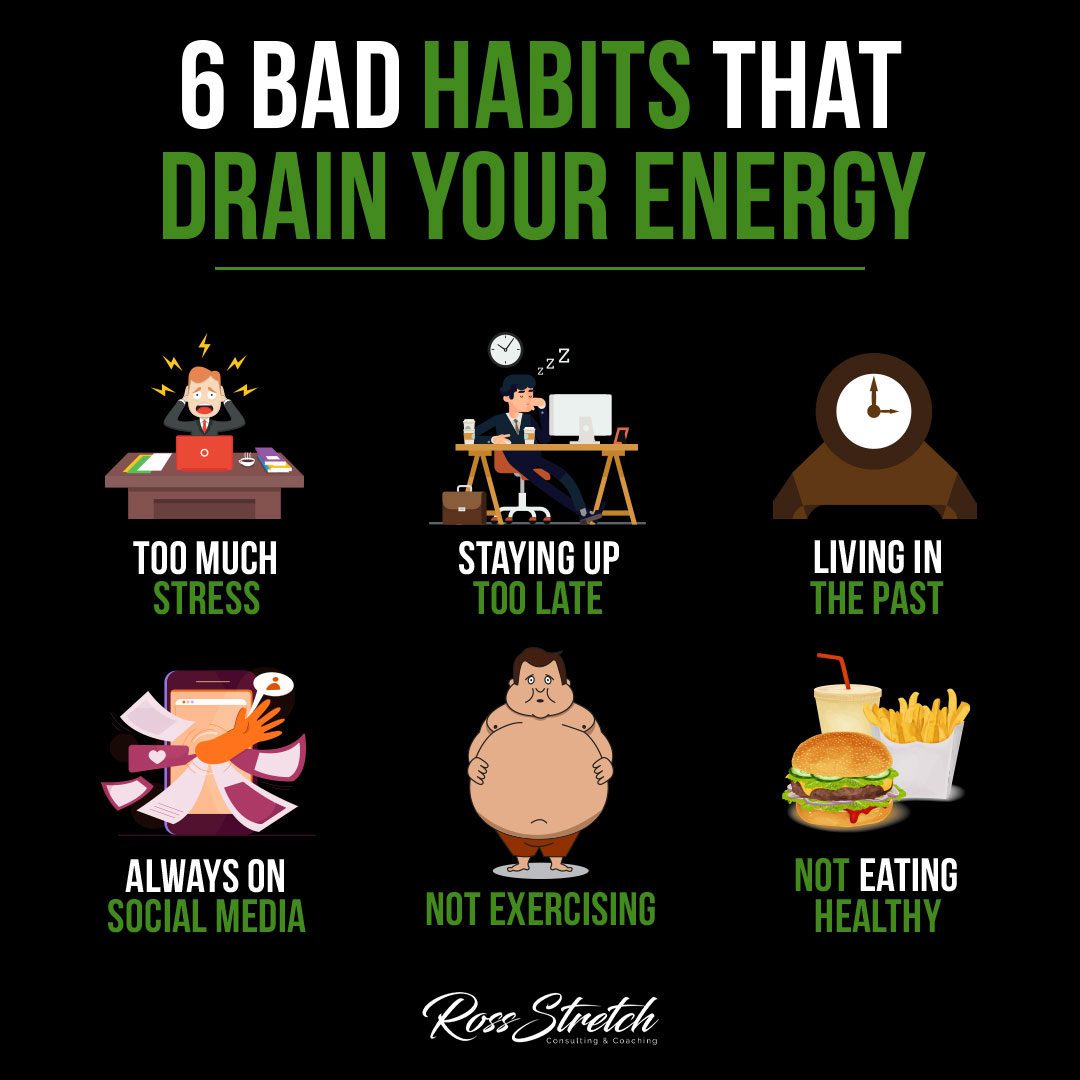
The six habits described here are among the most common and most underestimated energy drains affecting high-performing professionals. None of them feel catastrophic in isolation. Their damage is cumulative — slow, largely invisible, and often mistaken for burnout or general fatigue when the real cause is a collection of small daily choices compounding into chronic depletion.
1. Too Much Stress: The Silent Energy Thief
Chronic stress depletes faster than any workload
Acute stress — the kind triggered by an important presentation or a tight deadline — is not inherently harmful. It activates the nervous system, sharpens focus, and can improve short-term performance in measurable ways. Chronic stress is an entirely different phenomenon. When the stress response remains activated over weeks and months, it creates a sustained physiological burden that progressively exhausts the adrenal system, disrupts sleep architecture, impairs decision-making quality, and degrades every dimension of cognitive and physical performance.
The insidious challenge with chronic stress is that it normalizes. People adapt to feeling tense and anxious as their baseline state, losing the ability to recognize how much energy that activation is consuming. If you frequently feel tired despite adequate sleep, struggle to focus on tasks that previously felt straightforward, or notice your patience and emotional regulation deteriorating without obvious cause, chronic stress is a likely primary contributor.
- Actionable Tip: Introduce a ten-minute transition ritual at the end of each workday — a short walk, a few minutes of slow breathing, or a brief journaling session. This signals to your nervous system that the active work phase is complete and reduces the carryover of stress into evening recovery hours.
- Why It Works: The nervous system responds to consistent environmental cues. A reliable end-of-day ritual trains your body to shift out of the activated stress state, allowing genuine recovery during non-work hours rather than sustained low-level activation.
Pro Tip:
Categorize your top recurring stressors: those you can eliminate, those you can reduce, and those you can only manage. Most people invest significant energy managing stressors they could eliminate entirely with a single structural change. The highest-leverage intervention is almost always removing the source rather than developing more sophisticated coping mechanisms for it.
2. Staying Up Too Late: The Non-Negotiable Energy Tax
Sleep is the foundation every other performance variable builds on
The research on sleep and cognitive performance is among the most robust in all of behavioral science. Chronically sleeping fewer than seven hours per night impairs working memory, reduces emotional regulation capacity, compromises immune function, increases error rates, and — critically for entrepreneurs and ambitious professionals — significantly degrades the quality of complex decision-making. There is no meaningful adaptation to sleep deprivation. The brain does not learn to perform well on insufficient sleep; it learns to feel less impaired while actually performing significantly worse.
Late nights powered by screens compound the damage substantially. Blue light exposure within two hours of intended sleep disrupts melatonin production and delays sleep onset, meaning that even eight hours in bed produces less restoration than the duration suggests. Many professionals sustain this cycle for years — staying up late with screens, sleeping poorly, compensating with caffeine, which then disrupts the following night’s sleep and reinforces the cycle.
- Actionable Tip: Set a screen curfew 60 to 90 minutes before your target sleep time and replace that window with reading, a light stretching routine, or relaxed conversation. Track your subjective energy at 10 AM each morning for two weeks before and after making this change to measure the effect directly.
- Why It Works: Reducing evening blue light exposure and creating a genuine wind-down period measurably improves sleep onset speed and sleep quality, producing noticeably higher energy and cognitive clarity the following morning without any other change to your schedule.
Pro Tip:
Treat your sleep schedule as a non-negotiable performance input rather than a flexible lifestyle choice. High-performing athletes and executives who sustain output over the long term consistently cite sleep as a foundational, protected priority. More hours of low-quality, sleep-deprived work do not outperform fewer hours of high-quality, fully rested work — and the research consistently confirms this.
3. Living in the Past: A Mental Energy Drain
Rumination consumes energy without producing any forward movement
The brain has a well-documented negativity bias — a tendency to replay negative events more frequently and vividly than positive ones. This evolved as a survival mechanism, but in a modern professional context it often manifests as rumination: the repetitive mental replay of past mistakes, failures, conflicts, or decisions you wish you had made differently. Rumination feels productive because it resembles analysis. It consumes significant mental energy while producing no actionable insight or forward movement.
Professionals who struggle with rumination describe it as a persistent background process — thoughts about a difficult client interaction, a poor decision, or a missed opportunity running continuously in the background while they attempt to focus on current priorities. This mental overhead is genuinely exhausting and measurably reduces the cognitive bandwidth available for creative thinking, problem-solving, and genuine presence in current work and relationships.
- Actionable Tip: When you notice yourself ruminating, write the thought down on paper with a specific label — “I am replaying the conversation with X” or “I am worried about Y.” This act of naming and externalizing the thought interrupts the loop and signals to the brain that the concern has been registered and does not need continuous reprocessing to be remembered.
- Why It Works: Journaling and cognitive labeling engage the prefrontal cortex in a way that reduces the emotional intensity of the ruminating thought, creates psychological distance from it, and measurably reduces its ongoing energy consumption compared to passive rumination.
Pro Tip:
Distinguish deliberately between productive reflection and unproductive rumination. Productive reflection has a defined endpoint — you revisit an event, extract a specific lesson, and apply it forward. Rumination is circular and produces only distress. If you have revisited the same event more than three times without surfacing a new insight, apply the lesson you already have and intentionally redirect your focus to what is in front of you.
4. The Social Media Vortex
Passive scrolling is the most common hidden energy drain in modern life
Social media platforms are engineered by some of the most sophisticated behavioral designers in the world with a single primary objective: maximize time on platform. The techniques deployed — variable reward schedules, social validation loops, algorithmically curated outrage and novelty — are explicitly calibrated to override intentional behavior and drive compulsive engagement. This is not a personal weakness. It is an engineered vulnerability, and recognizing it as a systems design problem rather than a character flaw is the first step toward managing it effectively.
The energy drain from passive social media consumption is multidimensional. It fragments attention — each session involves dozens of micro-context switches that research suggests take an average of over 20 minutes of focused effort to fully recover from. It also generates low-grade social comparison stress, creates ambient anxiety from conflict-optimized content, and consumes hours that could have been used for genuinely restorative or productive activity without leaving the user feeling meaningfully better for having spent the time.
- Actionable Tip: Use your device’s built-in screen time controls to set a hard daily limit on social media apps — start with 30 minutes total. Most people discover that the information they feared missing by limiting consumption is almost entirely non-essential to their actual goals and responsibilities.
- Why It Works: Removing access to the infinite scroll removes the path of least resistance to passive consumption and forces a more deliberate choice about how discretionary time is used, freeing significant mental bandwidth and restoring a sense of agency over attention.
Pro Tip:
Delete social media apps from your phone and access them only through a browser on a laptop. This single friction-adding change reduces casual consumption dramatically for most people without requiring ongoing willpower expenditure. The inconvenience of opening a browser and navigating to a site replaces the instant gratification of a home screen tap and is often sufficient to break the reflexive check-in habit entirely.
5. A Sedentary Lifestyle
Physical movement is an energy input, not an energy expense
One of the most counterintuitive truths about energy management is that physical exercise increases available energy rather than depleting it. The body’s energy production systems — mitochondrial density, cardiovascular capacity, hormonal regulation — all improve with regular aerobic activity. A sedentary lifestyle, by contrast, causes progressive deterioration across all of these systems, resulting in lower baseline energy, greater fatigue from equivalent cognitive and physical effort, and reduced capacity for both sustained focus and creative output.
Regular exercise also produces direct cognitive benefits that are highly relevant to professional performance: it increases BDNF, a protein associated with improved memory consolidation and neuroplasticity; reduces circulating stress hormones; and improves sleep quality, which in turn enhances every other performance variable. Research suggests that even 20 to 30 minutes of moderate aerobic exercise three times per week produces measurable improvements in energy levels, mood stability, and cognitive function within two weeks of consistent practice.
- Actionable Tip: Schedule your exercise sessions at the beginning of each week in your calendar as fixed commitments rather than aspirational intentions. Treat a cancelled session with the same seriousness as a cancelled client call — because the performance cost of skipping it is equally real, even if the consequences are less immediately visible.
- Why It Works: Scheduled exercise removes the daily decision-making burden of “should I work out today?” — which is the primary failure point for most people’s fitness consistency. Removing the decision removes the friction.
Pro Tip:
If structured workout sessions feel unmanageable given your current schedule, start with walking. A 20-minute walk after lunch is both a meaningful physical movement intervention and a proven cognitive reset that measurably improves afternoon focus and creative problem-solving for the hours that follow. It also establishes the habit of intentional daily movement, which can be built upon incrementally over time.
6. Poor Nutrition
Your diet is the most direct lever you have on daily energy levels
The food you eat is the literal raw material your body uses to produce energy. High-sugar, highly processed foods provide a rapid glucose spike followed by a corresponding insulin-driven crash — the familiar mid-afternoon slump that many professionals attempt to manage with additional caffeine, which then disrupts the following night’s sleep. This pattern creates a self-reinforcing cycle of energy volatility that makes sustained focus and consistent performance extremely difficult to maintain across a full working day.
Optimizing nutrition for sustained energy does not require extreme dietary changes or complicated protocols. The foundational principles are straightforward: prioritize protein and complex carbohydrates over processed foods and refined sugar, maintain adequate hydration throughout the day — mild dehydration alone causes measurable cognitive impairment — and avoid skipping meals, which causes blood sugar dips that trigger fatigue and reduced concentration well before hunger becomes consciously noticeable.
- Actionable Tip: Prepare a protein-rich first meal before your workday begins — eggs, Greek yogurt, cottage cheese, or a whole-food protein shake. This stabilizes blood sugar from the morning and significantly reduces mid-morning energy crashes compared to a high-carbohydrate or skipped breakfast.
- Why It Works: Blood sugar stability is the most direct dietary lever for sustained cognitive energy. Protein and fiber slow glucose absorption, preventing the spike-and-crash cycle that undermines both morning productivity and afternoon performance.
Pro Tip:
Track your diet and energy levels together for a single week. Log everything you eat and note your subjective energy at two-hour intervals throughout the day. This basic exercise reveals patterns directly traceable to specific foods and timing that generic nutrition advice cannot surface, giving you a personalized roadmap for dietary optimization based on your own physiology rather than population averages.
Conclusion
Energy management is the meta-skill that determines how effectively you apply every other skill and strategy in your professional and personal life. No productivity system, time management framework, or ambitious goal-setting methodology will produce consistent results without the foundation of physical and mental energy to execute. Address these six habits not as a wellness project but as a core performance priority. The compounding return on energy invested in your own foundational health and daily habits is among the highest available to any professional serious about building something significant over the long term.
Resources

 Ross Stretch