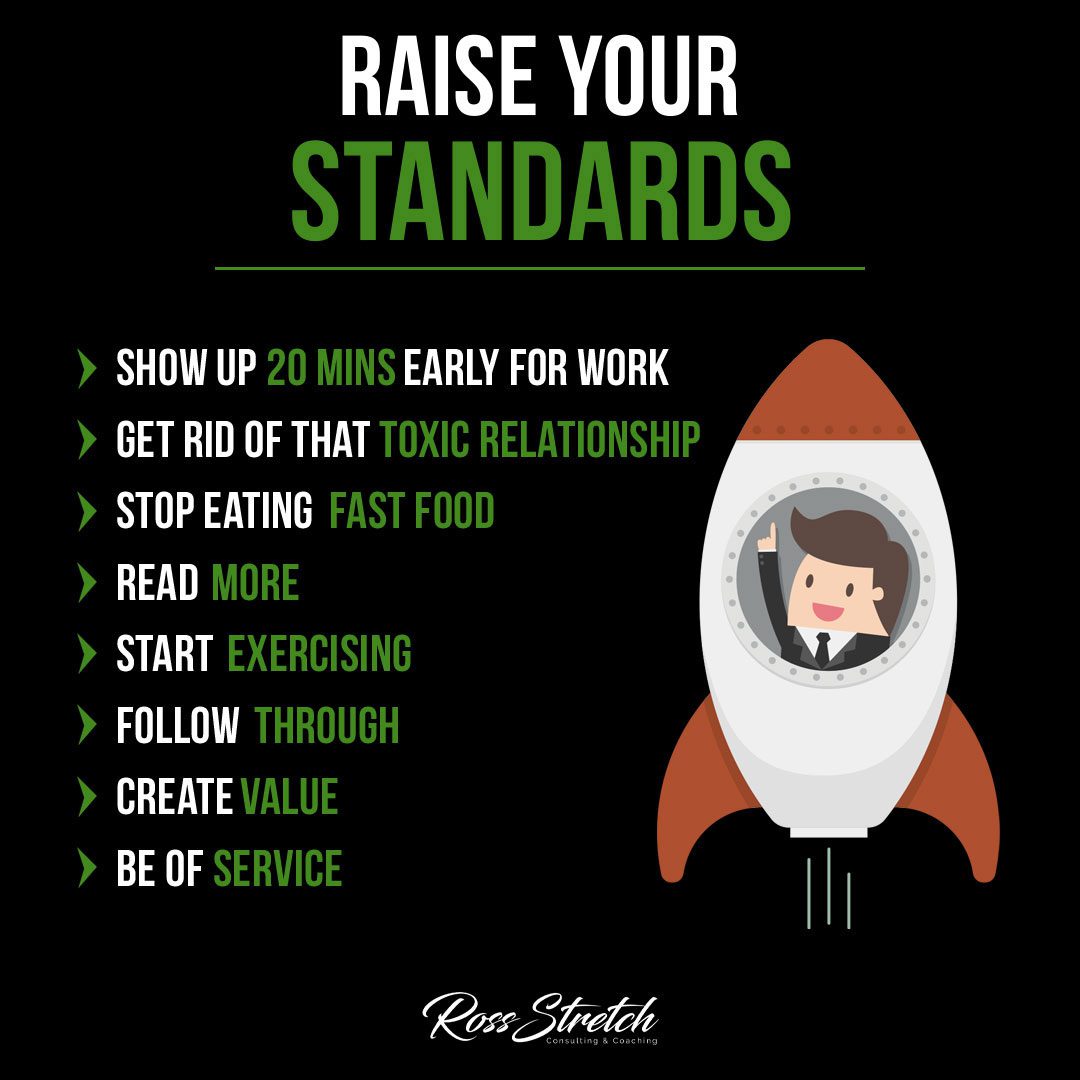
Most people set goals. Far fewer raise their standards. The difference is critical: goals are targets you aim for occasionally, while standards are the minimum level of performance you’re willing to accept — every day, in every area of your life. When you commit to raising your personal and professional standards, you aren’t just chasing better outcomes; you’re rebuilding the operating system that produces them. This guide walks through the key areas where higher standards create compounding results — and exactly how to make the shift stick.
Why Standards Matter More Than Goals
Goals are seasonal. Standards are permanent. You might set a goal to run a 5K, but if your standard is to move your body daily, the race becomes a natural byproduct. This distinction matters because most people set goals and revert to baseline behaviors when motivation dips — which it always does. When you raise your standard, the baseline itself shifts. Mediocrity becomes uncomfortable, not the norm.
Tony Robbins has long taught that the quality of your life is a direct reflection of the quality of your standards. High performers don’t just want more — they hold themselves to a different level daily. They don’t ask “Did I do enough?” They ask “Did I do my best?” That shift in question changes everything. You stop optimizing for comfort and start optimizing for growth. And unlike goals, which come and go, standards become embedded in your identity — which is what makes them durable.
Punctuality and Follow-Through: Respecting Others’ Time
Punctuality is one of the most visible signals of your standards. Arriving on time — or early — communicates that you value other people’s time as much as your own. It signals reliability, organization, and respect. These aren’t soft skills; they’re professional currency. The person who is chronically late sends a clear message: their time management isn’t yet at a standard that others can depend on.
The fix is simpler than most people admit. Planning ahead, building buffers into your schedule, and treating every commitment as a contract rather than a suggestion are the habits that build a reputation for reliability. And in business, reputation compounds — for better or worse. Whether you’re showing up for a client call, a job interview, or a team meeting, being the person who always arrives on time is a low-cost, high-return standard to adopt immediately.
Follow-through extends this further. When you say you’ll do something, do it. When you commit to a deadline, meet it. Accountability isn’t just about showing up — it’s about finishing what you start. This single standard separates high performers from people with good intentions and poor execution. Integrity, at its most practical, is simply doing what you said you’d do.
Nutrition, Fitness, and Physical Energy
Your physical energy is the foundation of everything else you want to accomplish. How you eat and whether you exercise are not just health decisions — they are performance decisions. You cannot build a high-performance life on a low-performance body. Poor nutrition creates brain fog, energy crashes, and reduced cognitive capacity. Regular movement, by contrast, improves mental clarity, mood, sleep quality, and long-term productivity.
Raising your physical standards doesn’t require an extreme diet or two-hour gym sessions. It requires consistency and intentionality. Prioritize whole foods over processed convenience meals. Build a movement habit that fits your life — whether that’s a 30-minute walk, a gym session, or a cycling class. The goal isn’t perfection; it’s raising the floor. When your standard is “I move my body daily and eat food that serves my health,” the results compound over months and years into a version of yourself that has far more energy to bring to your work and relationships.
Lifelong Learning: The Reading Habit That Changes Everything
The most successful people in the world are, almost without exception, voracious readers. Warren Buffett reportedly reads for several hours each day. Bill Gates reads 50 books a year. Elon Musk taught himself rocket engineering through books. Reading is the fastest and cheapest way to access the life experience, strategic thinking, and hard-won wisdom of the world’s best minds — and it’s available to anyone willing to commit the time.
If your current standard is “I read occasionally when I have time,” that’s not a reading habit — that’s reading by accident. Raise the standard to a daily practice. Even 20 minutes a day adds up to roughly 18 books per year. Diversify across genres: personal finance, biography, business strategy, science, and history will all make you a more capable and adaptable thinker. Set a target, track your reading, and treat it as non-negotiable. The knowledge advantage you accumulate is one of the few edges that truly compounds over a lifetime.
Relationships, Accountability, and Your Social Environment
The people you spend time with are not neutral influences — they actively shape your habits, beliefs, and expectations. Research in social psychology demonstrates that behaviors including financial habits, health choices, and levels of ambition spread through social networks. If your inner circle is defined by negativity, stagnation, or financial complacency, consistently outperforming those norms becomes an uphill battle.
Raising your relationship standards means being intentional about who gets access to your time. It means creating boundaries with people who drain your energy, and actively seeking out relationships with people who challenge, inspire, and hold you to a higher level. This doesn’t require cutting people off dramatically — it often just means investing more time in growth-oriented relationships and less in ones that anchor you in place. Find accountability partners, mentors, or communities where the standard of ambition is higher than your current one. Proximity to those people raises your game in ways no book or course can replicate.
Creating Value and Being of Service
The highest professional standard is not one of personal achievement — it’s one of contribution. The most successful and enduring businesses, careers, and leaders are those who consistently ask: “How can I create more value for the people I serve?” When your standard shifts from “What can I get?” to “What can I give?”, everything changes. You show up differently. You go deeper. You care more about the outcome.
This mindset also has a practical upside: value creation is the most direct path to income growth. Whether you’re an employee, entrepreneur, or freelancer, the people who advance fastest are those who consistently deliver more than expected. Service to others — through community involvement, mentorship, or simply doing your job with excellence — reinforces the habits of generosity and effort that define a genuinely high-standard life. The external rewards follow naturally when the internal standard is set correctly.
Conclusion: The Ongoing Work of Raising the Bar
Raising your standards is not a one-time decision — it’s a daily practice of choosing the slightly harder, slightly better path when it would be easy to coast. Start with one area: punctuality, nutrition, reading, or accountability. Build from there. As each new standard becomes your default, raise the bar again. Over years, the compounding effect of consistently elevated standards produces a life that looks exceptional from the outside, but feels entirely natural from the inside. That is the real reward of a high-standard life.
Resources
- Atomic Habits by James Clear — The foundational book on building lasting behavioral standards
- Tony Robbins: Raise Your Standards — A framework for identity-level change
- The Compound Effect by Darren Hardy — How small daily decisions build extraordinary results over time
- James Clear: Continuous Improvement — Practical strategies for raising the floor on your habits

 Ross Stretch