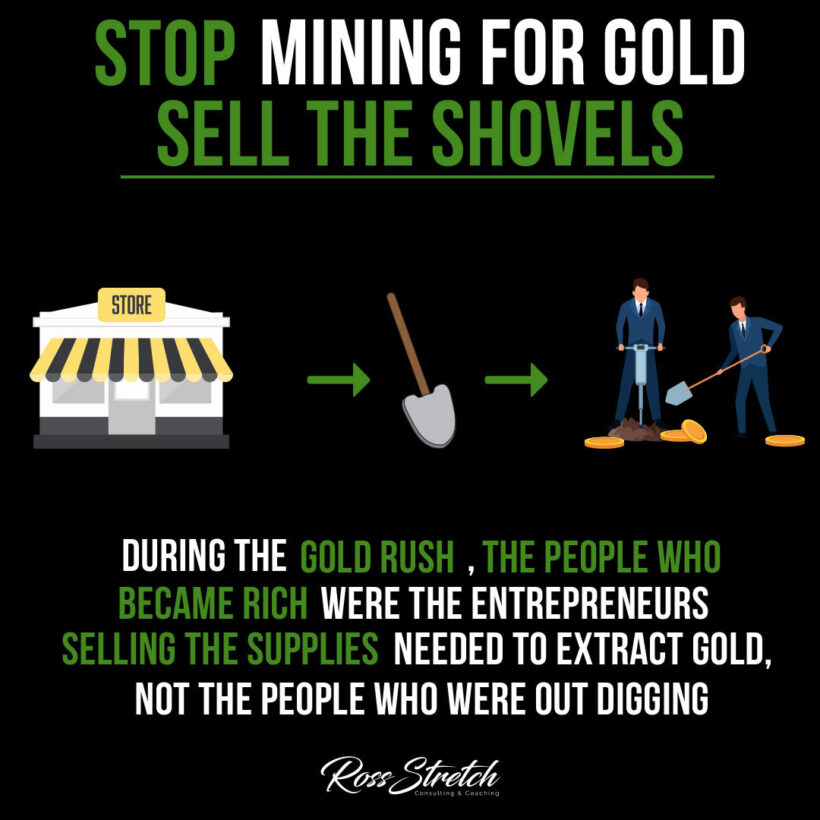

During the California Gold Rush of 1849, tens of thousands of miners flooded west chasing fortune. Most found nothing. But the merchants who sold them picks, shovels, and supplies built steady, reliable businesses regardless of who struck gold. That contrast — between chasing the prize and supplying the chase — is one of the most durable principles in entrepreneurship, and it’s more relevant today than ever. The real money in any gold rush is rarely in the gold.
What “Sell the Shovels” Actually Means
“Sell the shovels” means providing the tools, infrastructure, or services that enable an industry rather than competing within it. It means positioning your business one level removed from the primary competition — serving the people chasing the opportunity rather than chasing it yourself. Levi Strauss didn’t mine for gold; he sold durable denim pants to miners. Samuel Brannan didn’t dig; he bought up every pickaxe and shovel in San Francisco and resold them at a markup. Brannan became California’s first millionaire.
The principle holds because it inverts the risk profile of most entrepreneurial bets. When you compete in the main industry, your success depends on being better than everyone else chasing the same prize. When you sell shovels, your success depends only on the industry remaining active — and you benefit from the entire field, not just your corner of it. The miners compete with each other. You serve them all.
Why This Strategy Consistently Outperforms
The fundamental advantage of the shovel-seller position is structural. You face lower direct competition because most entrepreneurs are focused on the primary opportunity, not on what it requires. Your demand is driven by the industry’s activity level, not by your ability to beat everyone else within it. And because the people you serve have a genuine, ongoing need for your product or service, you build repeat customers rather than one-time transactions.
This model also scales differently than participating in the industry directly. Every new entrant to the primary market is a potential new customer for you. Growth in the industry you serve translates directly into growth for your business — without requiring you to capture market share from your peers. You’re not competing for a slice of the pie. You’re selling the equipment to everyone who is.
Risk is also materially lower. Shovel-sellers don’t need the market to produce winners — they need the market to remain active. During the dot-com boom, it didn’t matter which websites succeeded; Cisco, which sold the networking infrastructure, posted record revenues regardless. During crypto’s explosive growth phase, exchanges and wallet providers generated billions in fee revenue whether the underlying assets rose or fell.
Modern Examples of Selling the Shovels
The e-commerce boom produced far more Shopify millionaires than Amazon seller millionaires. Shopify didn’t compete with the merchants using its platform — it charged them a subscription to sell, take payments, and manage inventory. As e-commerce grew from a niche channel to the dominant retail format, Shopify’s revenue grew with every merchant who entered the space, regardless of whether those merchants succeeded individually. The platform won whether its users did or not.
The creator economy works identically. As millions of people attempt to build audiences on YouTube, Instagram, and TikTok, the real consistent winners are companies like Canva (design tools), Hootsuite (scheduling), Kajabi (course platforms), and ConvertKit (email marketing). These businesses serve creators across every niche without needing to build an audience of their own. Every new creator who enters the space is a potential customer — and the space adds new entrants daily.
Real estate offers another clear parallel. Buying and managing properties requires significant capital, carries vacancy risk, and demands operational complexity. But companies offering property management software, listing tools, real estate photography, or staging services profit from every transaction in the market without owning a single square foot. They benefit from the entire asset class being active — not from any individual property performing well.
How to Find Your Shovel in Any Industry
Identifying your shovel opportunity starts with a simple diagnostic: find a growing industry, map everything participants in that industry need to succeed, and look for gaps that aren’t well served. The best shovel businesses tend to address recurring needs — not one-time purchases — because recurring need creates recurring revenue and lasting customer relationships.
Look for friction. Where are participants in your target industry losing time, losing money, or experiencing consistent frustration? Those friction points are your opportunities. A fitness influencer who can’t manage their email list, a real estate agent who spends hours editing listing photos, a SaaS founder who can’t find affordable legal templates — each of these is a specific, solvable problem you can build a business around serving.
Specificity is your competitive advantage. “Marketing for businesses” is too broad. “Email marketing systems for e-commerce brands doing $500K to $5M in annual revenue” is a shovel. Narrow positioning allows you to speak directly to a defined buyer, develop deep expertise in their specific context, and charge accordingly. The narrower your focus, the less competition you face and the more you can charge for what you know.
Risks to Manage
The shovel strategy isn’t risk-free. The most significant risk is industry decline — if the primary market collapses or consolidates rapidly, demand for your supporting services drops with it. The solution is diversification across multiple industries or building transferable tools that serve adjacent markets. A project management platform that starts serving construction companies can expand to serve any project-driven business. Your shovel doesn’t have to be tied to one mine.
Commoditization is a secondary risk. If your shovel is easy to replicate, competitors will flood in once the opportunity is visible. The defense is continuous improvement, deep customer relationships, and building switching costs through integration and accumulated data. The best shovel businesses are not just useful — they become embedded in their customers’ workflows in ways that make leaving genuinely costly.
Conclusion
The Gold Rush lesson endures because human nature doesn’t change. Every new wave of opportunity — e-commerce, the creator economy, AI, clean energy, crypto — attracts waves of direct competitors, most of whom will fail. The people who build quietly durable businesses are often the ones who asked a different question: not “how do I win this race?” but “what does everyone running this race need?”
Before you chase the next gold rush, survey the landscape for shovels. Find the friction, solve it well, and charge for the solution. That path is less glamorous than striking it rich — and significantly more reliable.
Resources
- Harvard Business Review — Building Sustainable Competitive Advantage
- Entrepreneur — How to Find a Profitable Niche for Your Business
- Investopedia — Platform Business Models Explained
- Forbes — How to Find Your Niche and Succeed in Business


 Ross Stretch