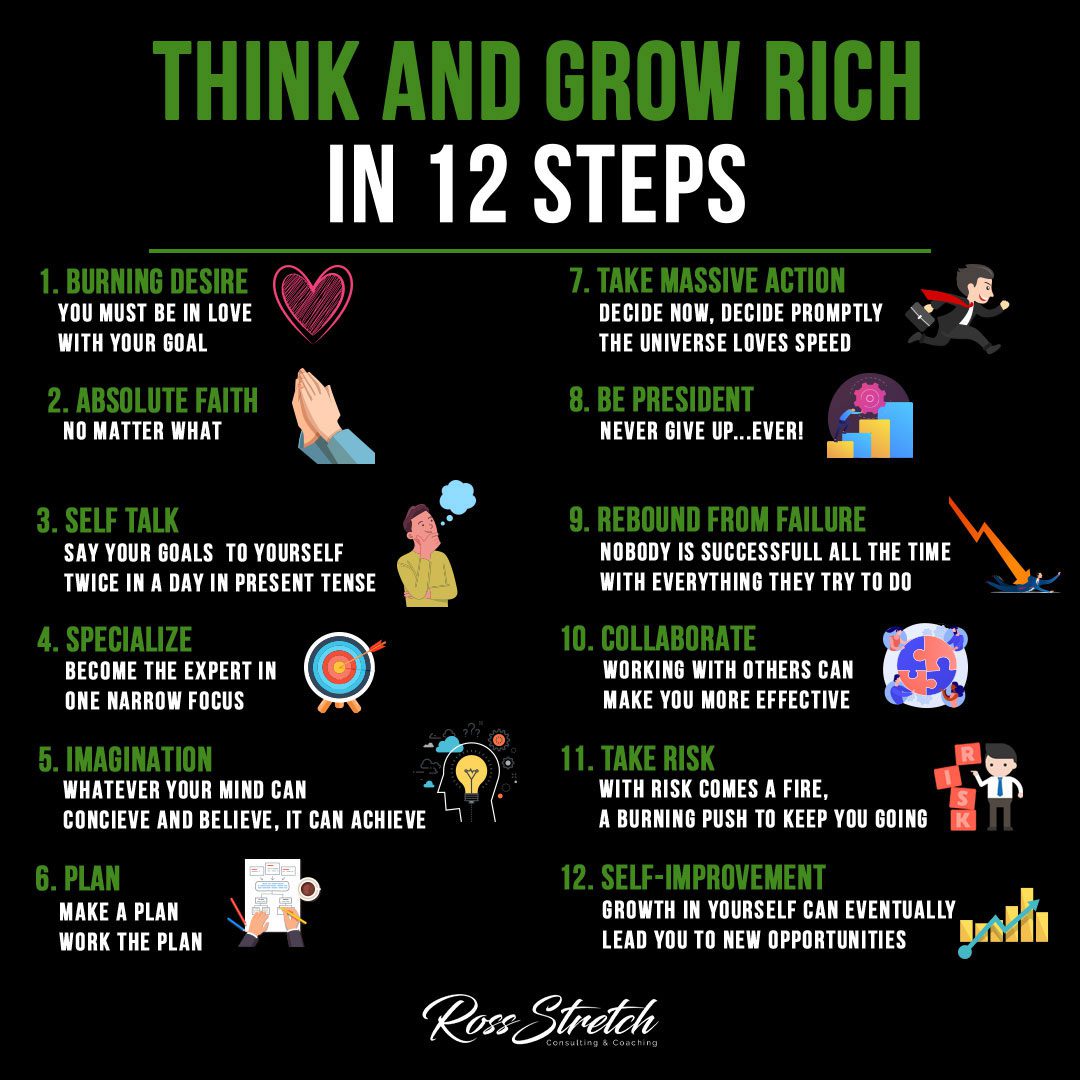
Published in 1937, Think and Grow Rich by Napoleon Hill remains one of the best-selling personal development books in history. After two decades studying more than 500 of the most successful individuals of his era — including Andrew Carnegie, Henry Ford, and Thomas Edison — Hill distilled their philosophies into a set of principles he believed anyone could apply to achieve financial success. The book is not simply about money; it’s about developing the mindset, systems, and habits that make financial prosperity a natural outcome rather than a matter of luck or circumstance. These 12 principles drawn from Hill’s framework provide a practical and timeless pathway for anyone serious about building wealth.
Overview
Hill’s central argument is that the starting point of all achievement is a specific, burning desire backed by unshakeable belief. Wealth begins as a thought before it becomes a reality. Alongside this foundational idea, Hill built a system that addresses the psychological barriers most people encounter on the path to financial success — from doubt and indecision to poor planning and lack of persistence.
What makes Think and Grow Rich enduring is its emphasis on internal conditions. Hill observed that the outer circumstances of wealthy individuals varied enormously across different industries, backgrounds, and starting points — but their inner operating systems were remarkably consistent. Mastering that inner system is what these 12 principles are designed to produce.
Key Lessons
1. Embrace a Burning Desire
Hill opens with desire because it is the root of every significant achievement. Not a vague wish or passive preference, but an intense, specific focus on a defined outcome. This level of desire provides the motivational fuel to persist when results don’t arrive on schedule and circumstances argue for giving up.
- Define your financial goal in specific terms — a concrete figure and a deadline, not a general aspiration.
- Review this goal daily to keep it active and prioritized in your thinking and decisions.
2. Cultivate Absolute Faith
Faith, in Hill’s framework, is an unshakeable confidence in your ability to achieve your goal. Doubt is the most corrosive force in the pursuit of wealth. Cultivating belief through visualization and consistent mental reinforcement keeps the mind oriented toward possibility rather than limitation and failure.
- Spend time each day visualizing your goal as already achieved in concrete, sensory detail.
- Identify the specific doubts that arise most often in your thinking and actively counter them with evidence.
3. Use the Power of Self-Talk
Positive affirmations, repeated consistently, reshape the internal narrative that governs behavior. What you tell yourself regularly becomes the lens through which you interpret opportunities and setbacks. Deliberate, constructive self-talk is not wishful thinking — it is intentional management of your mental environment.
- Write a personal affirmation statement aligned with your financial goal and read it aloud morning and evening.
- Notice negative self-talk patterns as they arise and interrupt them immediately rather than letting them run unchallenged.
4. Develop Specialized Knowledge
General knowledge has limited economic value. Specialized knowledge in a specific domain — and knowing how to apply it — is what creates commercial value. The people who build wealth are consistently those who become deeply expert at something others will pay for and who continuously deepen that expertise over time.
- Identify the specific skill or knowledge area most directly tied to your financial goal and invest in developing it with deliberate practice.
- Apply what you learn immediately — knowledge only becomes economically valuable through application.
5. Activate Your Imagination
Hill distinguished between synthetic imagination (recombining existing ideas in new ways) and creative imagination (accessing genuinely original insights). Both are valuable in building wealth. The ability to see possibilities that aren’t obvious to others is one of the most commercially valuable capacities a person can develop.
- Set aside regular time for unstructured thinking — no agenda, just open exploration of possibilities and new connections.
- Look for problems that others haven’t solved well. Dissatisfaction with the status quo is the seed of most business opportunities.
6. Create a Definite Plan
Desire without a plan is merely a wish. Hill insisted on written, specific plans with dates and milestones. The plan itself may evolve as circumstances change, but having one forces clarity about the gap between where you are and where you want to be — and what specifically you intend to do about it on a daily basis.
- Write a detailed, dated plan for achieving your financial goal — not a rough outline, but a specific sequence of actions with clear milestones.
- Review and update your plan regularly. A plan that adapts to new information is far more valuable than rigid adherence to an outdated one.
7. Make Decisions and Act on Them
Analysis paralysis is the enemy of wealth creation. Hill observed that successful people tend to make decisions quickly and change them slowly. Procrastination, by contrast, was among the most common causes of failure he encountered. A bias toward action — even imperfect action — is a genuine competitive advantage over those who wait for perfect conditions.
- Set a deadline for major decisions and honor it — gather the relevant information, then commit and move.
- Practice making smaller decisions faster to build the decision-making muscle where it matters before the stakes are highest.
8. Develop Persistence
Persistence, Hill wrote, is to character what carbon is to steel. Every person seeking financial success will encounter setbacks, rejection, and extended periods where results don’t match effort. Those who ultimately succeed are simply those who refuse to quit. Persistence isn’t stubbornness — it’s adaptability combined with an unwillingness to abandon the goal itself.
- Define in advance what you will do when your plan doesn’t produce expected results — this prevents reactive quitting in moments of discouragement.
- Track milestones and small wins to maintain momentum during long stretches without obvious progress.
9. Treat Every Failure as Data
Hill reframed failure entirely. In his framework, failure is not an endpoint but feedback — information about what doesn’t work that points more clearly toward what does. This mindset shift separates people who learn and iterate from those who quit after their first significant setback, never finding out how close they were.
- After every failure, conduct a brief review: what happened, what contributed to it, and what you would change next time.
- Collect examples of successful people who failed repeatedly before succeeding — they provide ongoing evidence that failure is a standard part of the process.
10. Build a Mastermind Alliance
Hill was an early advocate of what modern professionals call peer groups and strategic networks. He believed that two minds working toward a shared goal produce something greater than either could achieve alone. Surrounding yourself with people who are further along the path you’re walking accelerates growth in ways that solo effort simply cannot replicate.
- Identify two to five people whose knowledge and ambition complement yours and meet with them regularly with a shared agenda and purpose.
- Join professional communities in your field and contribute actively rather than passively consuming what others share.
11. Accept and Manage Calculated Risk
Wealth creation requires risk. Not reckless gambling, but calculated risk — the kind that comes from analysis, preparation, and a clear-eyed assessment of potential upside versus downside. Refusing all risk is itself a choice with consequences: it guarantees that outcomes will remain close to average, regardless of effort or intention.
- Evaluate opportunities using a simple risk-reward framework before committing: what’s the realistic upside, what’s the realistic downside, and can you absorb the downside?
- Start with smaller, recoverable risks to build your tolerance and judgment before scaling up your commitments.
12. Commit to Continuous Self-Improvement
The final principle is ongoing growth — a commitment to continuous learning, skill development, and personal development that never reaches a terminal point. The world changes, markets evolve, and skills that produced success in one context may need updating for the next. The person who stops learning gradually becomes irrelevant; the person who keeps learning remains positioned at the edge of the next opportunity.
- Read consistently in your field and across adjacent areas — the most innovative thinking often comes from connecting ideas across domains.
- Invest a portion of your income each year in courses, coaching, or experiences that expand your capabilities and perspective.
Key Takeaways
- Financial success begins in the mind: desire, belief, and self-talk are practical prerequisites for sustained effort, not soft concepts to be dismissed.
- Specialized knowledge applied with intention creates far more economic value than general information accumulated without application.
- Written plans with specific dates convert desire into actionable roadmaps that can be measured and adjusted over time.
- Persistence through failure is the single most consistent differentiator between those who eventually succeed and those who stop before they get there.
- Collaboration and continuous learning are force multipliers that accelerate every other principle in Hill’s framework.
Who Should Read This
Think and Grow Rich is worth reading for anyone who is serious about building financial independence and recognizes that the primary obstacle is often not a lack of opportunity but a lack of the right internal framework. It is particularly valuable for entrepreneurs, salespeople, and anyone transitioning from employment to self-directed wealth-building. If you’ve read it before, revisiting it at a different stage of life almost always surfaces principles you weren’t ready to absorb the first time.
Resources


 Ross Stretch