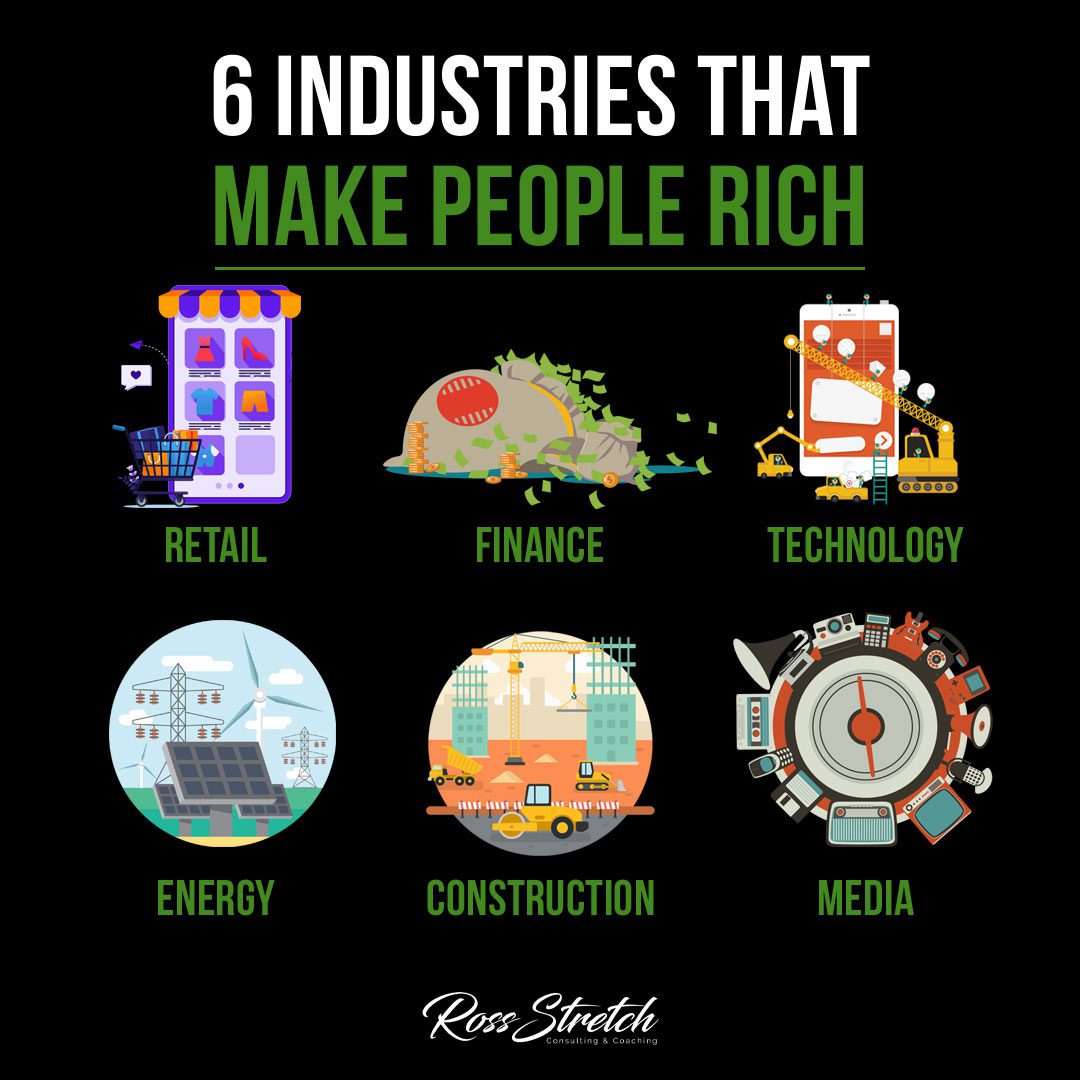
Wealth is rarely created in a vacuum. Certain industries consistently produce outsized returns for those who understand their mechanics, take strategic positions, and stay disciplined long enough to let compounding work. From ancient trade routes to modern digital platforms, the same fundamental principle holds: some sectors generate far more wealth than others, and knowing which ones — and why — gives you a meaningful edge. Here is an in-depth look at six industries that have made, and continue to make, people exceptionally wealthy.
1. Retail: The Marketplace of Wealth
Connecting Products to Consumers at Scale
Retail has been a cornerstone of wealth creation for centuries, and the digital revolution has amplified rather than diminished its power. The world’s wealthiest individuals include retail moguls like Jeff Bezos and the Walton family, whose fortunes were built on the straightforward premise of moving goods from producers to consumers more efficiently than anyone else. What makes retail powerful at scale is margin multiplication: the profit on any single transaction may be thin, but multiplied across millions of daily transactions, the numbers become extraordinary.
- Actionable Tip: Look for underserved niches where you can offer a superior product or customer experience. The most successful modern retail businesses compete on curation and service, not on price alone.
- Why It Works: Consumer demand is constant and growing. Whoever reliably fulfills that demand at scale — whether online or in person — captures significant margin over time and builds durable customer relationships.
Pro Tip: Control Your Supply Chain
The retailers who have built the most durable wealth don’t just sell products — they control how those products are manufactured and distributed. Owning or deeply influencing your supply chain dramatically increases your margins and competitive moat. Amazon’s massive investment in logistics infrastructure is the most visible modern example of this principle, allowing the company to deliver faster and cheaper than anyone else while capturing the economics that once went to third-party carriers.
2. Finance: The Art of Wealth Accumulation
Making Money Work for You
The finance industry doesn’t manufacture physical goods — it makes money move, grow, and compound. Banking, investment management, insurance, private equity, and venture capital all fall under this umbrella, and each has produced extraordinary concentrations of wealth. What sets finance apart is leverage: the ability to multiply returns using borrowed capital, other people’s money, or sophisticated financial instruments. When leverage is applied skillfully and responsibly, the results are transformative. The richest people in the world almost universally have deep financial knowledge, even if finance isn’t their primary industry.
- Actionable Tip: Even without working in finance professionally, you can apply its core principles. Invest consistently in index funds, understand how compound interest accelerates wealth over time, and ruthlessly avoid high-interest debt that works against you.
- Why It Works: Compound growth is the most powerful wealth-building mechanism available to ordinary individuals. Time in the market — not timing the market — is what builds lasting, meaningful wealth over a lifetime.
Pro Tip: Develop Financial Literacy Early
You don’t need to become a hedge fund manager to benefit from financial knowledge. Understanding how markets work, how businesses are valued, and how capital flows across an economy gives you an advantage in every financial decision you make — from negotiating your salary to evaluating a business investment. Financial literacy is a compounding asset just like capital itself.
3. Technology: Innovating Towards Fortune
The Sector That Rewrote the Rules of Wealth Creation
No industry has created more new wealth more rapidly than technology. Over the past three decades, software, the internet, mobile computing, and artificial intelligence have produced more billionaires than any other sector in history. The reason is elegantly simple: technology businesses can scale to serve millions of users at near-zero marginal cost. Once a software platform is built, adding the millionth user costs almost nothing — a dynamic that simply doesn’t exist in industries that require physical resources to grow. This scalability is the engine of the extraordinary valuations technology companies command.
- Actionable Tip: You don’t need to be an engineer to benefit from the technology sector. Learning to leverage no-code tools, developing digital marketing expertise, or building a tech-adjacent business positions you to capture growth without writing a single line of code.
- Why It Works: The scalability of digital products means the ceiling on potential returns is dramatically higher than in businesses that require proportional physical resources to grow. A software product built once can be sold an unlimited number of times.
Pro Tip: Focus on Problems, Not Features
The technology companies that have generated the most wealth aren’t necessarily the most technically sophisticated — they’re the ones that solved real, widespread problems in ways that were faster, cheaper, or simpler than existing alternatives. Start with the problem, not the product, and the technology becomes the means to an end rather than an end in itself. This problem-first thinking is what separates enduring tech companies from impressive demos.
4. Energy: Powering Wealth Creation
The Industry the World Cannot Function Without
Energy is the original industry of wealth. From the oil barons of the early 20th century to the clean energy entrepreneurs of today, those who control energy supply wield enormous economic power. The global energy transition currently underway — from fossil fuels toward renewables — is creating new fortunes while disrupting established ones. This transition represents one of the largest capital reallocation events in human history, with trillions of dollars moving into clean energy infrastructure over the coming decades as governments and corporations race to meet emissions targets and energy security goals.
- Actionable Tip: Watch where government subsidies, infrastructure investment, and regulatory momentum are flowing in the energy sector. These policy signals often precede significant wealth creation opportunities in specific segments of the market.
- Why It Works: Energy markets are driven by policy as much as by pure market forces. Understanding the regulatory environment gives you an edge in identifying where capital will flow next and which companies are best positioned to capture it.
Pro Tip: Consider Energy as an Investment Theme
Even without starting an energy company, investors can participate in the sector’s wealth creation through ETFs focused on clean energy, infrastructure REITs, or individual stocks in companies positioned for the energy transition. The key is understanding which parts of the value chain — generation, storage, distribution, or energy efficiency — are likely to win as the industry evolves over the next decade.
5. Construction: Building Foundations for Wealth
The Industry That Builds Everything Else
Construction is easy to overlook as a wealth-creation vehicle because it lacks the glamour of tech or finance. But the numbers tell a different story. The global construction industry generates over $13 trillion annually and produces lasting, appreciating assets. Every road, building, bridge, and data center that gets built requires construction expertise — and the people who understand how to manage those projects, control costs, and own the underlying real estate capture enormous value over time. Many of the wealthiest real estate developers in the world built their fortunes by combining construction knowledge with real estate ownership.
- Actionable Tip: If you’re interested in construction-adjacent wealth building, start by developing expertise in real estate development — understanding zoning, permitting, financing, and project management before taking on larger, capital-intensive projects.
- Why It Works: Real estate built through construction typically appreciates in value while simultaneously generating rental income. The combination of asset appreciation and ongoing cash flow is one of the most reliable wealth-building formulas available.
Pro Tip: Specialize in High-Demand Niches
The most profitable construction businesses don’t try to do everything. Specializing in high-demand segments — data center construction, sustainable building, or high-end residential development — commands premium pricing and reduces head-to-head competition. Find the niche where your expertise creates a genuine competitive advantage, then build a reputation that makes price a secondary consideration for clients who need what you specifically offer.
6. Media: Shaping Minds and Making Money
Attention Is the New Currency
In an economy where the average person consumes hours of content daily, the ability to capture and hold attention is enormously valuable. The media industry has always generated wealth — from newspaper empires to television networks — but the digital age has fundamentally democratized access to audiences. Today, an individual creator with the right content and distribution strategy can build a media business worth millions without the backing of a traditional media company. Newsletters, podcasts, YouTube channels, and subscription communities have all produced significant wealth for individuals who understood how to build loyal audiences.
- Actionable Tip: Build an audience around a specific expertise or distinctive perspective. The narrower and more focused your content, the more loyal and monetizable your audience tends to be. Niche media consistently outperforms general content in engagement, conversion, and advertiser value.
- Why It Works: A loyal, engaged audience is a durable asset that can be monetized through advertising, sponsorships, digital products, courses, memberships, and more. The revenue streams available to media businesses have never been more diverse or accessible.
Pro Tip: Own Your Platform
Social media audiences are rented, not owned. Build your media presence on platforms you don’t control, but consistently migrate your most engaged followers to assets you do own — an email list, a podcast feed, a membership community. When algorithms change, and they always do, owned audiences are the ones that survive and sustain your business through the disruption.
Conclusion: Navigating the Industries of Wealth
Each of these six industries has produced extraordinary wealth — and each carries its own unique risks, capital requirements, and learning curves. The common thread among those who succeed in them isn’t just access or initial capital; it’s a deep understanding of industry dynamics, the willingness to take calculated risks, and the patience to let compounding work over time. You don’t need to master all six — you need to pick the one that best aligns with your skills and interests, go deeper than your competition, and stay committed long enough to capture the rewards that consistency produces.
Resources
- Investopedia: Industries Creating the Most Millionaires — data-driven breakdown of wealth concentration by sector
- Forbes Billionaires List — track which industries are producing the world’s wealthiest individuals year over year
- The Millionaire Next Door by Thomas Stanley — research on where real, lasting wealth is actually built in America
- CB Insights Research — follow capital flows across technology and emerging industries to spot wealth-creation trends early


 Ross Stretch