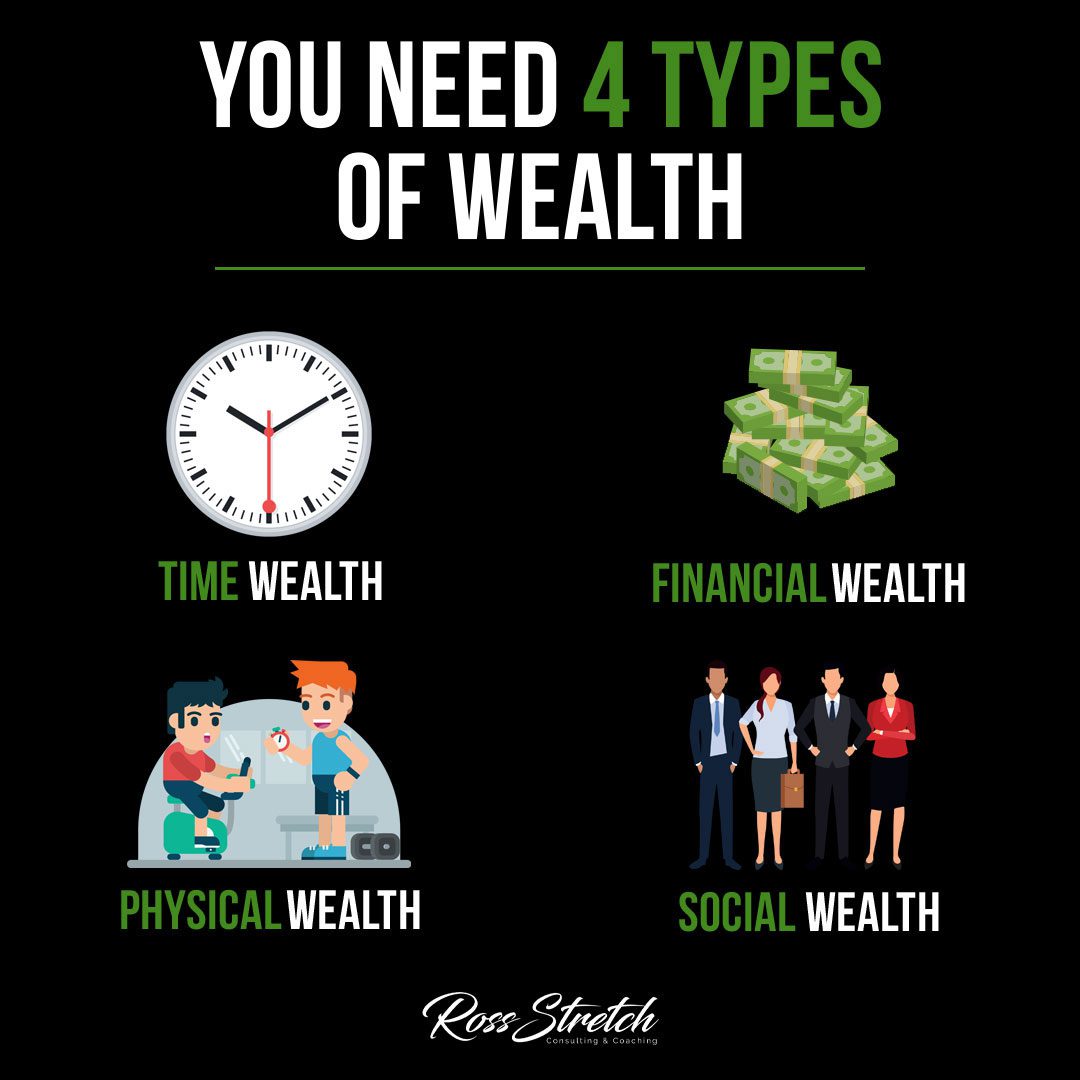
When most people think about wealth, they think about money. But financial abundance alone doesn’t produce a rich life — and the evidence for this is everywhere. High earners who are chronically exhausted, physically depleted, and disconnected from meaningful relationships consistently report lower life satisfaction than people with more modest incomes who have managed their time, health, and connections well. True prosperity requires developing and maintaining four distinct types of wealth, each of which reinforces the others. Neglect any one pillar, and the entire structure becomes unstable — no matter how impressive the bank balance looks on paper.
1. Time Wealth
Freedom Over How You Spend Your Hours Is the Most Undervalued Form of Wealth
Time wealth means having genuine discretion over how you allocate your most finite resource. It’s not simply about working fewer hours — it’s about eliminating obligations that don’t align with your values, and preserving your hours for work and activities that are genuinely meaningful. Many people who have accumulated significant financial wealth discover, paradoxically, that they have almost no time wealth. Their calendar is owned by their business, their clients, or their organization, and they feel perpetually behind despite their financial success.
- Actionable Tip: Conduct a weekly time audit — track every hour for one full week and categorize each block as either high-value (aligned with your goals and values) or low-value (habitual, obligatory, or merely convenient for others). Identify the three largest low-value time drains and systematically eliminate or delegate them.
- Why It Works: Most people spend their time reactively — responding to what’s urgent rather than what’s important. A time audit makes the unconscious conscious, providing the data needed to make deliberate choices about your most finite and irreplaceable resource.
Pro Tip:
Building time wealth is directly tied to financial strategy in a specific way: the higher your income per hour worked, the more efficiently you can buy back your time. Investing in skills, systems, and team members that allow you to earn more per hour — rather than simply working more hours — is the leverage point that unlocks time wealth without sacrificing financial progress. This is why high-value skill development is always a priority investment.
2. Financial Wealth
True Financial Wealth Is About Options, Not Just Accumulation
Financial wealth is not simply about having money — it’s about having enough financial resources that you can make important life decisions based on what you value rather than what you can afford. The professional who remains in a career they hate because they can’t financially afford to leave has income but not genuine financial wealth. The person who has built a portfolio generating passive income has something more valuable: the resources to say yes to opportunities and no to obligations that don’t serve them.
- Actionable Tip: Calculate your personal freedom number — the invested assets required to generate enough passive income to cover your essential expenses at a safe withdrawal rate of 3-4%. This gives you a concrete, measurable target to work toward rather than the vague aspiration of simply being wealthy.
- Why It Works: Financial independence — the point at which your assets work for you rather than the other way around — is a concrete and achievable goal for anyone who builds the right habits early enough. Giving it a specific number makes it plannable rather than merely aspirational.
Pro Tip:
Prioritize building financial wealth in the sequence that minimizes tax drag and maximizes compound growth: eliminate high-interest debt first, build a solid emergency fund, then maximize tax-advantaged retirement accounts before investing in taxable accounts. This sequence is not glamorous, but followed consistently over a decade, it produces outcomes that feel transformational when compared to approaches that skip or reorder these steps.
3. Physical Wealth
Your Health Is the Asset That Makes Everything Else Possible
Physical wealth is your health, vitality, energy, and physical capacity. It’s easy to treat health as something separate from financial and professional strategy, but the connection is direct and significant. Chronic health issues are among the leading causes of financial hardship — through reduced earning capacity, high medical expenses, and the compounding effect of operating at reduced cognitive and physical performance for years or decades. Conversely, excellent health produces the cognitive sharpness and sustained energy needed to pursue ambitious professional and financial goals at full capacity.
- Actionable Tip: Identify the three most important health habits for your specific situation — typically some combination of consistent sleep (seven to nine hours), regular strength training or cardiovascular exercise (at least three to four days weekly), and meaningful dietary improvements — and treat them with the same non-negotiable commitment you give your most critical professional responsibilities.
- Why It Works: Physical health is the foundation on which time wealth, financial wealth, and social wealth are all built. Without it, the other pillars erode: cognitive function declines, energy for meaningful relationships diminishes, and the capacity for sustained productive work decreases steadily. Prevention is dramatically cheaper than treatment — in both money and quality of life.
Pro Tip:
Consider what you currently spend monthly on insurance premiums, subscriptions, and discretionary items, then ask honestly whether your health habits are receiving proportional investment of time and money. Routine preventive care, consistent exercise, adequate sleep, and quality nutrition represent among the highest-ROI investments available — not just for longevity, but for the quality of performance and life you experience every single day between now and then.
4. Social Wealth
The Quality of Your Relationships Determines the Quality of Your Life
Social wealth is the value generated by your relationships — the quality and depth of your friendships, family connections, professional network, and sense of community belonging. Harvard’s famous 80-year longitudinal study on adult development — one of the longest studies of its kind ever conducted — found that close relationships, more than money, fame, or professional achievement, were the strongest predictor of health and happiness in later life. The people who reported the most satisfying relationships at age 50 were consistently the healthiest at age 80.
- Actionable Tip: Identify the five relationships in your life that matter most — professionally and personally — and schedule specific, recurring time with each of them. Strong relationships don’t maintain themselves on goodwill and good intentions; they require consistent investment of time, attention, and presence to remain vibrant over years and decades.
- Why It Works: Social wealth creates compounding returns that parallel financial wealth. Strong relationships provide emotional support during adversity, generate professional opportunities through warm introductions, accelerate learning through knowledge sharing, and produce the sense of belonging that sits at the center of psychological well-being and life satisfaction.
Pro Tip:
Building social wealth also means being intentional about the quality — not just the quantity — of your relationships. Invest time in people who challenge your thinking, model the behaviors you want to develop, and genuinely want to see you succeed. The people you spend the most time with shape your habits, your beliefs, and your trajectory more powerfully than almost any other factor — making relationship selection one of the highest-leverage decisions in a well-designed life.
Conclusion
True wealth is a four-dimensional concept. Financial resources provide options and security. Time freedom allows you to direct your life according to your own priorities. Physical health gives you the energy and cognitive capacity to pursue your goals fully. And rich, meaningful relationships make the entire endeavor worthwhile. These four pillars are interdependent — strength in each one reinforces the others, and neglect in any one eventually weakens the whole structure. Building a truly rich life means developing a clear picture of where you currently stand in each dimension, making intentional investments to strengthen your weakest areas, and never sacrificing one pillar entirely at the altar of another. Wealth, in its fullest sense, is not just what you accumulate — it’s what you get to do with your one life.
Resources


 Ross Stretch