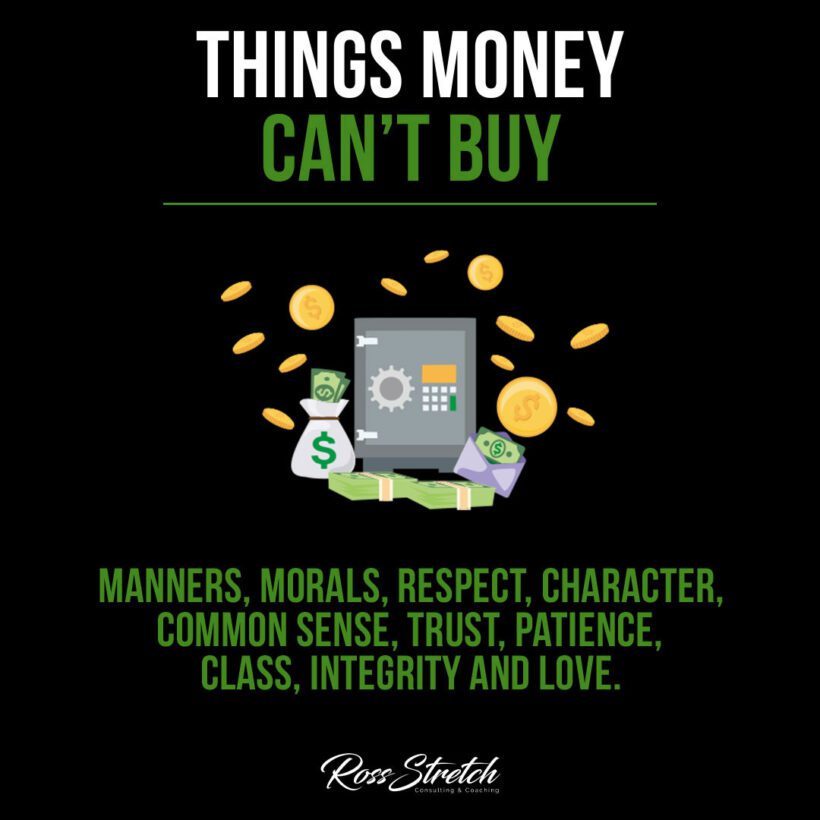

There is a category of wealth that doesn’t appear on any balance sheet. It cannot be purchased online, inherited with an estate, or acquired through a raise. Yet it shapes every meaningful dimension of a person’s life — their relationships, their reputation, their inner peace, and the legacy they leave behind. People who possess this intangible wealth lead richer lives by every meaningful standard. People who pursue money at its expense often find themselves materially comfortable and spiritually hollow. Understanding what money can’t buy isn’t a case against financial ambition — it’s an argument for pursuing it without sacrificing the things that make success worth having.
Manners and Morals: The Foundation of Character
Good manners are among the most underrated success factors in professional and personal life. The ability to listen attentively, acknowledge others, express genuine gratitude, and treat people with basic dignity isn’t learned in a boardroom — it’s developed through consistent practice and genuine regard for others. And while manners might seem soft compared to technical skills or financial acumen, research in organizational psychology consistently shows that interpersonal skills are among the top predictors of leadership effectiveness, career advancement, and team cohesion.
Morals are the deeper layer beneath manners. Where manners govern behavior in social situations, morals govern behavior when no one is watching. A person with strong moral principles makes the same decision whether they’re being evaluated or operating in private. This consistency creates integrity — arguably the most valuable professional asset a person can build over a career. Businesses built on ethical foundations outperform those driven purely by short-term profit over meaningful time horizons, a pattern borne out by decades of corporate governance research.
The challenge is that neither manners nor morals can be acquired through transaction. They are cultivated through upbringing, self-reflection, mentorship, and the deliberate practice of choosing what’s right over what’s convenient. No amount of money accelerates their development. They require only time, attention, and the willingness to be honest about where you fall short.
Respect and Trust: The Currency of Deep Relationships
Respect is often confused with status. A CEO may command deference — but that’s positional authority, not respect. Genuine respect is earned through consistent behavior, follow-through, and the demonstrated capacity to value others regardless of their rank or utility to you. It doesn’t care about income levels, social media followers, or the neighborhood you live in. And unlike authority, it cannot be revoked by a board vote or a market crash.
Trust functions similarly. In professional contexts, trust reduces friction, accelerates decision-making, and enables the kind of delegation that allows businesses to scale. In personal life, trust is the bedrock of every meaningful relationship. It takes years to build and moments to destroy — which is why people who understand its value guard it with unusual care. No negotiation skill, no marketing strategy, and no amount of money can replicate the long-term advantage of being known as someone who does what they say.
For entrepreneurs and professionals building reputations over the long arc of a career, these qualities matter especially. The referrals, partnerships, and opportunities that flow from being deeply trusted are worth more than any advertising budget. The best business development strategy in most industries remains simply this: be someone people trust completely, and let that reputation do the work.
Patience, Common Sense, and the Power of Delayed Gratification
In a culture obsessed with speed and instant results, patience has become genuinely rare — and therefore genuinely valuable. Every meaningful financial outcome requires it. Index funds compound over decades. Businesses take years to become profitable. Skills take thousands of hours to master. The people who build real wealth in any domain are almost universally distinguished by their ability to stay the course through the inevitable periods of stagnation and setback.
Common sense is similarly underrated. It’s the capacity to assess a situation clearly, cut through noise, and identify the most practical path forward. Not every high-stakes decision requires an MBA or a consultant. Sometimes the best next step is visible to anyone willing to slow down and think honestly. Common sense can’t be bought. It’s developed through experience, failure, and the discipline to examine outcomes honestly rather than explaining them away.
Together, patience and common sense underpin the kind of judgment that distinguishes people who make consistently good decisions from those who lurch between trends and crises. These qualities don’t trend on social media and they don’t make for compelling content — but they show up quietly and reliably in the lives of people who seem to consistently land on their feet.
Integrity, Love, and the Bonds That Actually Last
Integrity is alignment. It’s the state of being the same person in public that you are in private — the absence of a gap between your stated values and your actual behavior. In an era of curated personal branding and performative authenticity, real integrity is a competitive differentiator. People sense it, even when they can’t articulate why someone feels trustworthy and another doesn’t. Over a career, being known as a person of integrity is worth more than almost any credential or credential combination.
Love and genuine human connection occupy a different category entirely. No amount of financial success compensates for isolation. The research on this is unambiguous: meaningful relationships are the single strongest predictor of life satisfaction, health, and longevity. Harvard’s 85-year Study of Adult Development — one of the longest-running studies on human flourishing ever conducted — found that the quality of a person’s relationships was a more reliable predictor of late-life health and happiness than cholesterol levels, income, or professional achievement. The relationships you build through genuine care, presence, and investment of time are among the most valuable assets you will ever accumulate.
Why These Qualities Matter More Than Net Worth
The most practically successful people tend to be those who cultivate both financial capability and character. Neither alone is sufficient. Financial security without character produces people who are difficult to work with, impossible to trust, and surrounded by relationships built on transaction rather than genuine connection. Character without financial foundation produces people who are admirable but perpetually stressed, unable to build on their values because they’re trapped in survival mode.
The synthesis is what ambitious professionals should be building toward: the financial foundation that removes scarcity-driven anxiety, combined with the character that makes the resulting freedom meaningful. Manners, morals, trust, patience, integrity, and love aren’t soft extras that come after the money is made. They are the operating system that determines whether the money, when it arrives, produces a life worth living.
Conclusion
Money is a powerful tool. But the qualities that make you worth knowing, worth trusting, and worth being around are the ones that compound most reliably over a lifetime. They require no startup capital and no special access. They require only the consistent decision to act with integrity, invest in relationships, cultivate patience, and choose long-term meaning over short-term comfort. That is a form of wealth available to everyone — and it is the foundation on which every other kind of wealth is most securely built.
Resources
- Harvard Study of Adult Development — the world’s longest-running study on what makes a good life
- The Good Life by Robert Waldinger and Marc Schulz — insights from the Harvard longitudinal study on relationships and fulfillment
- The Road to Character by David Brooks — a compelling case for building inner virtues alongside external success
- Greater Good Science Center (UC Berkeley) — research on gratitude, compassion, and character development

 Ross Stretch