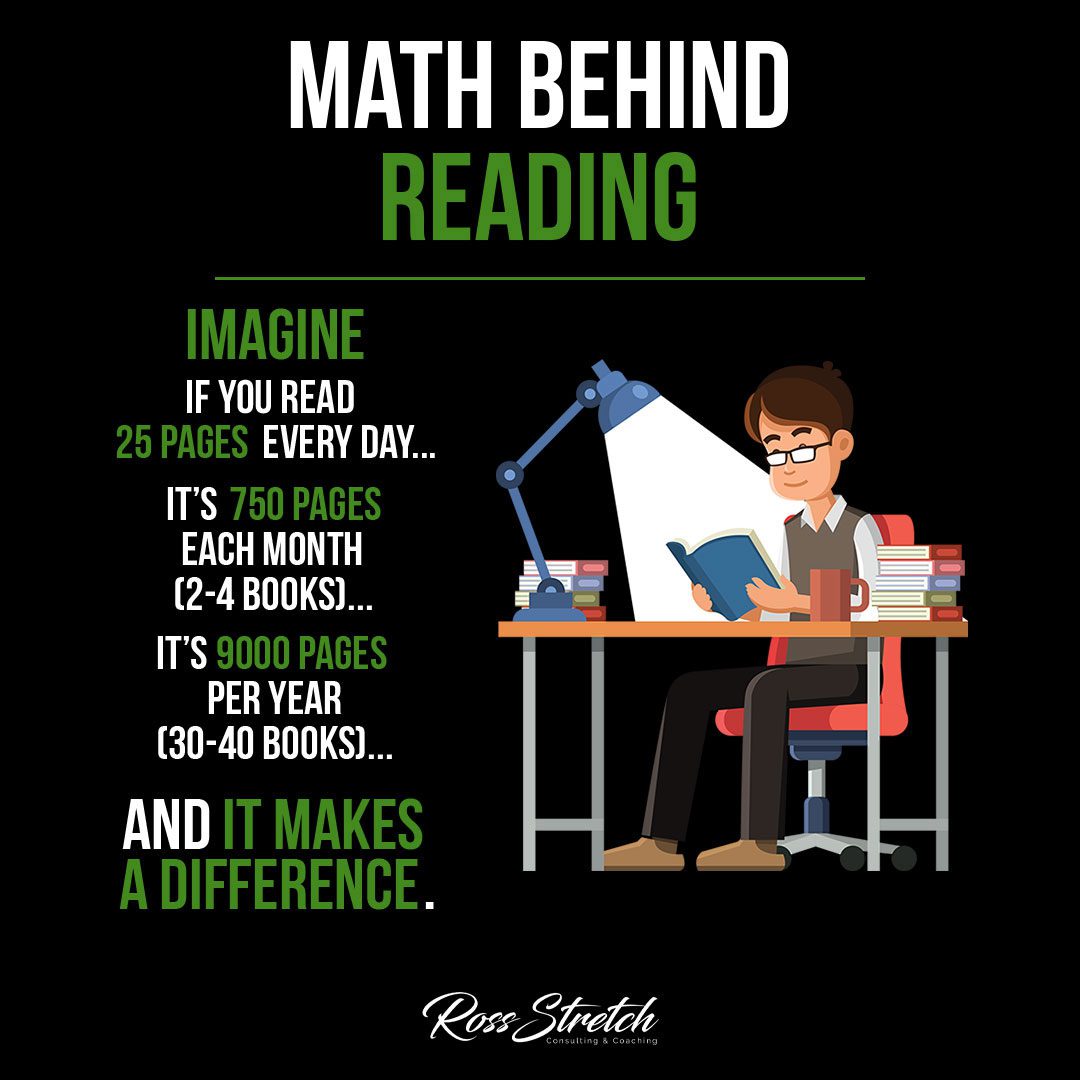
Most people dramatically underestimate how much they could learn if they simply read more consistently. Not two hours every night — just a modest daily reading habit of 25 pages. It sounds unremarkable until you run the numbers. At that pace, you finish 30 to 40 books per year, absorbing frameworks and perspectives from some of the most accomplished thinkers and practitioners in the world. This article breaks down the math behind reading, what it actually adds up to over time, and how to build the habit that makes it sustainable.
\
\
\
\
The Daily Commitment: Why 25 Pages Is the Right Number
\
\
Twenty-five pages takes most readers between 20 and 40 minutes, depending on the density of the material. That’s roughly the time you might spend scrolling your phone before bed, sitting in a waiting room, or commuting. It requires no special schedule, no dedicated reading space, and no extraordinary willpower. It just requires intention and a book nearby.
\
\
The power of 25 pages isn’t in any single session — it’s in the accumulation. Reading is one of the rare activities where benefits compound over time in a way that’s difficult to see day to day but undeniable at the end of a year. Each book you finish adds a new framework, a new perspective, or a new set of practical tools that you carry into everything you do afterward. Stack 30 to 40 of those per year, and you are a meaningfully different thinker than you were twelve months ago.
\
\
The choice of 25 pages is also intentional from a habit-design perspective. It’s ambitious enough to feel meaningful but modest enough that skipping feels like more of an inconvenience than just reading. That friction matters. When the default behavior is to read, the habit sustains itself with far less effort than more aggressive targets that lead to streaks, guilt, and abandonment.
\
\
\
\
Monthly Milestones: 750 Pages and 2 to 4 Books
\
\
Twenty-five pages per day adds up to 750 pages in a month. The average nonfiction book runs between 200 and 350 pages, meaning you’re finishing two to four books every single month. In practice, this gives you room to move between genres and formats — a dense business strategy book one month, a faster-reading memoir the next, an investing classic after that.
\
\
The variety matters. Reading across different domains accelerates the kind of cross-disciplinary thinking that drives creativity and better problem-solving. The person who has read broadly across history, psychology, business, and science sees patterns and connections that a narrower reader misses. A monthly pace of two to four books keeps your reading portfolio diverse enough to make that kind of thinking possible.
\
\
Two books a month also sustains momentum. You’ll finish books frequently enough that reading feels productive rather than like a slow trudge through an endless volume. The regularity of completion is an underrated motivator — each finished book reinforces the habit and builds confidence that you’re genuinely making progress.
\
\
\
\
The Annual Impact: 30 to 40 Books a Year
\
\
Annualized, 25 pages per day yields roughly 9,000 pages and 30 to 40 books completed. Put that in perspective: the average adult reads fewer than five books per year. At a 25-page daily pace, you’d be reading six to eight times more than the average person — while spending less than an hour a day doing it.
\
\
Over five years, that’s 150 to 200 books. Over ten years, 300 to 400 — a personal library of knowledge spanning entrepreneurship, personal finance, history, human psychology, leadership, science, and whatever else you choose to explore. The cumulative advantage of that knowledge base compounds in the same way that financial investments do: slowly at first, then faster and faster as the breadth of your understanding deepens and ideas from different domains begin to connect.
\
\
The people who are consistently excellent in their fields — whether in business, medicine, law, or any other discipline — almost universally have a serious reading habit. It’s not coincidence. Reading at scale is one of the most reliable ways to develop the judgment, perspective, and mental models that drive genuinely good decisions over the long run.
\
\
\
\
What You Actually Gain From Reading This Much
\
\
The benefits of consistent reading go well beyond information accumulation. Reading widely and regularly builds vocabulary, improves writing clarity, deepens analytical thinking, and develops the capacity to hold complex ideas simultaneously. These are transferable skills that show up directly in professional performance, communication, and decision-making quality.
\
\
- \
- Expanded knowledge base across multiple disciplines and perspectives
- Stronger critical thinking and pattern recognition from exposure to diverse arguments
- Improved writing and communication skills absorbed from well-crafted prose
- Greater empathy and emotional intelligence developed through biography and narrative
- A growing library of frameworks and mental models to apply in real situations
\
\
\
\
\
\
\
There’s also a less quantifiable benefit: reading is one of the few activities that provides genuine intellectual stimulation while also being restorative. Unlike scrolling social media — which occupies attention without enriching it — reading a good book leaves you with something durable to show for the time spent. Most consistent readers describe their habit as one of the clearest contributors to their sense of forward momentum and ongoing personal growth.
\
\
\
\
How to Build and Sustain the Reading Habit
\
\
Building the 25-pages-a-day habit is mostly about making it easy. Start by keeping your current book somewhere you’ll always see it — on your nightstand, in your bag, or on your desk. Attach reading to an existing routine: right after your morning coffee, during lunch, or as the last thing you do before sleep. The fewer decisions you have to make about when and where you’ll read, the more consistently you’ll do it.
\
\
If you lose interest in a book, stop reading it and pick up something you’re genuinely curious about. Forcing yourself through a book you don’t care about is one of the most reliable ways to kill the habit. There are more great books than you could read in a lifetime — never feel obligated to finish one that’s not serving you. Permission to abandon books that bore you is not laziness. It’s smart habit maintenance.
\
\
Track what you read. Goodreads and similar apps make it easy to log books, set annual goals, and review what you’ve finished. The act of tracking reinforces the habit and makes it easier to appreciate the progress you’ve made. When you can see thirty-five books logged at the end of December, you understand viscerally how a small daily habit produces remarkable results over time.
\
\
\
\
Conclusion
\
\
The math behind reading is simple and the implication is clear: a modest daily commitment produces outsized annual results. Twenty-five pages a day is all it takes to finish 30 to 40 books a year, build a deeper knowledge base than nearly everyone around you, and develop the kind of broad-based thinking that drives better decisions in every area of life. The question isn’t whether you have time to read. The question is whether you’re willing to treat it as the priority it deserves to be.
\
\
\
\
Resources
\
\
- \
- Goodreads — Track your reading, discover new books, and set annual reading goals with a community of millions of readers
- Solve the Problem of Not Reading Enough — James Clear — Practical strategies for building and sustaining a consistent reading habit that actually sticks
- How to Read a Book by Mortimer Adler — The classic guide to reading actively and extracting maximum value from every book you finish
- Blinkist — Key ideas from nonfiction books in 15-minute audio and text summaries, useful for previewing books before committing
\
\
\
\

 Ross Stretch