Jack Ma is not the most obvious career advisor. He was rejected from Harvard ten times, failed his college entrance exam twice, and was turned down for dozens of jobs — including a position at KFC where 23 of 24 applicants were hired and Ma was the one who wasn’t. He went on to found Alibaba, one of the most valuable companies in history. The path was not linear, and the career advice he draws from that experience reflects lived complexity in ways that conventional career guidance rarely does.
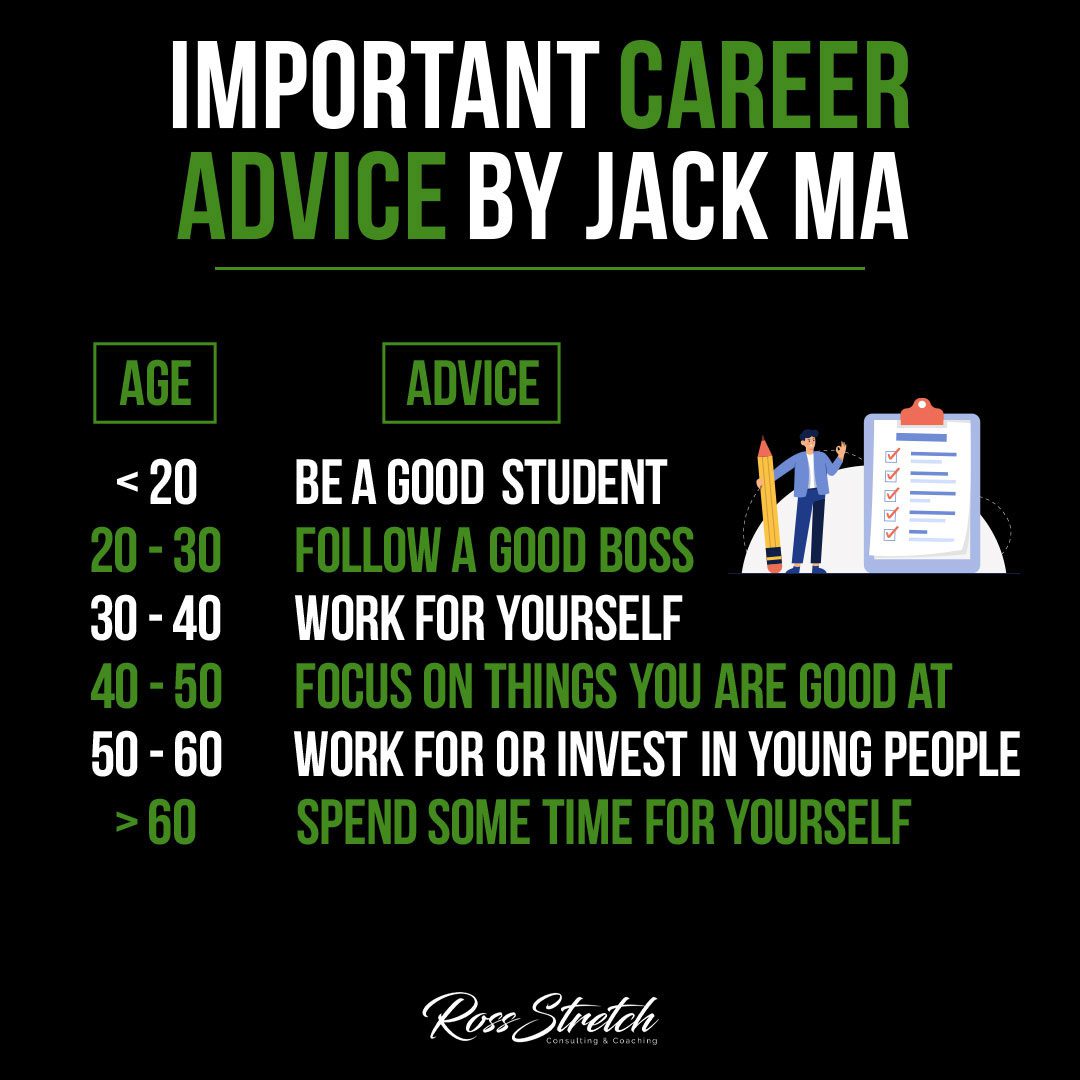
What makes Ma’s framework compelling is its structure. Rather than offering general principles, he breaks professional life into decade-by-decade priorities — specific orientations for each stage of life that determine whether your cumulative effort builds toward something meaningful or dissipates in activity without direction. Getting the right priority right at the right time, he argues, is what separates people who build something lasting from those who work hard without gaining real ground.
Before 20 — Be a Committed Student
Ma’s advice for those under 20 is direct: focus on being a good student — and not just in the academic sense. This period of life is for developing the foundational habits of learning: curiosity, intellectual discipline, the willingness to sit with difficult material until it yields, and the capacity to work toward long-term goals without immediate reward. The professional and entrepreneurial muscles you develop before 20 are often the ones that carry you farthest across the decades that follow.
This does not mean grinding for perfect grades at the expense of everything else. Ma emphasizes learning how to learn — developing frameworks for understanding new domains quickly, building the habit of reading broadly and thinking critically, and cultivating a work ethic that will serve as the engine of everything that comes after. Students who enter their 20s as capable, curious, disciplined learners carry a compounding advantage that plays out over an entire career.
Practically, this also means resisting the cultural pressure to rush. The urgency many young people feel to start a business or aggressively chase income before they have developed real competence is often counterproductive. The foundational years are genuinely foundational — the time to build something solid, not to sprint onto the next floor before the base is fully set.
In Your 20s — Find the Right Mentor, Not the Biggest Brand
One of Ma’s most counterintuitive pieces of advice is aimed at professionals in their 20s: follow a good boss rather than a prestigious company. The instinct in early careers is to optimize for resume prestige — a role at a well-known organization in a recognized industry. Ma argues this is the wrong optimization. What matters most in your 20s is learning, and real learning happens fastest under the right manager.
A mediocre manager at an elite company gives you the brand name but deprives you of the mentorship, honest feedback, and developmental experiences that actually build competence. A great manager at a smaller or less prestigious organization will challenge you, invest in your development, give you exposure to decisions above your pay grade, and teach you how to think — not just how to execute. That education is worth far more in the long run than a famous logo on your professional profile.
The quality of your 20s is largely determined by the quality of the people you learn from. Be deliberate about who you work for. Ask direct questions about management philosophy and development culture before accepting roles. Talk to people who have worked under a prospective supervisor. Optimize your early career choices for mentorship and meaningful challenge, not just compensation or brand recognition — you will compound those early lessons for the rest of your working life.
In Your 30s — Bet on Yourself
By your 30s, Ma argues, you should have accumulated enough experience, skills, and self-knowledge to stop working primarily for others and start working for yourself. This is the decade to take the leap — whether that means founding a company, launching a consulting practice, developing a specialist freelance career, or some other form of professional ownership over your own trajectory.
The 30s are the right window for this transition for several reasons. You have enough real-world experience to understand what you are genuinely good at and what the market actually needs. You likely have professional networks that can support early momentum. You still carry the energy and risk tolerance to absorb the inevitable early setbacks of striking out on your own, and enough runway ahead to build something substantial if you start now rather than waiting for everything to feel safer.
Ma is not prescribing that everyone must become an entrepreneur in the traditional sense. The underlying principle is about ownership — of your career trajectory, your professional identity, and your income. Whether you launch a business or pursue deep specialist expertise within an organization, the 30s are when you should stop being primarily directed by others and start actively directing yourself toward the work that only you can do.
In Your 40s — Focus on Strengths, Not Every Opportunity
The 40s, in Ma’s framework, are about ruthless focus. By this point, you have enough data about yourself to know where you create disproportionate value — where your specific combination of skills, experience, and temperament produces outcomes that others genuinely struggle to match. The career mistake of the 40s is trying to do everything. The winning move is concentrating your energy on what you do better than almost anyone else in your field.
This requires letting go of activities, roles, and ambitions that do not play to your documented strengths — even when they are interesting, well-compensated, or socially valued. The 40s are when the gap between generalists and genuine experts tends to widen dramatically across every industry. The people who have spent years developing deep domain expertise become increasingly valuable and increasingly sought out; those who spread themselves across too many directions plateau and find their differentiation shrinking.
Focus applies to relationships and commitments as much as to professional activities. In your 40s, your time and attention are your scarcest resources. Being deliberate about where you direct them — which opportunities to pursue, which to decline, which people and projects to invest in deeply — is one of the highest-leverage decisions available to you at this stage.
In Your 50s — Invest in the Next Generation
By your 50s, the most valuable thing you can offer the world is not your direct labor — it is your accumulated judgment, your network, and the hard-won experience that can only come from having done the work through multiple cycles. Ma’s advice is to invest that capital in young people: mentoring emerging professionals, supporting founders with genuine potential, and creating pathways for talent that would otherwise lack access to the resources and connections you can provide.
This is not purely altruistic, though it has deep meaning at that level. Investing in the next generation extends your influence and impact well beyond what you could ever achieve through direct effort alone. The founders you mentor, the careers you help launch, the ideas you fund carry forward the compounded value of everything you have learned and built — and that legacy grows in ways that direct personal production cannot match.
For many accomplished professionals in their 50s, this transition from producer to developer of other people is one of the most fulfilling professional evolutions possible. The skills it requires — identifying genuine talent, coaching effectively, making sound judgment calls about people and ideas under uncertainty — are precisely the skills the best professionals develop naturally through decades of doing the hard work themselves.
After 60 — Create Space for What Matters Most
Ma’s final milestone is not retirement in the traditional sense of stopping. It is reorientation: creating time and space to pursue what you find genuinely meaningful — free from the pressure of performance or obligation. This might mean deeper engagement with family, extended travel, creative work, philanthropic investment, or simply the freedom to think and be without an external schedule governing every hour. After decades of directed effort, having the space to choose what comes next is the reward for doing the preceding stages well.
Reaching this stage with real resources and meaningful relationships intact requires that all the preceding stages were navigated with intention. The professional who spent their 20s learning under the right mentors, their 30s building with genuine ownership, their 40s focusing on real strengths, and their 50s investing in the next generation arrives at their 60s with options — which is what professional and financial success should ultimately provide.
Conclusion
Jack Ma’s career framework is valuable precisely because it is stage-specific. Generic advice to work hard and follow your passion applies equally to every decade of life, which means it effectively applies to none. Ma’s model assigns distinct priorities to each phase and makes a compelling case that getting the sequencing right matters as much as the effort you apply within any given period. Learn deeply when young. Find great mentors in your 20s. Take ownership of your direction in your 30s. Focus where you are genuinely exceptional in your 40s. Invest in others in your 50s. Create space for what matters in the years that follow. The staircase looks the same for everyone — the strategy is knowing which step you are actually on.
Resources

 Ross Stretch