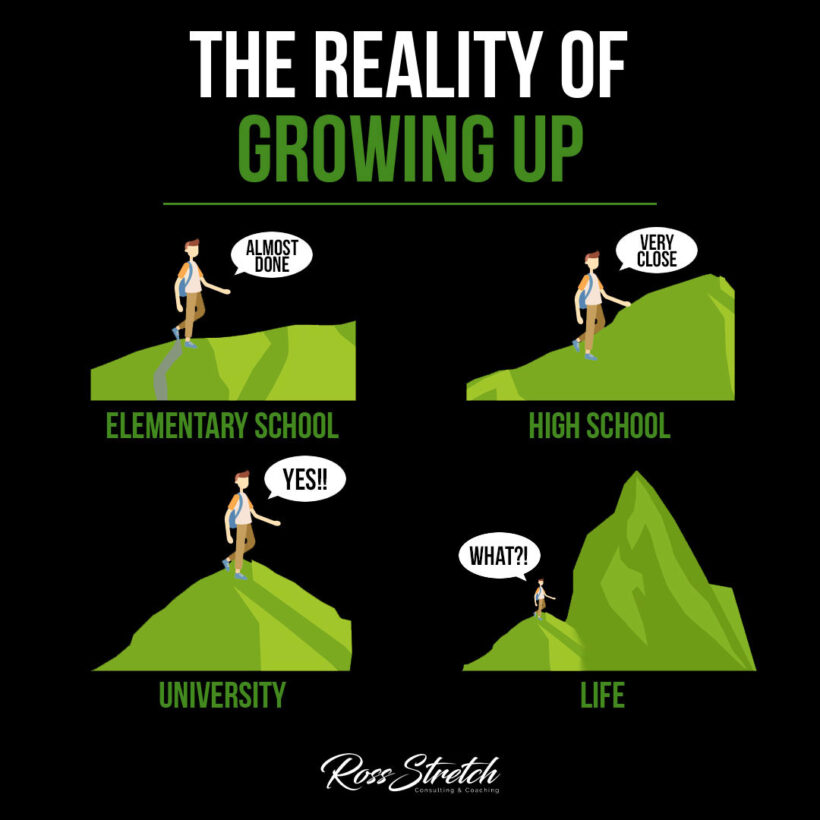

Nobody warns you that growing up is less of an arrival and more of a continuous series of realizations that you were wrong about what comes next. The gap between expectation and reality is one of the defining experiences of adulthood, and how you navigate that gap determines whether you thrive or spend your life waiting for something that never quite comes. At every stage — elementary school, high school, university, and life itself — the same core lesson repeats: the next milestone isn’t the finish line you thought it was. It’s just the door to a more complex room.
Why This Matters More Than You Think
The journey from childhood through adulthood follows a predictable emotional arc. Elementary school teaches the basics and leaves children feeling almost done. High school ratchets up complexity and creates the sensation of being very close. University delivers a triumphant “yes!” moment at graduation. Then real life arrives and says, flatly, “What?” This pattern is universal — but most people experience it as a personal failure rather than a structural feature of human development.
When graduates discover that a degree doesn’t automatically translate to a fulfilling career, or when high achievers find that reaching one goal immediately reveals the next larger one, they often internalize that gap as evidence that something is wrong with them. It isn’t. The gap is the point. Every stage is designed to prepare you for a more demanding version of the next one, not to complete you.
Understanding what each life stage actually teaches — versus what you believed it would deliver — is one of the most clarifying mental reframes available to ambitious people. It replaces disillusionment with direction and turns every “what now?” moment into a conscious step forward rather than a stumble into confusion.
What Each Stage Is Really Teaching You
Each stage of growing up carries an official curriculum and a hidden one. Elementary school is officially about reading and arithmetic; it’s really about whether curiosity survives structured repetition. High school is officially about grades and standardized tests; it’s really about whether you can manage peer pressure and begin forming an independent identity under significant social pressure. University is officially about your degree; it’s really about whether you can sustain self-directed effort without someone monitoring your every step.
Adult life — the “What?!” stage — has no official curriculum at all. For the first time, the goalposts aren’t pre-set. You have to decide what they are, plant them yourself, and run toward them without any guarantee you’ve aimed at the right thing. This is where most people struggle most, and where the most important growth happens. The people who navigate this stage well are not the ones who had everything figured out — they’re the ones who learned to act before certainty arrived.
How to Apply This in Your Life
Stop Waiting for the “Done” Feeling
The most practical thing you can take from understanding life’s stages is this: the sense of completion you’re waiting for is not coming. Not after the degree, not after the promotion, not after the house. The sooner you stop organizing your life around a future state of “finally made it,” the sooner you can find genuine satisfaction in the work of becoming. This is not pessimism — it is liberation from a condition that keeps high-potential people perpetually dissatisfied with what they have already achieved.
Redefine What Success Looks Like for You
Unlike school, adult life has no standardized rubric. This is terrifying and extraordinary in equal measure. The most successful people — by their own definition — have done the uncomfortable work of deciding what they actually value, independent of what parents, peers, or culture told them to pursue. Ask yourself: What would a genuinely good year look like? What would you be doing if outcomes were guaranteed? The answers to those questions are more useful than any credential.
Build Resilience as a Core Skill, Not a Personality Trait
Life after school is filled with setbacks that have no grade curves and no makeup exams. The people who navigate adulthood well are not the ones who avoid setbacks — they’re the ones who treat setbacks as information rather than verdicts. Resilience isn’t something you either have or don’t; it’s a practiced skill, built through repeated exposure to difficulty combined with intentional reflection on what each hard experience taught you.
Commit to Learning Long After the Diploma
University is a credential, not the endpoint of your intellectual development. The most relevant skills in today’s economy — critical thinking, adaptability, financial literacy, interpersonal influence — are largely self-taught in the years after formal education ends. Committing to one new skill or one substantive book per month compounds dramatically over a decade in ways no degree program can replicate.
Find Meaning in the Process, Not Just the Milestones
Every stage of growing up has intrinsic value beyond what it produces. The relationships formed, the self-understanding deepened, the character tested — these don’t appear on any resume but constitute the texture of a life well lived. People who learn to find meaning in the daily process rather than only in milestone moments report dramatically higher life satisfaction and significantly lower rates of burnout and regret.
Common Mistakes People Make
- Treating each stage as temporary suffering to endure rather than a chapter with its own inherent value — leading to chronic dissatisfaction and the sense of always waiting for life to “really” begin.
- Measuring personal success against peers’ external markers — using other people’s titles, salaries, or relationship milestones as benchmarks for a race you never agreed to enter.
- Assuming the expectation-reality gap is a personal failure — when it is, in fact, a universal feature of human development that every honest adult will recognize if you ask them directly.
- Stopping learning once formal education ends — leaving a void that is filled by stagnation and the slow erosion of the competitive edge that education once provided.
The Bottom Line
The reality of growing up is that each stage hands you a gift wrapped in a challenge. Elementary school gives you curiosity through structure. High school gives you identity through pressure. University gives you confidence through accomplishment. And life — the stage that never quite ends — gives you wisdom through everything that didn’t go as planned. None of these stages are failures. They are, each in their own way, exactly what you needed for the one that follows.
Growing up is not about reaching a final destination. It is about continuously adapting, redefining, and choosing to find meaning in the journey rather than deferring all satisfaction to some imagined future point of arrival. The people who live with the most vitality and purpose are not the ones who had the smoothest path — they are the ones who made peace with the reality that the path never ends, and learned to love the walking.
Resources
- Psychology Today — Adult Development and the Stages of Growth
- Harvard Business Review — The Case for Lifelong Learning
- Mindful — Why Every Life Transition Is an Invitation
- The Atlantic — How Adults Actually Grow and Change

 Ross Stretch