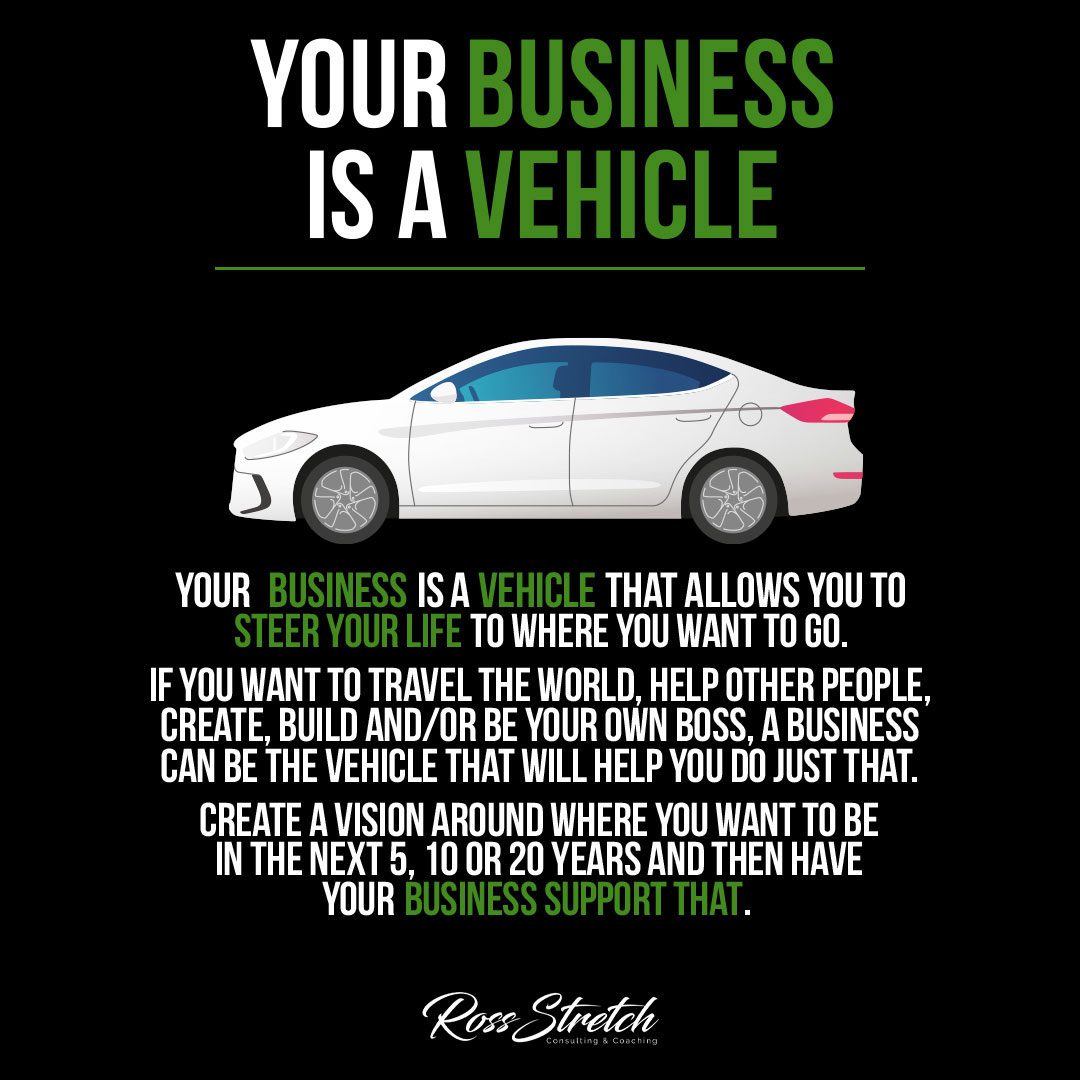
There is a powerful way to think about your business that changes how you make every decision within it: not as a job, not as a financial target, but as a vehicle. A vehicle that — when built correctly, maintained consistently, and driven with intention — takes you exactly where you want to go in life. This is not motivational language. It is a strategic framework that clarifies priorities, reveals misalignments, and helps entrepreneurs build companies that serve their lives rather than consume them.
Most people build businesses by accident — assembling whatever structure seems to work in the moment without asking what the whole thing is actually for. The result is often a business that generates revenue but demands everything in return: every hour, every decision, every bit of discretionary energy. A business built as a vehicle is designed differently, from the ground up, with a destination already in mind.
Defining Your Destination First
No vehicle is useful without a destination. Before you can design a business that takes you where you want to go, you have to know where that is. This sounds obvious — but most entrepreneurs spend far more time planning what they will sell than thinking clearly about what they actually want their life to look like in five, ten, or twenty years.
The destination is not a revenue number. Revenue is fuel, not a destination. Your destination is a life — the way you spend your time, who you spend it with, what problems you are solving, what freedom you have, and what contribution you are making. When you get specific about those dimensions, the design of your business becomes much clearer. Certain structures, models, and business types suddenly make more sense. Others reveal themselves as roads pointed in the wrong direction entirely.
Take time to write down your life vision in concrete terms. Not “financial freedom” but what a specific day looks like when you have achieved it. Not “a successful business” but what success means to you in terms of your relationships, your schedule, your health, and your sense of purpose. This document becomes your GPS — the reference point against which every significant business decision gets measured.
Steering Your Business with Purpose
Once your destination is defined, you can begin steering deliberately. Most businesses operate reactively — responding to customer demands, competitive pressure, market trends, and cash flow concerns as they arise. A business operated as a vehicle responds to those same external factors, but always through the filter of “does this move us toward the destination or away from it?”
This filter changes day-to-day decisions in meaningful ways. It affects which clients you take on, which opportunities you pursue, which partnerships you build, and which offers you decline. A client who pays well but creates persistent chaos and drains your energy may be moving you away from your destination rather than toward it. An opportunity that looks lucrative on paper may require building a structure that fundamentally conflicts with the kind of business and life you want to run.
Purpose-driven steering requires discipline, especially early, when saying yes to everything feels financially necessary. But the entrepreneurs who report the highest satisfaction are consistently those who are clearest about their destination — and who build businesses they still want to own five years in, rather than businesses they are desperate to sell or escape from.
Building a Vehicle That Lasts
A vehicle built on a poor foundation will not take you far. The same principle applies to your business. Sustainable success requires investing in the right infrastructure early — even when short-term pressures make it tempting to cut corners and rely entirely on founder effort and improvisation.
Building for durability means creating documented systems and repeatable processes rather than carrying all operational knowledge in your head. It means bringing in people whose strengths complement yours rather than duplicating what you already do well. It means maintaining financial discipline so that growth does not consistently outpace your ability to fund and sustain it. These investments feel slow in the moment. Over a three-to-five year horizon, they are the difference between a business that compounds and one that plateaus.
The most durable businesses are also the most transferable — meaning they operate on systems and culture rather than exclusively on the founder’s daily presence. Building toward that standard, even from the early stages, creates genuine optionality. You can scale it, step back from operations, bring in a leadership team, or eventually sell it, because the vehicle runs on more than just your personal energy.
Navigating the Entrepreneurial Terrain
Every entrepreneur encounters unexpected terrain. Markets shift. Key team members depart. Products that were converting well stop performing. New competitors emerge. Economic conditions tighten. The ability to navigate these disruptions without permanently veering off course is what separates businesses that survive from those that do not.
Navigation requires two things working simultaneously: a clear sense of the destination — so you know what “off course” looks like — and genuine flexibility in your methods — so you can find alternate routes when the primary path is blocked. Entrepreneurs who are too attached to their original plan become brittle. Those who lack a clear destination become directionless. The balance is strategic clarity combined with tactical adaptability.
Staying informed is a non-negotiable part of navigation. Competitive intelligence, customer feedback, financial reporting, and regular strategic planning conversations should be built into your operating rhythm, not treated as activities for when business is slow. The businesses that detect disruption early have time to adapt thoughtfully. Those that detect it late are left with no margin to recover.
Harmonizing Business and Life
The vehicle metaphor only works if you actually enjoy the journey. A business that generates income but destroys your health, your relationships, or your sense of purpose is not a successful vehicle — it is a trap dressed as a success story. The goal is not maximum revenue extraction. The goal is a business that funds and actively supports the life you actually want to live.
This means building deliberate time protections into your schedule and respecting them. It means measuring success not only in revenue and growth metrics but in how your business affects your energy, your relationships, and your quality of daily life. These are not secondary considerations — they are the entire point of treating your business as a vehicle rather than as an end in itself.
Entrepreneurs who achieve this integration share a recognizable pattern: they defined what they wanted before they built, and they held that vision accountable throughout every growth stage. The business was always the vehicle. The life was always the destination.
Conclusion
Your business is one of the most powerful tools available for shaping the life you want — but only when used intentionally. Define your destination with genuine specificity. Build structures that can sustain the journey without depending entirely on your personal heroics. Navigate with both conviction and flexibility. And never lose sight of the fact that the business exists to serve your life, not replace it.
The most fulfilled entrepreneurs are not those who sacrifice everything for the company. They are those who built companies worthy of the life they envisioned — and then actually lived it.
Resources

 Ross Stretch