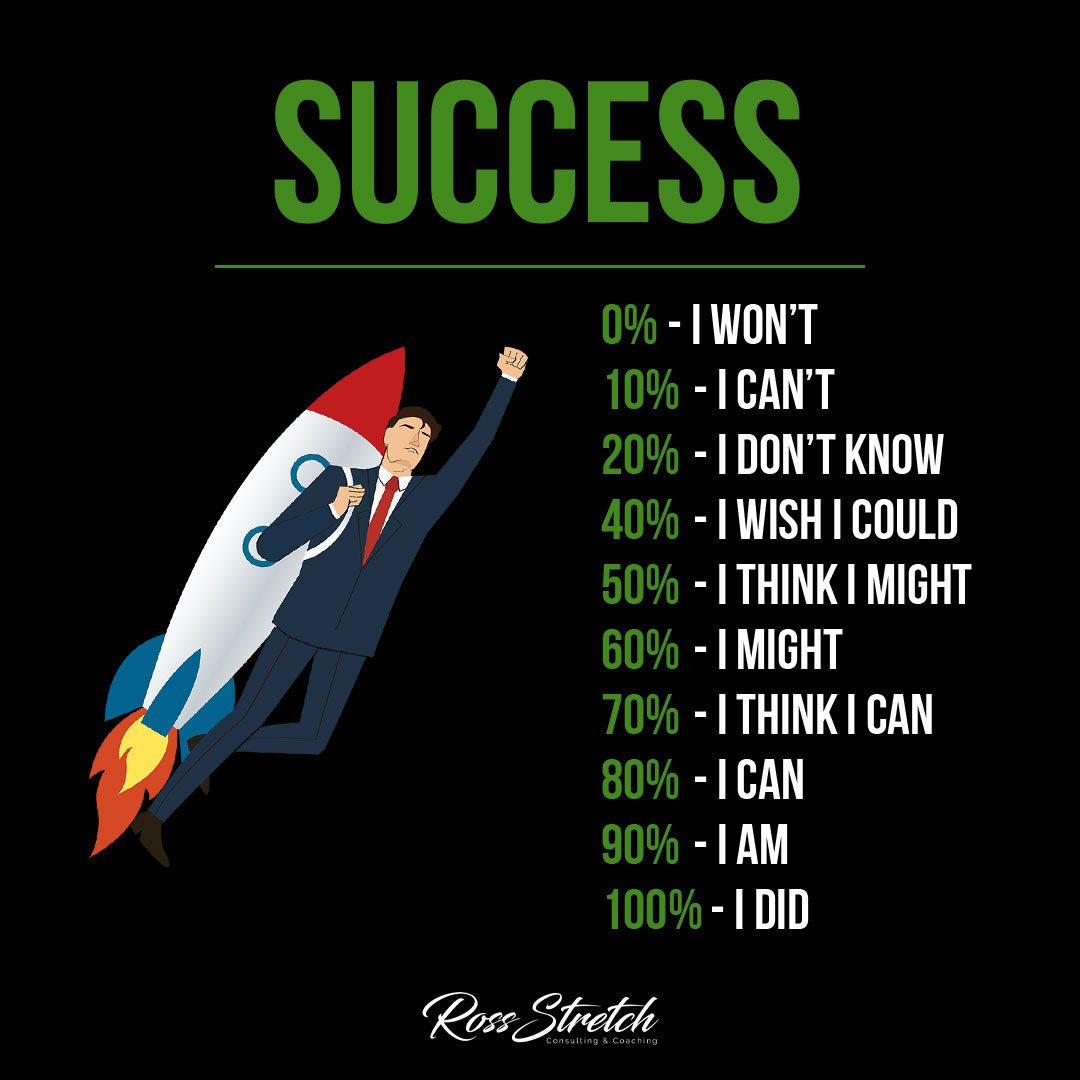
Success is not handed out randomly — it follows a predictable psychological path. The words you use to describe your own capabilities are not just expressions; they are commitments that shape your actions and define your outcomes. Understanding the progression from “I won’t” to “I did” gives you a map for the interior journey that every meaningful achievement requires. Shifting your internal dialogue is one of the most powerful levers available for changing results in work, finances, and life — and it costs nothing to start.
\
\
\
\
Why Your Inner Voice Sets the Ceiling
\
\
Before a single action is taken, the outcome of most endeavors is already being shaped by the conversation happening inside your head. Psychologists and performance researchers consistently find that self-efficacy — the belief in your own capacity to execute a task — is one of the strongest predictors of actual performance. You cannot consistently outperform your own self-concept for long. Your actions will eventually conform to what you believe you are capable of.
\
\
This is not motivational fluff. It is a practical observation about how human behavior works. When you believe something is impossible for you, you stop looking for solutions, stop trying new approaches, and interpret setbacks as confirmation of your belief rather than as useful data. Conversely, a shift in self-belief — even a small one — opens up cognitive resources that were previously locked behind the door of doubt. The staircase begins in the mind, and every step up starts with a different sentence.
\
\
\
\
Stage One: “I Won’t” — The Closed Door
\
\
“I won’t” is different from “I can’t.” It is a deliberate refusal, and it is often rooted in fear dressed up as choice. When someone says “I won’t start a business” or “I won’t try investing,” they are usually protecting themselves from the discomfort of potential failure. The refusal feels like control, but it is actually avoidance masquerading as a decision.
\
\
The way through this stage is not to force enthusiasm you do not feel, but to examine the underlying reason for the refusal. Ask yourself what you are actually afraid of losing — time, money, status, comfort — and whether that fear is proportionate to the actual risk. Most “I won’t” statements collapse when examined honestly. They are built on assumptions and worst-case projections rather than evidence of what would actually happen if you tried.
\
\
\
\
Stage Two: “I Can’t” to “I Might” — Cracking the Wall
\
\
“I can’t” is a statement about capability rather than will. It is a step forward from “I won’t,” because it acknowledges that the goal is desirable — but it still erects a firm barrier around your ability to reach it. The shift from “I can’t” to “I might” is where the growth mindset begins to take hold, and where real change becomes possible for the first time.
\
\
Carol Dweck’s research on mindset makes clear that the belief in your ability to grow — rather than in a fixed set of talents you either have or don’t — is the foundation of long-term achievement. “I might” is the crack in the fixed mindset. It is the admission that circumstances could change, that learning is possible, and that the gap between where you are and where you want to be could theoretically be closed with the right effort and information.
\
\
To move from “I can’t” to “I might,” start by looking for proof. Find one person who has achieved what you want to achieve and study how they got there. Their existence is proof that it is possible, which means your “I can’t” is a story — a useful one, perhaps, but not a fact. Once you see it as a story, you can choose to write a different one.
\
\
\
\
Stage Three: “I Think I Can” — The Pivot Point
\
\
“I think I can” is where passive possibility becomes active intention. This is the planning stage — where you stop observing others who have succeeded and start mapping your own route. At this stage, belief has begun to outpace doubt, even if only slightly. The balance has tipped in favor of action, and that shift changes everything about how you relate to your goal.
\
\
The danger at this stage is staying in it too long. Planning feels productive, but it is still a form of inaction. Research, preparation, and strategizing all have value, but they can also become comfortable substitutes for actually beginning. At some point, “I think I can” must give way to execution. The plan does not need to be perfect — it needs to be started. The clarity you are waiting for rarely arrives before you begin; it arrives because you began.
\
\
\
\
Stage Four: “I Am” — Identity in Motion
\
\
“I am” is one of the most powerful declarations available to a person. “I am building a business.” “I am getting out of debt.” “I am becoming someone who invests consistently.” These are not just descriptions of activities — they are identity statements. And identity is the most durable form of motivation available, because it does not depend on how you feel on a given morning.
\
\
James Clear, in Atomic Habits, makes the case that the most effective way to change behavior is to change identity first. When your actions are tied to who you are rather than what you are trying to accomplish, they become self-reinforcing. Every time you act in accordance with your “I am” statement, you cast a vote for that identity. Over time, those votes accumulate into an unshakeable self-concept that carries you through resistance and setbacks.
\
\
This stage requires consistency more than intensity. You do not need to move fast — you need to keep moving. Show up when it is inconvenient, when results are slow, when the initial excitement has faded. That is when identity becomes the anchor that keeps you on course while motivation fluctuates around you.
\
\
\
\
Stage Five: “I Did” — Reflection and What Comes Next
\
\
“I did” is the arrival — but it is not the end. Every achievement is simultaneously a completion and a new starting point. When you reach a goal, the most valuable thing you can do is take time to understand how you got there. What beliefs shifted? What habits formed? What did you have to give up or push through? This reflection converts a single win into a repeatable process you can apply to the next challenge.
\
\
Research on goal achievement suggests that people who consciously acknowledge what they have accomplished — who allow the “I did” moment to fully register before moving to the next challenge — build stronger intrinsic motivation over time. Do not rush past the finish line. Let it land. Then apply what you have learned to a bigger mountain. Each completed staircase becomes the foundation of the next one.
\
\
\
\
Conclusion
\
\
The staircase from “I won’t” to “I did” is not climbed in a single leap. It is built one step at a time, through honest self-examination, deliberate action, and the willingness to update your beliefs as your evidence changes. The most important move you can make today is identifying which stage you are currently in — and then taking one honest step toward the next one. Success is not a destination; it is a practice of moving forward.
\
\
\
\
Resources
\
\

 Ross Stretch