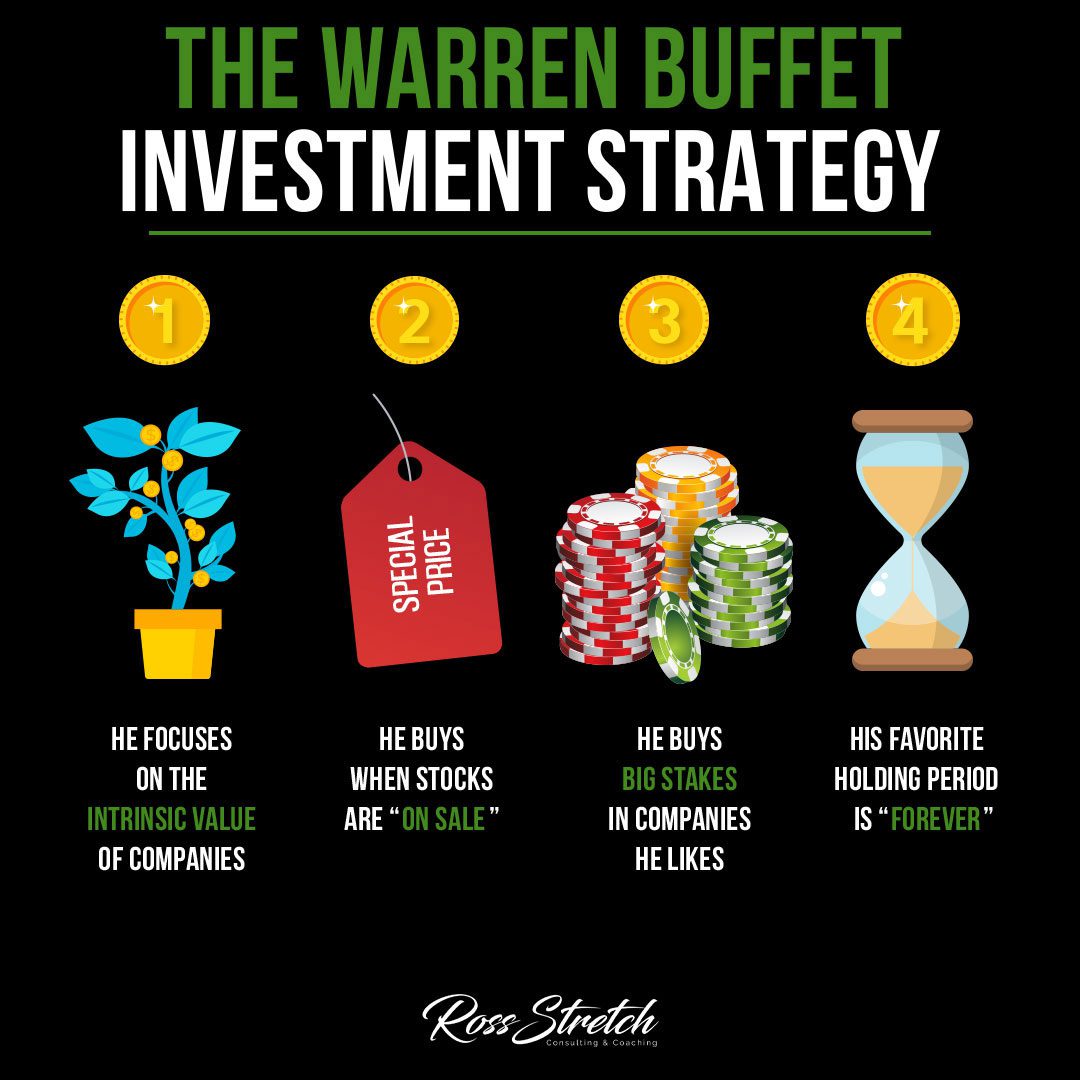
Warren Buffett, known as the Oracle of Omaha, is arguably the most successful investor in modern history. Through Berkshire Hathaway, he has compounded wealth at an average annual return of roughly 20% over more than five decades — a track record no index fund or algorithm has matched. His strategy is not complex, and it is not secret. Value investing, patience, and disciplined thinking are its core tenets, and they are accessible to any investor willing to think long-term about money and resist the pull of short-term market noise.
The Foundation: Intrinsic Value
Everything in Buffett’s strategy begins with one question: what is this business actually worth? He calls this intrinsic value — essentially the present value of all future cash flows a business will generate over its lifetime. If a stock trades at a significant discount to that intrinsic value, it represents a genuine buying opportunity. If it trades at a premium, regardless of how compelling the growth story sounds, he walks away and waits.
This framework comes directly from his mentor Benjamin Graham, the Columbia professor who pioneered value investing in the 1930s and 1940s and wrote The Intelligent Investor. Buffett refined Graham’s approach by adding a crucial qualitative filter: he looks not just for statistically cheap stocks, but for exceptional businesses trading at fair prices. The distinction matters enormously over long time horizons because an exceptional business compounds value year after year, while a merely cheap business is often cheap for good reason.
The practical challenge for individual investors is calculating intrinsic value with enough confidence to act on it. Buffett focuses on businesses with predictable, consistent earnings — ideally protected by some form of durable competitive advantage, or moat. Utilities, consumer staples, and established financial services companies tend to offer the cash flow predictability he requires. Early-stage growth companies, regardless of their appeal, rarely meet his standard of estimability.
Buying When Stocks Are on Sale: The Margin of Safety
Even after identifying a high-quality business with strong intrinsic value, Buffett will only buy if the market price is meaningfully below that value. This gap is what Benjamin Graham called the margin of safety, and it is one of the most important concepts in all of investing. It is the difference between a calculated bet and speculation.
The margin of safety serves two functions simultaneously. First, it limits downside risk. Your estimate of intrinsic value is always imperfect — a significant discount gives you room to be wrong without losing money. Second, it amplifies returns. Buying at a discount and watching the price recover to fair value generates gains that have nothing to do with how the company actually performed during your holding period. You benefit from two sources: company earnings growth and price normalization.
Buffett’s famous maxim — “Be fearful when others are greedy, and greedy when others are fearful” — is a direct expression of this principle. Market corrections and recessions, which terrify most investors, represent exactly the kind of environment where high-quality businesses go on sale. The investor who has studied the businesses on their watchlist and knows their intrinsic value is prepared to act decisively when the market offers a discount. The investor who has done no preparation is left paralyzed by the same volatility.
Investing Within Your Circle of Competence
Buffett invests only in businesses he genuinely understands — their economics, their competitive dynamics, their customer relationships, and their long-term prospects. He calls this operating within his circle of competence, and staying strictly within it has been as important to his success as any analytical tool he uses. His deliberate avoidance of technology stocks during the 1990s dot-com boom was not contrarianism for its own sake. He simply could not reliably estimate the intrinsic value of companies whose future cash flows were unknowable.
This principle has significant practical implications for individual investors. Deep expertise in your own industry is a genuine investing edge. The restaurant owner who recognizes which casual dining chain has structurally superior unit economics has real informational depth that most Wall Street analysts lack. The nurse who understands which medical device company has the strongest clinical relationships and the highest switching costs has a perspective the market may not fully price in. Your professional knowledge is not irrelevant to investing — it is potentially your sharpest tool.
The instruction is to build a focused watchlist of businesses you understand deeply and wait for the market to offer them at a meaningful discount. This requires patience — sometimes years of waiting — but the combination of genuine understanding and the right price creates the conditions for the kind of returns Buffett has spent a career generating.
The Long-Term Holding Period
Buffett has said his favorite holding period is forever. This is not hyperbole. He has held Coca-Cola since 1988, American Express since the mid-1990s, and See’s Candies since 1972. The logic is purely mathematical: compounding requires time, and every sale event triggers capital gains taxes and resets the compounding clock. Staying invested in a great business year after year allows that business’s earnings to compound without interruption, which is the engine behind virtually all of Buffett’s most spectacular long-term results.
The practical wisdom here is to resist the urge to trade on short-term price movements. If you bought a stock because of its long-term fundamentals and those fundamentals have not changed, a price decline is an opportunity to add to your position — not a signal to sell. The emotional discipline required to hold through volatility is, in Buffett’s view, more important than analytical intelligence. Many smart investors underperform because they cannot sit still. Buffett’s edge is temperament as much as intellect.
Applying Buffett’s Principles in Today’s Market
Buffett’s strategy has faced periodic criticism in recent years as growth investing — particularly in high-multiple technology companies — has periodically generated spectacular short-term returns that value approaches cannot match. Critics argue that low interest rates and technological disruption have made traditional valuation frameworks obsolete. Buffett himself has acknowledged missing early opportunities in companies like Amazon and Google.
But the fundamentals of his approach remain structurally sound across full market cycles. Through the crash of 2000 to 2002, the financial crisis of 2008 to 2009, and the broad selloffs of more recent years, businesses with pricing power, loyal customers, and durable competitive advantages have demonstrated meaningful resilience. They are the ones most likely to survive disruption and, in many cases, to benefit from it as weaker competitors fall away.
For the individual investor, the practical application is straightforward: buy quality businesses when they are priced below their intrinsic value, understand what you own deeply enough to hold through volatility, avoid excessive trading, and think in decades rather than quarters. The Oracle’s strategy requires no special access, no trading algorithm, and no financial engineering. It requires only discipline and patience — qualities far rarer than raw intelligence in any market environment.
Conclusion
Warren Buffett’s investment strategy is a masterclass in simplicity applied with extraordinary consistency over time. Intrinsic value, margin of safety, circle of competence, and long-term holding are principles any investor can adopt regardless of portfolio size. The challenge is not understanding them — it is having the conviction to apply them when the market is screaming otherwise. That is where the real edge lies, and where the compounding begins.
Resources


 Ross Stretch