
You do not need a degree, a business loan, or years of professional experience to start building real income as a student. Some of the most successful early entrepreneurs launched their first venture while still in school — using low overhead costs, flexible schedules, and direct access to a captive network of potential customers and collaborators. Every business below requires more hustle than capital, and every one of them builds skills that remain valuable long after graduation.
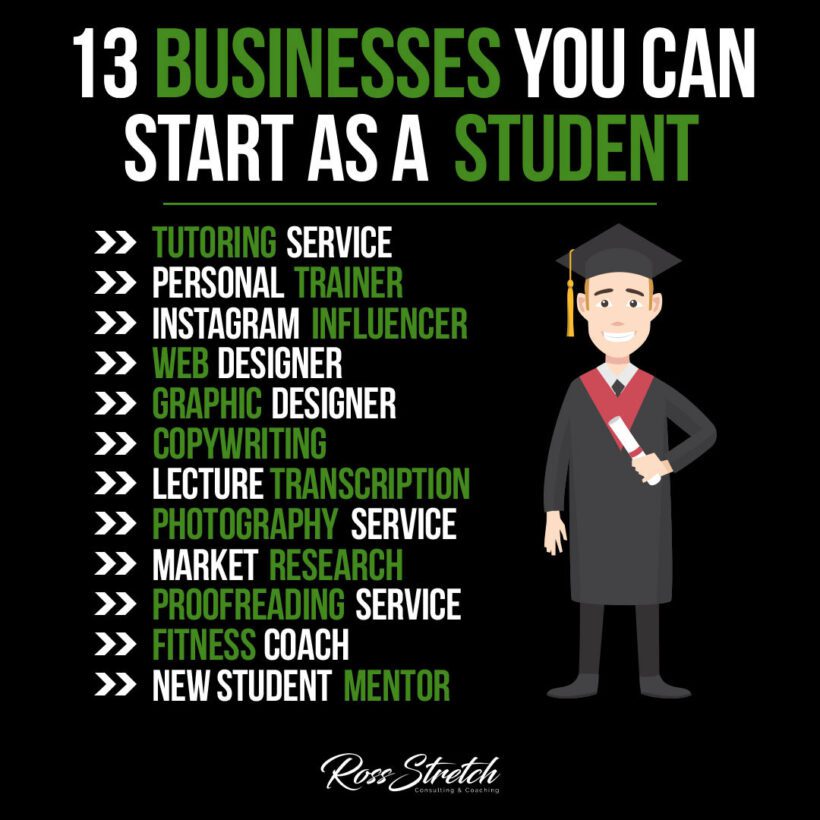
1. Tutoring Service
Academic tutoring is one of the fastest paths to student income because demand is constant and startup cost is essentially zero. Identify the subjects where you consistently perform well — economics, organic chemistry, calculus, essay writing — and offer one-on-one sessions to fellow students or high school students in your area. Platforms like Wyzant and Tutor.com let you list services and set your own rates, while word-of-mouth referrals within your campus network can build a full client roster quickly. Rates typically range from $25 to $80 per hour depending on subject and level.
2. Personal Training
If you have a genuine passion for fitness, becoming a certified personal trainer while still in school gives you both a marketable skill and a flexible side income. A certification through NASM or ACE typically costs between $500 and $800 and can be completed within a few months alongside coursework. Once certified, you can train clients at a campus gym, a local fitness facility, or outdoors in parks. Personal referrals from satisfied clients tend to build this business organically once you have your first few success stories.
3. Social Media Content Creator
Building a focused audience on platforms like Instagram, TikTok, or YouTube around a topic you know well — student budgeting, fitness, study techniques, tech reviews, campus life — can generate brand partnership income and affiliate commissions over time. Monetization requires consistency and a willingness to stay with a niche for at least 12 to 18 months before meaningful income appears. The upfront cost is your existing phone camera and your time. The compounding value of the audience you build extends well beyond graduation.
4. Web Design
Small businesses consistently need affordable, professional web presence, and students with even basic proficiency in WordPress, Squarespace, or Webflow can charge $500 to $3,000 per project. Build an initial portfolio with one or two pro-bono projects for local nonprofits or student organizations, then approach small businesses through direct outreach. As you complete more projects, specializing in a single industry vertical — restaurants, law firms, health practitioners — lets you command higher rates and generate referrals within that community.
5. Graphic Design
Demand for graphic design services — logos, social media graphics, presentation templates, marketing materials — is consistent across virtually every industry and business size. Tools like Adobe Illustrator, Figma, and Canva Pro are accessible to students, and many universities provide free or discounted Adobe Creative Cloud access. List services on Fiverr or 99designs to build initial reviews, then move toward direct client relationships where margins are significantly higher. A well-curated portfolio on Behance or your own website is your primary sales tool.
6. Copywriting
Businesses pay well for compelling written content: website copy, email sequences, product descriptions, LinkedIn articles, and blog posts that drive real traffic. If you write clearly and can learn the fundamentals of persuasive writing, you can charge $50 to $150 per hour as you build experience and a portfolio of measurable results. Start by offering services to startup founders or small business owners in your immediate network, document the outcomes, and use those results to attract better-paying clients at higher rates.
7. Transcription Service
Researchers, journalists, podcasters, and legal and healthcare professionals regularly need accurate, fast transcriptions of recorded audio. Platforms like Rev and TranscribeMe provide immediate access to transcription work for reliable typists. As you establish a reputation for accuracy and fast turnaround, you can move toward direct client relationships and premium pricing for specialized content — medical records, legal depositions, academic interviews — where rates are substantially higher than general transcription work.
8. Photography
Photography services — event coverage, professional headshots, brand photography, real estate imagery — are in consistent demand, and a student with a capable camera and strong editing skills can charge rates that far exceed most part-time jobs. Start by photographing campus events, producing headshots for classmates, or shooting product photography for small local businesses to build a portfolio. As your body of work strengthens, niche into the market segment where you produce the best results and receive the most enthusiastic referrals.
9. Market Research
Companies pay for fresh consumer insights, and students embedded in specific demographics — Gen Z spending behavior, university student purchasing decisions, specific cultural communities — have genuine research value to offer. You can provide research services through platforms like UserTesting, or approach local businesses and early-stage startups directly, offering to conduct surveys, user interviews, and competitive analysis reports. Business, sociology, and psychology students are particularly well-positioned for this work given their academic training.
10. Proofreading and Editing
Academic papers, business reports, grant applications, website content, and book manuscripts all need skilled editing before publication. Students with exceptional grammar, strong attention to detail, and familiarity with style guides like APA, MLA, or Chicago Manual of Style can offer proofreading and editing services to fellow students, faculty, and professionals. Platforms like Reedsy connect editors with authors needing manuscript work. Rates typically range from two to five cents per word depending on the depth of editing required.
11. Online Fitness Coaching
The growth of digital fitness platforms has made it possible to coach clients remotely through video calls, custom workout plans, and app-based accountability check-ins. Unlike in-person personal training, online coaching is location-independent and scalable — you can serve clients across multiple time zones without additional time cost per new client. Build a social media presence around your fitness niche, offer a free initial consultation or assessment, and convert engaged followers into paying clients through demonstrated expertise and consistent content.
12. New Student Mentoring
The transition to university is genuinely difficult across academic, social, and logistical dimensions. Upper-year students who have navigated this transition successfully have real value to offer incoming students: effective study systems, campus navigation, social integration, and the unwritten rules of university life that no orientation manual covers. Formal peer mentorship programs exist at most institutions, but entrepreneurial students can also create premium one-on-one packages or group programs specifically tailored to international students, first-generation college students, or students entering competitive professional programs.
13. Social Media Management
Most small business owners know they need a consistent, strategic social media presence but lack the time and platform expertise to maintain one. Students who are fluent in the content formats, posting cadences, and analytics of platforms like Instagram, TikTok, and LinkedIn can offer social media management retainers to local businesses for $500 to $2,000 per month per client. Start with businesses in your personal network, deliver measurable results — follower growth, engagement improvements, website traffic — and use those documented outcomes as case studies to attract new clients at higher rates.
Conclusion
The best student business is the one you actually start. Every option on this list has a low barrier to entry, a clear path to early revenue, and skills that remain valuable long after graduation. Pick the one that best matches your existing strengths and your available schedule, commit to it for at least 90 days, and treat it with the same seriousness you bring to your academic work. The business experience you build as a student — the clients won, the problems solved, the habits formed under real pressure — will compound in ways your degree certificate alone cannot replicate.
Resources


 Ross Stretch