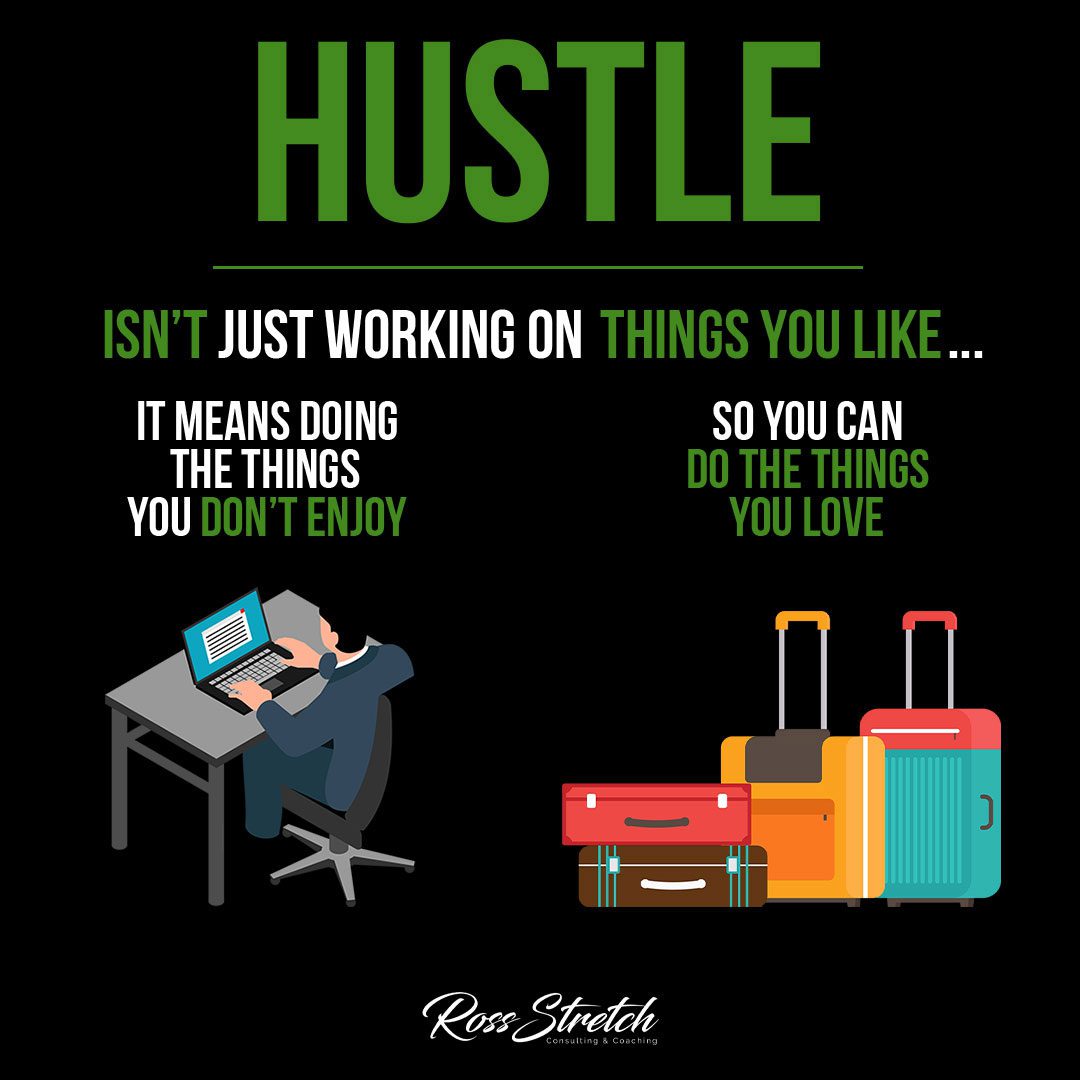
There’s a version of hustle that gets glamorized on social media — late nights fueled by passion, grinding on the work you love. That kind of hustle is easy to romanticize because it looks aspirational. But the hustle that actually changes careers and builds businesses looks different. It looks like doing work you don’t enjoy because it leads somewhere you genuinely need to go.
Real hustle is a transactional relationship with discomfort. It’s answering emails when you’d rather rest, learning skills that bore you because they’re what the market demands, and handling the administrative grind of running a business so the creative side can eventually flourish. Understanding this distinction separates people who start things from people who actually finish them.
What Hustle Actually Means
The word hustle has been diluted by overuse. At its core, hustle means sustained effort applied in the direction of a meaningful goal — even when that effort is uncomfortable, thankless, or temporarily unrewarding. It is not the same as busyness. A person can be busy all day while actively avoiding the work that would actually move them forward.
True hustle involves identifying what needs to happen next — even if it’s unglamorous — and doing it anyway. For an aspiring entrepreneur, that might mean cold-calling prospects for months before a single deal closes. For a freelancer building a client base, it might mean writing guest posts on other people’s platforms before anyone is reading your own. For a professional pivoting careers, it might mean accepting an entry-level role to gain the credibility needed to eventually command a senior position. In each case, the unglamorous work is not a distraction from the real work — it is the real work.
Breaking Out of Your Comfort Zone
The comfort zone is seductive precisely because it feels safe. The activities within it are familiar, manageable, and require minimal psychological risk. But the comfort zone and the growth zone are mutually exclusive territories. Every meaningful skill, relationship, and opportunity lives outside the range of what you can already do effortlessly.
Breaking out of your comfort zone doesn’t require dramatic leaps. Research in organizational psychology suggests that the most effective method for expanding capacity is incremental exposure — doing slightly harder things repeatedly until they become the new baseline. The discomfort you feel when cold-pitching a client, presenting to an audience, or starting a project in unfamiliar territory is a signal that growth is available, not a warning to retreat.
Every accomplished professional can point to a period where they were doing work that was well outside their comfort zone — work they didn’t enjoy, work that was difficult and uncertain. What they have in common is that they did it anyway, and then they did it again. Repeated exposure to manageable discomfort is how capability is built and how confidence actually develops.
Hustle as an Investment in Your Future Self
The most powerful reframe for the difficult parts of hustle is this: every hour of unpleasant but necessary work is an investment with a future return. The professional who endures years of demanding, sometimes tedious work to master their industry has a compounding advantage that the person who avoided discomfort simply cannot replicate. Skills, relationships, and reputation are all forms of capital that accumulate over time.
This is the principle of delayed gratification applied to career building. In a culture that prizes instant results and visible wins, the willingness to work toward outcomes that won’t materialize for months or years is genuinely rare — and therefore genuinely valuable. The people who understand that today’s unpleasant tasks are tomorrow’s building blocks consistently outperform those who only pursue the enjoyable work. They’re not more talented. They’re more willing to pay the price before the reward arrives.
The Role of Persistence
Persistence is not stubbornness. Stubbornness means continuing to do the same thing that isn’t working and expecting different results. Persistence means maintaining commitment to the goal while remaining adaptable about the approach. Every significant professional journey includes phases where progress feels invisible — where the effort is real but the results haven’t yet caught up with the input.
This is where most people quit. The problem is rarely a lack of talent or opportunity — it’s an inability to sustain effort through the natural lag between input and output. Cultivating persistence requires understanding that this lag is normal, not a sign that something is fundamentally wrong. It also helps to track leading indicators — calls made, applications sent, content published — rather than fixating exclusively on lagging outcomes like deals closed or audience size. The inputs are within your control; the outputs are not.
Sustaining the Hustle Without Burning Out
Hustle culture at its worst ignores biology. The human brain and body require recovery to perform at their best, and treating sleep, rest, and relationships as optional costs comes at a steep price. Chronic overwork degrades decision-making, creativity, and emotional regulation — the very faculties most needed for ambitious, high-stakes work. Burnout doesn’t just slow you down temporarily; research published in occupational health journals shows it can have lasting effects on cognitive performance and long-term career satisfaction.
Sustainable hustle means treating recovery as part of the system, not as a reward for completion. It means setting work boundaries and protecting them, maintaining physical health habits even when schedules get compressed, and being honest about when you’re pushing through productive discomfort versus running on empty. The goal is to be operating at a high level five years from now — not to extract every last productive hour from yourself over the next six months and arrive depleted.
Conclusion
Hustle, done right, is one of the most powerful forces available to an ambitious professional. But it requires a clear-eyed understanding of what it actually demands. It is not about loving every minute of the work — it is about committing to the work that builds toward the life and career you actually want. The cold calls, the unglamorous administrative tasks, the skills acquired out of necessity rather than passion — these are the inputs. Fulfillment, freedom, and meaningful impact are the outputs. Do the work that earns the life you’re building toward.
Resources
- The War of Art by Steven Pressfield — The definitive book on overcoming resistance and doing the hard work that matters
- Atomic Habits by James Clear — A practical framework for building systems that support sustained effort over time
- Harvard Business Review: Beating Burnout — Research-backed strategies for sustaining high performance without breaking down
- Gary Vaynerchuk’s Blog — Perspective from a practitioner who built multiple businesses through relentless, unglamorous execution

 Ross Stretch