As e-commerce continues its relentless growth, the pressure on online sellers to fulfill orders faster and more reliably has never been greater. A micro fulfillment center offers a practical solution — a lean, scalable business that provides professional warehousing and shipping services to online sellers without requiring a massive commercial facility. If you have a clean garage, a spare room, or access to a small rented storage unit, you already have the foundation for a profitable operation that taps directly into the infrastructure gap affecting small and mid-sized e-commerce businesses.
What Is a Micro Fulfillment Center?
A micro fulfillment center (MFC) is a small-scale storage and distribution hub that handles inventory on behalf of e-commerce businesses. Unlike traditional third-party logistics providers that require thousands of square feet and significant infrastructure investment, an MFC operates lean — often from a home garage, a rented storage unit, or a compact commercial space. The model is built on a simple premise: online sellers need reliable local partners to store products and fulfill orders on demand, and most existing options are too expensive or too large-scale for smaller operators.
The e-commerce landscape has fragmented significantly. Millions of small-to-medium sellers on platforms like Shopify, Etsy, and Amazon cannot afford enterprise-level fulfillment providers, yet they need faster delivery windows to stay competitive. A well-run micro fulfillment center fills that gap at a price point smaller sellers can actually afford, while giving the operator a recurring revenue stream with minimal incremental effort once systems are in place.
How the Business Model Works
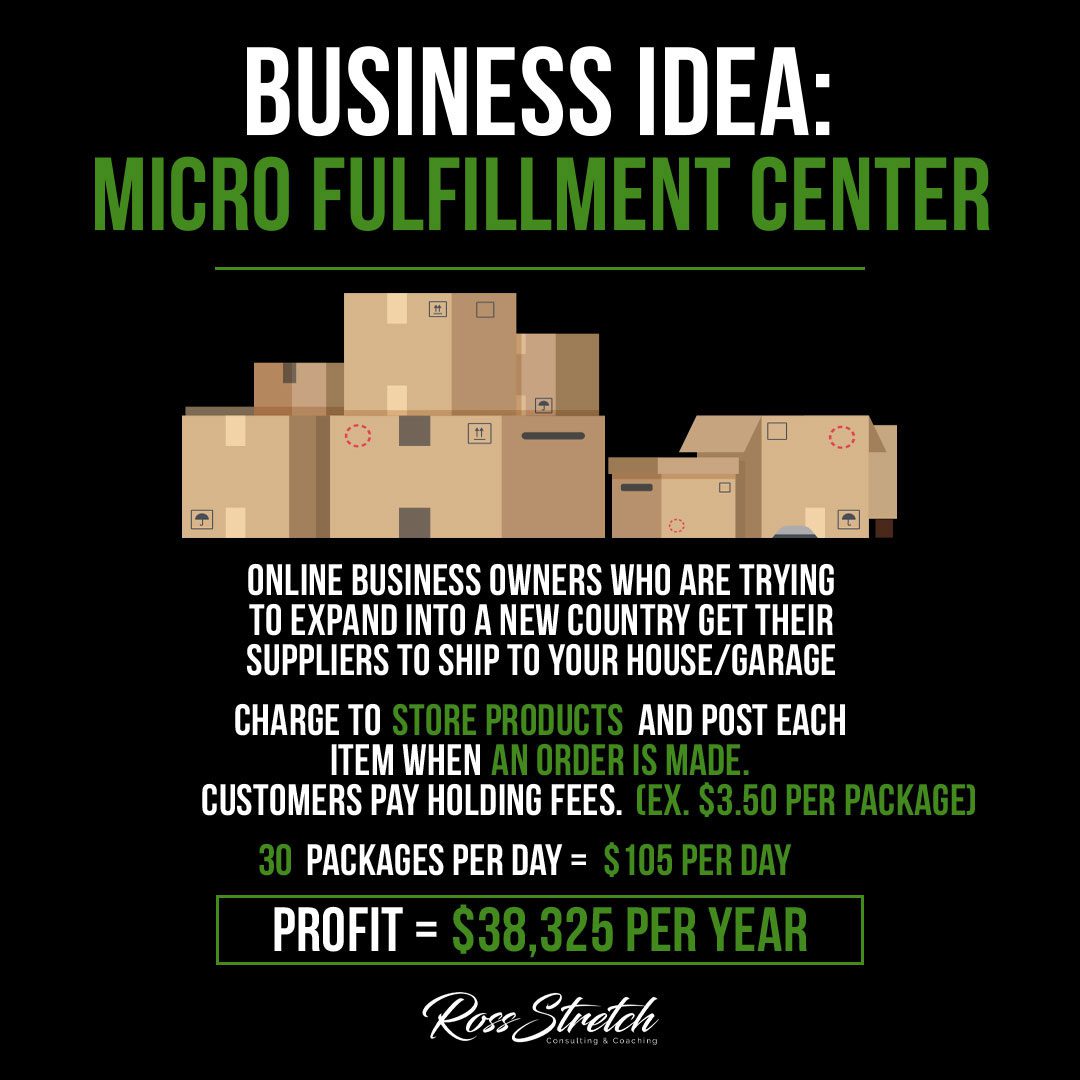
The mechanics are straightforward. E-commerce sellers ship their inventory to your facility. You store it, manage it, and when a customer places an order, you pick, pack, and ship the item on the seller’s behalf. You charge for two things: a daily holding fee per package stored, and a service fee or margin on outgoing shipments.
A common pricing structure charges a daily holding fee per package. At $3.50 per package per day with 30 packages stored, you generate $105 in daily holding revenue. Across roughly 370 operating days — accounting for the 24/7 nature of storage — that translates to approximately $38,000 in annual revenue from storage fees alone. Add shipping margins, pick-and-pack fees, and additional services, and the model becomes a meaningful income stream from a modest footprint. The key is pricing clarity: holding fees, pick-and-pack fees, and shipping pass-throughs should all be documented in a simple client agreement from day one.
Setting Up Your Space and Systems
You do not need a dedicated commercial warehouse to get started. Many operators begin with a clean, organized garage or spare room. The priorities are security, organization, and climate control. Inventory that gets damaged in your facility is your liability, so investing in proper shelving, moisture control, and basic security measures from the start protects both your clients’ inventory and your business reputation.
On the systems side, inventory management software is essential even at a small scale. Tools like Linnworks, SKUVault, or a well-structured spreadsheet can track incoming stock, current quantities, and outgoing shipments. Sellers need confidence that their inventory is accurately tracked — any discrepancy erodes trust quickly. Pair your inventory system with a multi-carrier shipping platform like ShipStation to compare rates across Canada Post, UPS, and FedEx, print labels efficiently, and keep shipping costs competitive.
Finding Your First Clients
The most direct path to your first client is through online seller communities. Facebook Groups, Reddit communities like r/ecommerce and r/fulfillment, and Shopify’s community forums are full of sellers actively looking for fulfillment solutions. Lead with your location advantage — if you are based in a specific city or region, that geographic reach is your primary selling point for sellers who want faster delivery to customers in your area.
Reaching out to sellers on Etsy or Shopify who are based overseas but sell into your country is a particularly high-leverage approach. These sellers often struggle with international shipping costs and delivery times. Offering to receive bulk shipments and fulfill orders locally solves a real, painful problem. Start with one or two clients, prove your process, refine your systems, and collect testimonials before scaling. Referrals in seller communities can grow your client list faster than any paid advertising campaign.
Scaling the Operation
Once your initial operation runs smoothly, scaling becomes primarily a matter of capacity and process. Moving from 30 to 100 packages per day does not require proportional increases in effort — most of your fixed costs are already covered. The incremental margin on each additional package stored is high, which means growth accelerates profitability faster than it increases workload.
From a single location, you can expand by taking on more space, hiring part-time help for pick-and-pack during peak seasons, or developing specialized services like kitting, custom packaging, or returns processing. Each of these commands a premium and differentiates your operation from basic storage alternatives. Some micro fulfillment operators eventually open a secondary location to serve a different region, building a small logistics network from what started as a garage setup.
Conclusion
The micro fulfillment center model is one of the more practical low-barrier business opportunities in today’s e-commerce landscape. It requires real space, real organization, and real client relationships — but it does not demand large capital investment or specialized technical knowledge. If you are entrepreneurially minded and willing to build systems and trust methodically, this business can generate meaningful income from a modest footprint and grow into something considerably larger over time.
Resources
- ShipStation — multi-carrier shipping software for fulfillment operations
- Linnworks — inventory and order management platform
- Shopify Community Forums — connect with e-commerce sellers seeking fulfillment partners
- r/fulfillment on Reddit — community discussion on fulfillment operations and client acquisition


 Ross Stretch