Behind every purchasing decision, career choice, and daily habit is a set of core human desires that drive behavior at a level deeper than conscious reasoning. Understanding these fundamental motivations — what people genuinely want at a psychological and emotional level — is one of the most powerful tools available to entrepreneurs, marketers, and leaders. It’s also the foundation of living a more intentional life yourself. When you know what really drives people, you can build better products, craft more resonant messages, and make more deliberate choices about your own time, money, and energy.
\
\
\
\
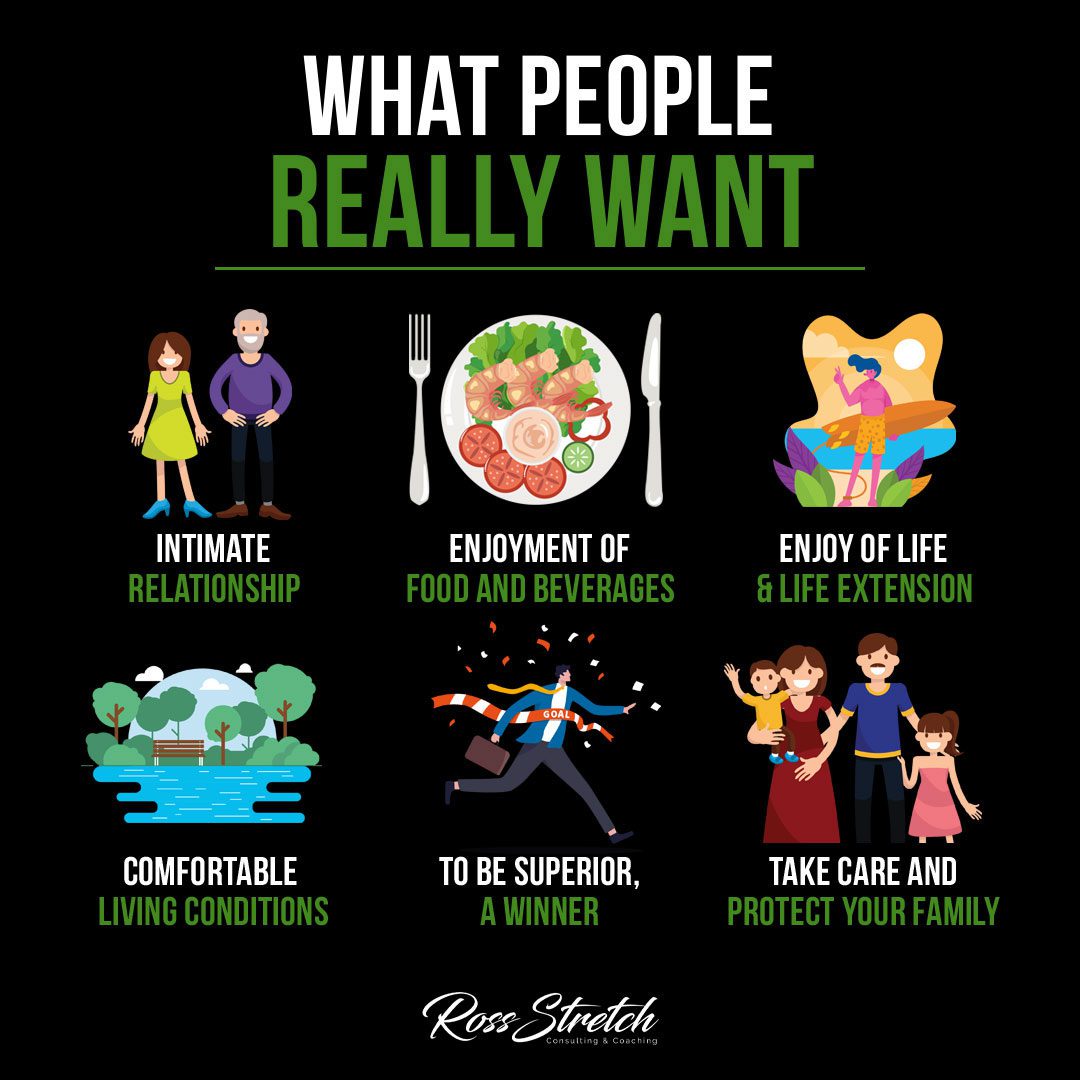
The Desire for Deep Connection
\
\
Humans are fundamentally social animals. Our evolutionary history has hardwired us to seek connection, belonging, and intimate relationships. Research consistently shows that social connection is among the strongest predictors of happiness, health, and longevity — more powerful, in fact, than diet, exercise, or socioeconomic status. The Harvard Study of Adult Development, one of the longest-running studies on human wellbeing, found that the quality of close relationships was the most reliable predictor of life satisfaction and even physical health in later decades. Connection is not a luxury — it’s a core human need.
\
\
This desire for belonging has enormous commercial significance. Products and brands that successfully tap into the human need for community command fierce, durable loyalty. Harley-Davidson didn’t just sell motorcycles — it sold membership in a culture. CrossFit didn’t just sell fitness programming — it sold belonging to a tribe. When a business helps its customers feel connected to something larger than themselves, it stops functioning as a vendor and begins operating as a cultural institution, which is a far more defensible competitive position.
\
\
For entrepreneurs, the practical implication is clear: build community around your product or service, not just a customer base. People who feel genuinely connected to a brand and to each other become your most powerful marketing force — advocates who refer others and defend your brand because membership in your community is part of their identity.
\
\
\
\
The Pursuit of Pleasure and Experience
\
\
The desire for enjoyment — through food, travel, entertainment, beauty, and sensory pleasure — is one of the most reliable drivers of consumer spending in every economy. Humans don’t just seek the absence of pain; they actively pursue positive experiences that make life feel richer and more meaningful. This is why the experience economy has grown so dramatically over the past two decades, with people increasingly allocating spending toward experiences rather than possessions.
\
\
Research on the psychology of happiness, including work by Cornell psychologist Thomas Gilovich, shows that experiences deliver more lasting satisfaction than objects of equivalent cost. The restaurant industry, the travel industry, the entertainment industry, and even the personal care industry are all, at their core, in the business of selling positive emotional states. The businesses that understand this don’t sell products — they sell how the product makes you feel. A high-end restaurant isn’t selling food; it’s selling an evening of pleasure, connection, and memory-making.
\
\
This insight applies equally to personal financial decisions. Knowing that experiences tend to generate more sustained happiness than material purchases gives you a rational basis for spending decisions that might otherwise seem indulgent. Investing in travel, meaningful experiences with people you care about, and activities that create lasting memories is not frivolous — it’s aligned with what the research actually shows about human wellbeing.
\
\
\
\
The Need for Security and Comfort
\
\
Abraham Maslow identified safety and security as foundational human needs — and the commercial implications of that need are enormous across every industry. People will spend significantly to protect what they have, to reduce uncertainty, and to create environments that feel predictable and safe. This is why insurance is a massive industry, why home security systems command premium pricing, and why financial products that promise stability attract enormous amounts of capital even during periods of strong market performance.
\
\
Psychological comfort extends beyond physical safety. The feeling of predictability, reliability, and control is equally powerful. Brands that are consistently reliable build enormous trust advantages over time. When people know exactly what they’re going to get from a company — whether it’s a fast food restaurant or an accounting firm — the cognitive burden of choosing drops to near zero. That reliability is itself a product, and it commands a significant price premium in markets where it’s genuinely rare.
\
\
For entrepreneurs, addressing the security desire often means making the purchase decision feel safe rather than risky. Money-back guarantees, transparent return policies, clear warranties, and authentic customer reviews all serve this function. When buying feels safe, conversion rates rise. When it feels uncertain or opaque, they fall — regardless of how good the product actually is. Reducing perceived risk is often more commercially impactful than improving the product itself.
\
\
\
\
The Drive for Status and Achievement
\
\
The desire to be respected, recognized, and seen as successful is one of the most powerful drivers of human behavior — and one of the most commercially significant. Status-seeking behavior explains the existence of the luxury goods industry, the premium placed on prestigious educational credentials, the appeal of exclusive memberships, and the willingness to pay significantly more for a product that visibly signals success to others.
\
\
This is not shallow vanity — it’s deeply rooted in our social evolution. Status signaling was, and in many ways still is, a survival and reproductive strategy. High-status individuals historically had better access to resources, alliances, and protection. Our brains remain wired to care about social hierarchy, even when our rational minds know it isn’t the most important thing. Understanding this helps explain purchasing behavior that might otherwise seem irrational from a purely economic standpoint.
\
\
The achievement dimension of this desire is equally important and more universally accessible. People want to feel competent, to make measurable progress, and to reach goals they’ve set for themselves. This is why gamification works so effectively, why fitness apps celebrate every milestone, and why learning platforms track and display progress. When you help someone feel like they’re winning — even in small, incremental ways — you build the kind of engagement and habit formation that is very difficult for competitors to disrupt.
\
\
\
\
The Instinct to Protect and Provide
\
\
The desire to care for and protect those we love may be the most primal of all human motivations. Parents will sacrifice an extraordinary amount for their children’s wellbeing and future. Partners make major financial decisions based on protecting each other from uncertainty. This protective instinct extends beyond immediate family to community, future generations, and legacy — what we will leave behind when we’re gone.
\
\
Commercially, this desire powers some of the largest industries in the world: life insurance, children’s education products, estate planning services, financial planning, and healthcare. When you frame a product or service in terms of protection — protecting your family’s financial future, your children’s opportunities, your health, or your ability to provide — you access one of the deepest and most durable emotional drivers available. This framing works not because it manipulates, but because it addresses a genuine and profoundly felt need.
\
\
For those building personal financial plans, this same protective instinct provides the emotional fuel for genuinely long-term thinking. Shifting your framing from saving for your own retirement to building something that protects and benefits the people you love most transforms wealth-building from a personal exercise into a legacy project. That shift in purpose is often the difference between incremental saving and deeply motivated, sustained financial discipline.
\
\
\
\
Conclusion: Applying Human Desire to Life and Business
\
\
The desires explored in this article — connection, pleasure, security, status, and protection — represent the core drivers behind the majority of significant decisions people make, both as consumers and as human beings navigating their lives. Whether you’re building a business, developing a product, crafting a marketing message, or making decisions about your own priorities, understanding these motivations gives you a framework for asking better questions and making more effective choices. The businesses that thrive long-term, and the people who build genuinely fulfilling lives, are those who engage authentically with what humans actually want — not what they say they want, but what drives them at a level deeper than words.
\
\
\
\
Resources
\
\
- \
- Influence: The Psychology of Persuasion by Robert Cialdini — the definitive work on the principles that drive human decision-making and compliance
- Harvard Business Review: The Elements of Value — research identifying the 30 fundamental attributes that drive consumer purchasing decisions
- Buyology by Martin Lindstrom — groundbreaking research on the subconscious forces that shape buying behavior
- Predictably Irrational by Dan Ariely — a behavioral economist’s exploration of why humans make the choices they do, and how to design for it
\
\
\
\

 Ross Stretch