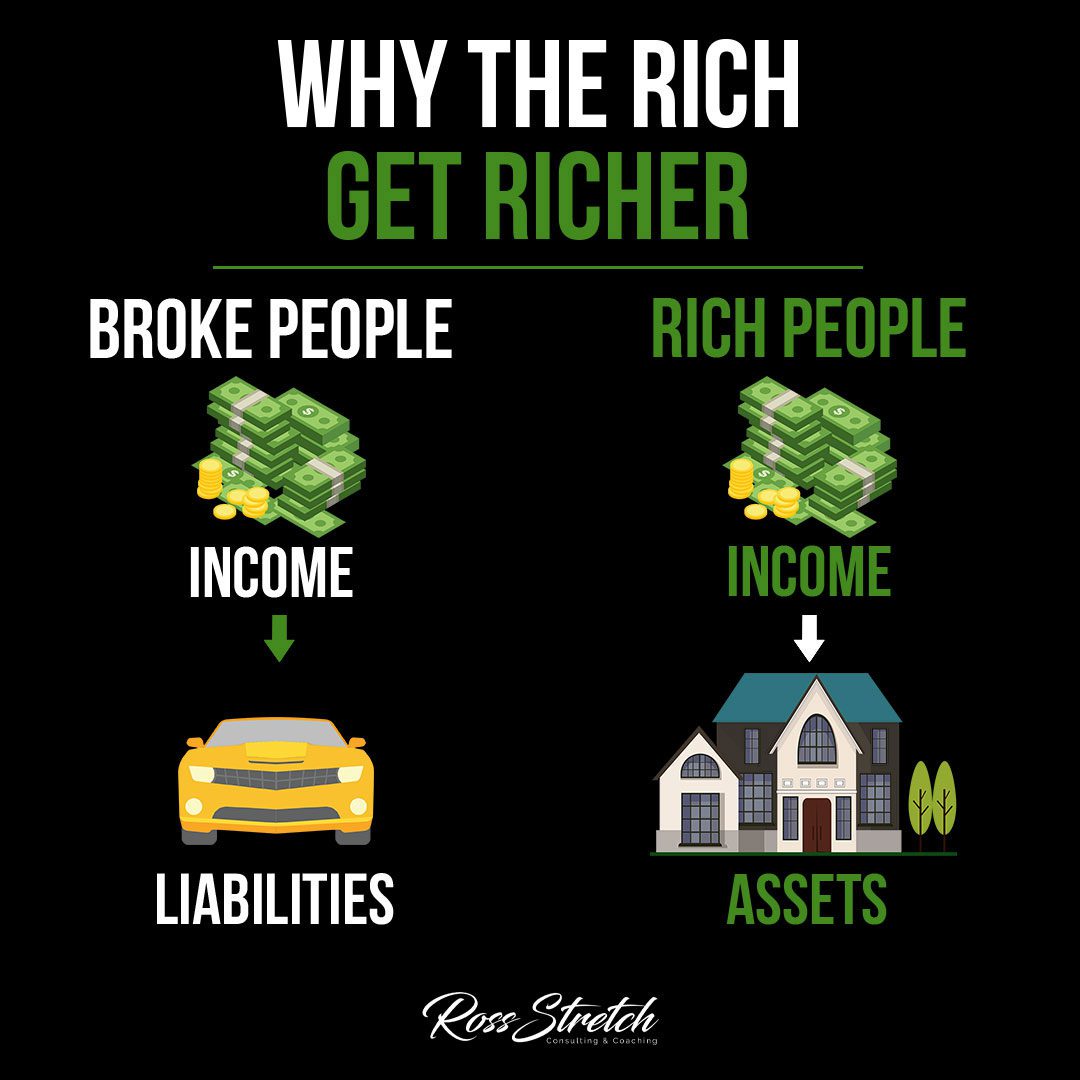
The gap between those who accumulate wealth and those who struggle financially is not simply a matter of luck or inheritance. At its core, the wealth gap is driven by three fundamental forces: income potential, asset acquisition, and the burden of liabilities. Understanding these dynamics — and the systemic factors that reinforce them — can help anyone make smarter financial decisions and chart a course toward lasting financial independence.
The Income Equation: Why Earning More Is Only the Beginning
Most people understand that higher income leads to greater wealth, but the relationship is more nuanced than it appears. Rich individuals don’t just earn more — they earn differently. A salaried employee trading time for money faces a hard ceiling on income; a business owner or investor earns even while sleeping. The distinction between active income and passive income is one of the defining financial divides of our time.
Broke individuals often face limited income potential due to low-paying jobs, lack of educational opportunities, or restricted access to professional networks. According to the Economic Policy Institute, workers in the bottom wage quintile have seen their real wages stagnate for decades, while those at the top have enjoyed consistent gains — a divergence driven largely by access to high-skill, high-demand careers and equity-based compensation that most workers never see.
The path forward requires deliberately expanding income potential — through education, skill acquisition, strategic negotiation, or entrepreneurship. Even a sustained 20% increase in earnings, consistently invested over a decade, can radically alter a person’s financial trajectory. The key is turning income growth into asset accumulation rather than lifestyle inflation. More money without more assets is just more spending.
Multiple Income Streams: The Wealthy Person’s Safety Net
One of the clearest distinctions between the wealthy and the financially struggling is the number of income streams each relies upon. The rich rarely depend on a single paycheck. They diversify their earnings through salaries, dividends, rental income, royalties, and business profits — creating financial resilience that insulates them from economic downturns and job market disruptions.
According to Federal Reserve data, the wealthiest 10% of Americans hold nearly 70% of all financial wealth, much of it in the form of business equity and investment portfolios that generate ongoing passive income. This income compounds over time, creating an ever-widening advantage over those who rely on wages alone. The structural advantage isn’t just what they earn — it’s that their money earns money independently of their effort.
Building even a modest second income stream — freelancing, dividend investing, a small rental property — can meaningfully change your financial position over time. The goal isn’t to work multiple exhausting jobs; it’s to build systems and assets that generate income independently of your direct, ongoing effort. This is the transition from working for money to having money work for you.
Assets vs. Liabilities: The Fundamental Divide
As Robert Kiyosaki explained in Rich Dad Poor Dad, the rich buy assets while the poor and middle class buy liabilities they mistake for assets. Rich individuals strategically acquire income-generating assets — real estate, stocks, businesses — that appreciate in value and produce passive returns. Broke individuals, meanwhile, often carry a heavy burden of consumer debt, high-interest loans, and depreciating purchases that drain their monthly cash flow without building anything of lasting value.
Consider the contrast: a luxury car loses 20–30% of its value in the first year of ownership, costs money to insure and maintain, and generates zero income. A rental property, by contrast, can produce monthly cash flow while appreciating over time. Both involve significant spending, but only one builds wealth. Every dollar spent on a liability is a dollar that cannot become an asset — and that opportunity cost compounds every year it isn’t invested.
When debt payments consume 40–50% of monthly income — a reality for millions carrying student loans, car payments, and credit card balances — there is simply no capital left to invest. The first step for many people isn’t learning which stocks to buy; it’s freeing up cash flow by eliminating high-interest liabilities and redirecting those dollars toward income-producing assets. The path to wealth is blocked until that foundation is cleared.
The Power of Compounding: Time as the Ultimate Wealth Builder
Compound interest is arguably the most powerful force in personal finance — and it works equally for and against you, depending on which side of the ledger you occupy. For investors, compounding turns modest, consistent returns into substantial wealth over time. For debtors carrying high-interest balances, compounding accelerates the downward spiral, ensuring that small debts become crushing obligations if left unaddressed.
A straightforward illustration: $10,000 invested at a 7% annual return grows to roughly $76,000 over 30 years without adding a single additional dollar. Add $500 per month to that initial investment, and it grows to over $600,000. The math is unforgiving — every year you delay investing is a year of compounding permanently surrendered. This is why wealthy individuals begin investing early and reinvest returns rather than spending them.
Wealthy individuals harness this principle deliberately — reinvesting dividends, profits, and returns rather than cashing them out for consumption. This snowball effect, where returns generate their own returns, is why wealth accelerates over time for those who start early and stay consistent. For those starting from behind, the same principle applies: small, consistent investments in index funds or retirement accounts can generate remarkable wealth over a working career. The barrier is rarely the math — it is the monthly cash flow and the discipline to begin.
The Role of Financial Literacy in Closing the Gap
Financial literacy is one of the most underappreciated factors in the wealth gap. Wealthy families often transmit financial knowledge across generations — how to read a balance sheet, structure a business, negotiate compensation, or legally optimize tax strategies. Those without this inherited education are left to figure it out independently, often making costly and avoidable mistakes in the process.
According to the FINRA Investor Education Foundation’s National Financial Capability Study, only 34% of Americans can correctly answer five basic financial literacy questions covering concepts like inflation, interest rates, and diversification. This knowledge gap translates directly into a wealth gap: people who understand investing start earlier, avoid high-fee financial products, and make better decisions during market volatility. Ignorance is expensive in ways most people never calculate.
Closing the wealth gap starts with closing the knowledge gap. Free and low-cost resources — through Khan Academy, Investopedia, public libraries, and community financial education programs — provide access to the same financial education once available primarily to the privileged. The decision to educate yourself financially is one of the highest-ROI investments available to anyone, at any income level. Financial literacy and education are crucial in empowering individuals to make informed decisions and manage their finances effectively.
Systemic Factors: The Barriers Beyond Personal Choice
Honest analysis of the wealth gap demands acknowledgment of structural barriers that individual effort alone cannot fully overcome. Discriminatory lending practices, unequal school funding, and limited access to startup capital continue to create measurable disadvantages for specific communities. Recognizing these systemic factors isn’t defeatist — it’s necessary for accurate diagnosis and effective action at both the personal and policy level.
Understanding which obstacles require systemic solutions — and which can be addressed through personal strategy — allows individuals to focus their energy where it has the most impact. Equal access to quality education, fair lending, and entrepreneurship support programs are investments in a more productive economy that benefits everyone. In the meantime, individuals navigating systemic disadvantages must be especially intentional about building financial knowledge, seeking mentorship, and identifying communities and networks that can expand access to opportunity. By addressing income disparities and limited access to opportunities, society can strive toward a more equitable financial landscape.
Conclusion
The wealth gap is not a mystery. It is the predictable result of income differentials, strategic asset allocation, the burden of liabilities, and unequal access to financial knowledge — all compounded over decades. Understanding these dynamics is the essential first step toward changing them, both individually and collectively. The rich continue to accumulate wealth because they understand and leverage these forces; anyone who learns to do the same puts themselves on a dramatically different trajectory.
By adopting strategies that enhance income potential, promote asset acquisition, and reduce liabilities — while simultaneously building financial literacy — anyone can begin improving their financial position. The path isn’t equally accessible for everyone, and acknowledging that matters. But the tools exist: deliberate investment, financial education, multiple income streams, and the discipline to build assets instead of accumulate liabilities. Every intentional financial decision narrows the gap, one choice at a time.
Resources


 Ross Stretch