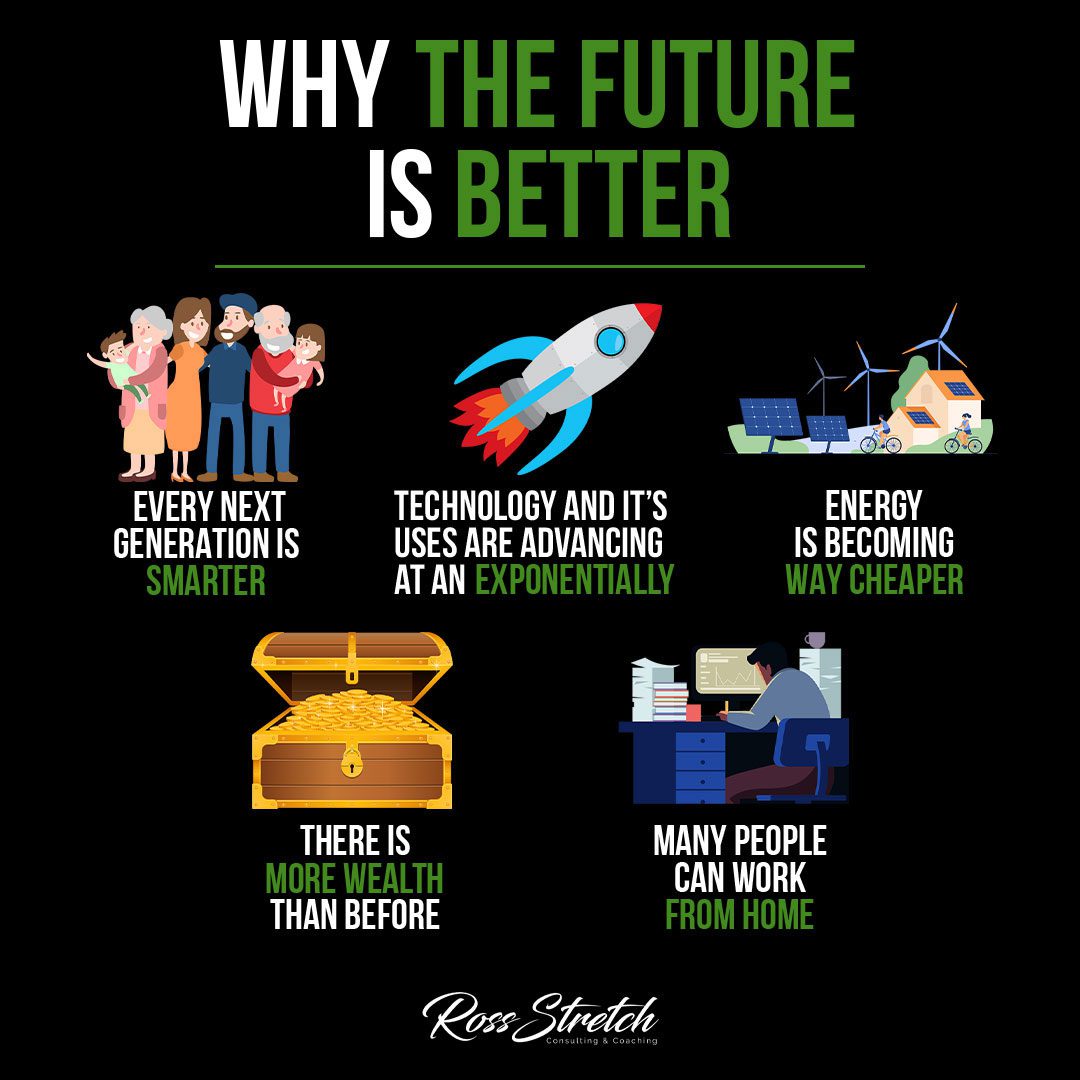
Despite the relentless stream of alarming headlines that dominates daily news cycles, the long arc of human progress is unmistakably upward. Technological innovation, expanding access to education, falling energy costs, and the rise of location-independent work have created a world that offers more opportunity, more freedom, and more prosperity than any previous generation has experienced. That doesn’t mean the future is without challenges — it means that the tools available to solve those challenges are more powerful than ever. If you’re building a business or a financial future today, the structural conditions in your favor have never been more favorable in human history.
Each Generation Builds on What Came Before
One of the most consistent patterns in human history is that each successive generation inherits a more sophisticated knowledge base than the one before it. Psychologists call this the Flynn Effect: the documented rise in average IQ scores across populations throughout the 20th century, attributed largely to better nutrition, broader education, and exposure to increasingly complex cognitive environments.
Today’s young people grow up navigating multi-layered digital systems, global information networks, and multi-platform communication that develop cognitive capabilities far more sophisticated than those required in previous eras. The average person today has access to more educational resources, more information on demand, and more sophisticated mental models than researchers in elite universities had access to fifty years ago.
This accumulation of collective intelligence means that the problems of the future will be worked on by the most capable population that has ever existed. Combined with tools that amplify human thinking — AI, simulation, global collaboration infrastructure — the compound effect of these cognitive gains is extraordinary. That’s a genuinely optimistic reality, and one that rarely receives the attention it deserves.
Technology Is Advancing Faster Than Any Previous Era
Advances in artificial intelligence, biotechnology, materials science, and energy storage are converging in ways that are compressing decades of progress into years. What once required massive corporate research and development budgets now requires a laptop, an internet connection, and the willingness to learn. The barrier to building sophisticated technology products has never been lower.
For entrepreneurs and individuals building their financial futures, this acceleration represents genuine opportunity. Tools that were enterprise-only five years ago — AI-powered analytics, advanced automation, sophisticated content creation — are now accessible to small businesses and independent operators at near-zero cost. The gap between what a large company can do and what a motivated individual can build has never been smaller.
Technology is also democratizing who gets to participate in high-value markets. A developer in one country, a designer in another, and a marketer on a different continent can form a world-class team without ever sharing a physical office. The geographic and capital barriers that historically limited who could participate in global commerce are eroding rapidly — and that creates a more competitive but far more inclusive economic environment.
Energy Costs Are Falling — And the Implications Are Enormous
Energy is the foundational input of virtually every economic activity, and its cost has fallen dramatically over the past decade. The cost of utility-scale solar power dropped by more than 90 percent between 2010 and 2023. Wind energy costs fell by over 70 percent in the same period. Battery storage costs continue to decline steeply, enabling the electrification of transportation, industrial processes, and heating systems that were previously dependent on fossil fuels.
Cheaper energy means lower production costs across every industry that relies on it — which is to say, every industry. It means greater energy independence for nations that have historically been dependent on imported commodities, reduced vulnerability to geopolitical supply shocks, and the potential to bring reliable electricity to the hundreds of millions of people worldwide who still lack consistent access to it.
For those thinking about long-term financial planning, the energy transition reinforces the case for optimism about global productivity growth. Lower energy costs raise the productive potential of every economy that embraces the transition — which translates into broader prosperity, expanding consumer markets, and new categories of entrepreneurial opportunity that don’t yet exist.
Global Wealth Has Never Been Higher — And It’s Spreading
By nearly every objective measure, human material well-being has improved dramatically over the past two centuries. Global extreme poverty has fallen from over 80 percent of the world’s population in 1820 to under 10 percent today. Life expectancy has roughly doubled. Child mortality has plummeted. Literacy rates have surged. These are extraordinary achievements of human cooperation, trade, and applied innovation.
The rise of the global middle class — particularly in Asia, Latin America, and increasingly in sub-Saharan Africa — represents one of the largest expansions of consumer purchasing power in history. This growing affluence creates massive new markets for products and services that didn’t exist a generation ago, and it creates demand for entrepreneurial innovation from people who understand those markets from the inside.
The tools for wealth creation — access to capital markets, online business infrastructure, global payment networks, and digital distribution — are more widely available than at any point in history. The opportunity to participate in wealth creation has genuinely never been more democratic. Someone with a strong skill set, an internet connection, and genuine discipline can build a viable income from virtually anywhere in the world.
Remote Work Has Permanently Expanded Economic Opportunity
Prior to 2020, remote work was a perk offered by progressive employers to a minority of knowledge workers. The pandemic forced a rapid, large-scale global experiment in distributed work — and the results were broadly positive. Productivity held up, talent was retained, and both employees and employers discovered that physical co-location was far less essential than most had assumed. The result is a permanent structural shift in how and where knowledge work gets done.
For individuals, remote work represents a meaningful expansion of freedom. Workers in smaller cities or rural areas now have access to job markets that were previously limited to expensive urban centers. People with caregiving responsibilities can maintain professional careers more effectively. And skilled knowledge workers anywhere in the world can now compete for positions at organizations they previously couldn’t have accessed without relocating.
For entrepreneurs, the remote-first economy means lower overhead, access to global talent pools, and the ability to build distributed teams without the constraints of geography. Companies that might once have been limited to local hiring can now source the best people for each role from anywhere in the world — and pass the resulting productivity and quality gains on to customers and stakeholders alike.
Conclusion
Pessimism about the future is easy — bad news is immediate, vivid, and emotionally compelling. But the data tells a different story: rising collective intelligence, accelerating technology, falling energy costs, growing global prosperity, and expanding access to economic opportunity. None of this means the work of building something valuable is simple, or that real challenges don’t exist. What it means is that the tools, access, and structural conditions for success have never been better. The future belongs to those who can see through the noise and act deliberately on the genuine opportunity in front of them.
Resources
- The Rational Optimist by Matt Ridley — the data-driven case for why progress is real and ongoing
- Our World in Data: Global Extreme Poverty — the long-run data on prosperity
- Our World in Data: Renewable Energy — tracking the decline in clean energy costs
- World Economic Forum: The Future of Remote Work

 Ross Stretch