Almost every failure in career, business, and finance can be traced back to a mindset problem before it becomes a strategy problem. People don’t fail to build wealth because they lack information — they fail because they don’t believe, at a fundamental level, that financial security is genuinely available to them. Entrepreneurs don’t fail because they lack a viable idea — they fail because their internal narrative about risk, failure, and worthiness isn’t aligned with what building a business actually demands.
The claim that mindset is 99% of the game sounds like motivational hyperbole until you examine what’s actually happening in the cases where talented, resourceful people consistently underperform relative to their potential. The execution gap — the space between knowing what to do and actually doing it — is almost always a mindset gap. Close it, and the results tend to follow.
Why Mindset Determines Everything
Carol Dweck’s research at Stanford University established the framework that has since become foundational in performance psychology: the distinction between a fixed mindset and a growth mindset. People with a fixed mindset believe their intelligence, talent, and capabilities are static — you either have it or you don’t. People with a growth mindset believe abilities can be developed through effort, strategy, feedback, and mentorship. The practical consequences of these two belief systems are enormous.
Fixed mindset individuals avoid challenges that might reveal incompetence, give up quickly in the face of obstacles, interpret feedback as personal attack, and feel threatened by others’ achievements. Growth mindset individuals seek out challenges, persist through setbacks, treat feedback as useful information, and draw inspiration from observing what others have accomplished. Same circumstances, entirely different trajectories — driven almost entirely by a belief about how ability works.
In business settings, growth mindset leaders create more innovative cultures, make better decisions under uncertainty, and develop their teams more effectively. The mindset you bring to your career is not a background condition — it is an active variable that shapes every decision, relationship, and result you produce over years and decades of professional life.
Rewiring Negative Thought Patterns
The mind does not default to positive, constructive thinking without deliberate effort. The negativity bias — the human tendency to weight negative information more heavily than positive — is evolutionary in origin, not a personal failing. But in a modern context where the threats we face are psychological rather than physical, the negativity bias often works against us, amplifying perceived risks while minimizing actual opportunities and assets.
Rewiring negative patterns is not about forced positivity or pretending problems don’t exist. It’s about developing the habit of examining your thoughts rather than being unconsciously driven by them. Cognitive reframing — identifying a negative thought, questioning its accuracy, and replacing it with a more balanced alternative — is one of the most evidence-backed tools in psychology for doing exactly this. A thought like “I’m terrible at sales” becomes: “I don’t have much sales experience yet, and I know it’s a skill that can be learned.” The reframe isn’t dishonest — it’s more accurate than the distorted original.
Most negative self-talk is distorted in the direction of permanence and pervasiveness: this always happens, I never succeed, I’m the only one who struggles with this. None of these are accurate descriptions of reality. Challenging those distortions directly — in writing, in conversation with a trusted person, or through structured reflection — creates space for more functional thinking to emerge and take hold over time.
Taking Action — The Bridge Between Mindset and Results
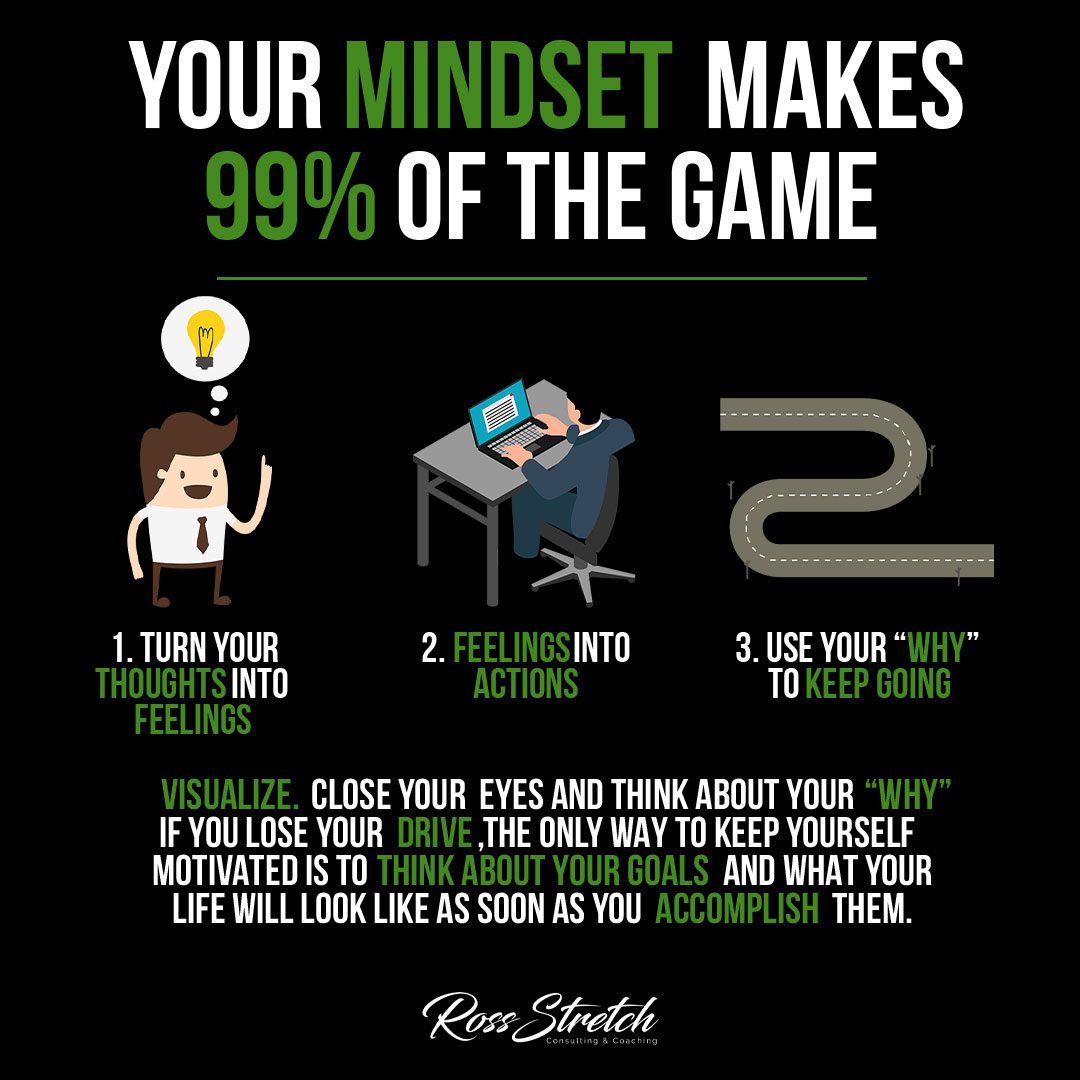
A positive mindset without consistent action is just comfortable fantasy. The bridge between thought and result is behavior — specifically, the daily behaviors that accumulate into meaningful outcomes over weeks, months, and years. The professionals who understand this don’t wait to feel ready or sufficiently motivated before taking action. They act, and allow the action itself to generate momentum.
Motivation is commonly misunderstood as a precondition for action. In reality, motivation is frequently a product of action rather than a prerequisite for it. Getting started on a project — even reluctantly, even imperfectly — creates forward motion that wasn’t present before you began. Taking action changes your psychological state, and that changed state makes continued action more accessible. The person who waits for motivation before starting is often waiting indefinitely.
The practical implication is to consistently bias toward starting small rather than waiting for ideal conditions. The person who writes 200 words every morning will have a book within a year. The person who plans to write when they finally have a long, uninterrupted block of time will, in most cases, still be planning a year from now. Conditions are rarely ideal. The work happens anyway or it doesn’t happen at all.
Anchoring to Your “Why”
Every ambitious goal includes a period where the work is real and the reward isn’t yet visible. This is the window where most people quit. The professional who sustains effort through that difficult period is almost always the one with a clear, emotionally compelling reason for doing it — a why that goes substantially deeper than the surface-level goal.
“I want to make more money” is a motivation. “I want to build financial security so my family doesn’t live with the anxiety I grew up with” is a driver. The second version creates a fundamentally different quality of commitment because it connects the goal to something that genuinely matters. When the work gets hard — and it reliably will — surface motivations fade quickly. Deep drivers don’t fade in the same way, because they’re connected to identity and values rather than just desire.
Clarifying your why doesn’t require a dramatic revelation. It requires honest reflection about what you actually value, what you’re genuinely afraid of, and what kind of life you’re actually building toward. Once you understand those things clearly, you can connect your daily work to outcomes that matter — and that connection is what makes sustained effort feel meaningful rather than merely exhausting.
Visualization as a Performance Tool
Visualization is sometimes dismissed as wishful thinking, but the research on mental rehearsal is more substantive than its popular reputation suggests. Studies of elite athletes — from Olympic competitors to professional golfers — consistently show that vivid mental rehearsal activates many of the same neural pathways as physical practice. Athletes who rehearse their performance mentally, in addition to physically, tend to outperform those who rely on physical practice alone.
Applied to career and business goals, visualization works not by magically attracting outcomes but by training your brain to recognize and respond to opportunities aligned with what you’re focused on. The reticular activating system — the brain’s filtering mechanism — prioritizes information that matches your current goals and concerns. When you consistently visualize a specific outcome, you effectively program this filter to surface relevant data, opportunities, and connections that an unfocused mind would have ignored or missed entirely.
Effective visualization is specific and sensory rather than vague and abstract: see the outcome clearly, feel what achieving it actually feels like, and mentally rehearse the actions required to get there — not just the destination. Five minutes of deliberate, specific visualization each morning is a small, consistent investment with a disproportionate impact on focus and follow-through across the rest of the day.
Conclusion
Mindset is not a soft concept. It is the operating system that determines how you process information, respond to challenges, and what actions you take every day across every domain that matters. Develop a growth orientation, challenge your negative patterns directly, act before you feel fully ready, anchor to a compelling and personal why, and use visualization to keep your brain oriented toward what you’re building. These are not passive practices — they require consistent effort. But that effort compounds in the same direction as the results you’re pursuing: toward a life and career that reflects your actual potential rather than the limits of your current thinking.
Resources
- Mindset: The New Psychology of Success by Carol Dweck — The foundational research on growth versus fixed mindset and its measurable impact on performance
- James Clear: Identity-Based Habits — How to align your self-concept with the behaviors that produce lasting, compounding change
- Harvard Business Review: What Having a Growth Mindset Actually Means — A research-backed clarification of the concept and how to apply it practically in professional contexts
- Tony Robbins on the Power of Mindset — Practical mindset frameworks from one of the most recognized performance coaches working today

 Ross Stretch