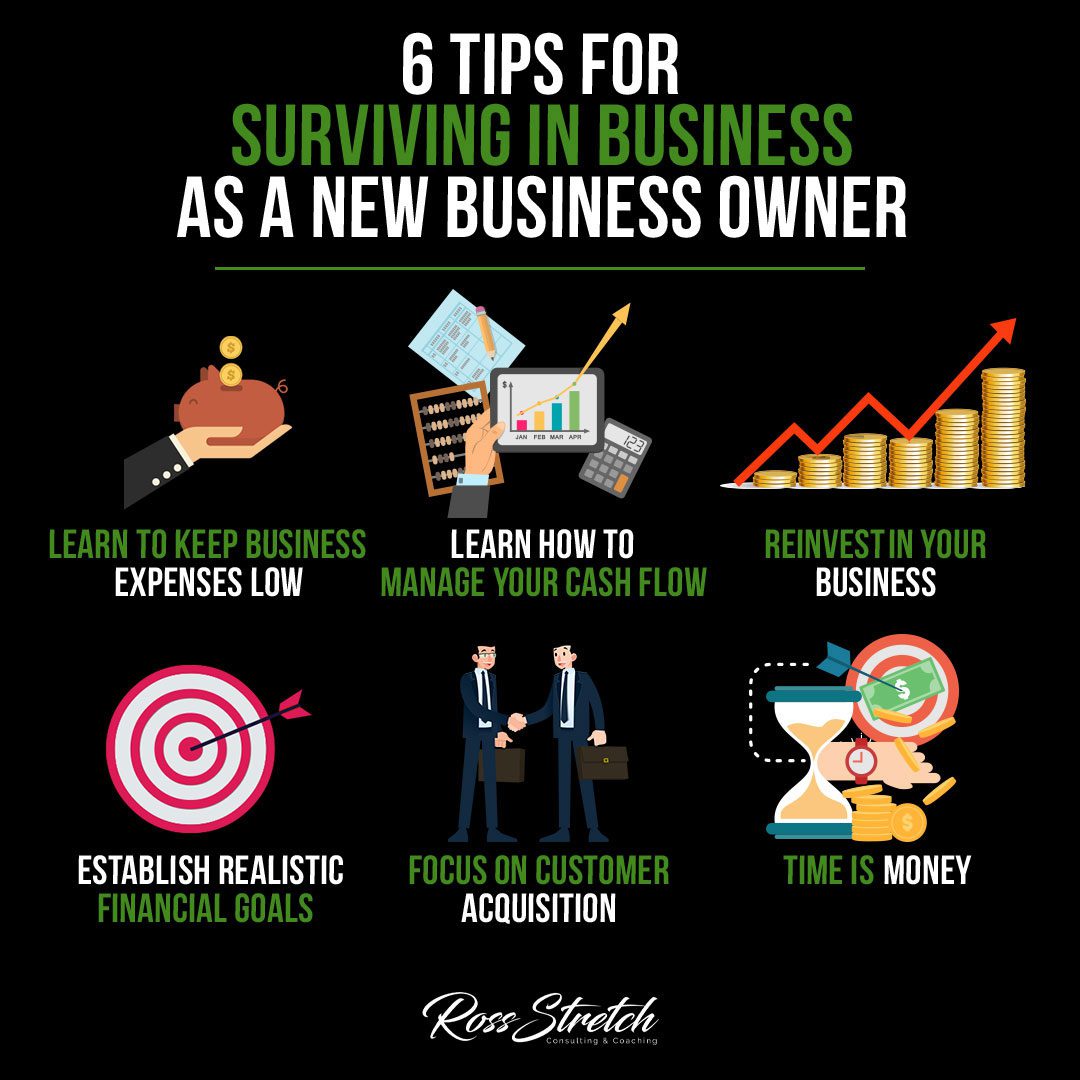

The first two years of any business are a brutal filter. According to the U.S. Bureau of Labor Statistics, roughly 20% of new businesses fail within year one — and nearly half are gone by year five. The survivors aren’t always those with the best ideas. They’re the ones run by owners who mastered the fundamentals of business survival before chasing growth. Here are six tips for new business owners that need to be implemented immediately — not someday, not when you’re more established, but now.
1. Keep Business Expenses Ruthlessly Low
Your Survival Window Is Longer When Your Burn Rate Is Smaller
In the early stages, cash is oxygen. Every dollar you don’t spend on overhead extends your runway — the critical window of time you have to find customers, refine your offer, and reach profitability. New business owners routinely overinvest in office space, branding, and software they don’t yet need, burning through capital before meaningful revenue arrives.
- Actionable Tip: Build a “minimum viable budget” — a lean spreadsheet listing only the expenses absolutely required to deliver your product or service to your first 10 paying customers. Cut everything else, including anything that makes you feel like a “real” business but doesn’t directly produce revenue. Add expenses back only when income explicitly justifies them.
- Why It Works: The Lean Startup methodology, validated across thousands of businesses, demonstrates that resource constraints force creative problem-solving and stronger unit economics. Companies built lean in early stages develop better operational discipline and healthier profit margins than those spending toward a vision before proving the model works.
Pro Tip:
Negotiate everything — especially in the beginning. Supplier rates, software subscriptions, professional service fees, and even office rent are far more flexible than they appear. A simple email asking “Is there any flexibility on pricing for a business just starting out?” will surprise you with how often the answer is yes. Every dollar saved extends your runway.
2. Master Cash Flow Before Everything Else
Profitable Businesses Fail When They Run Out of Cash — Don’t Let That Be You
Profitability and cash flow are not the same thing, and confusing them is a fatal mistake. Many businesses show a profit on paper while running dangerously short of actual cash because invoices go unpaid, expenses are front-loaded, or revenue is seasonal. Cash flow management is the unglamorous skill that keeps the lights on during the inevitable gaps between billing and collection.
- Actionable Tip: Build a 13-week rolling cash flow forecast — a week-by-week projection of money in and money out for the next quarter. Update it every Monday morning. This single habit gives you 90 days of visibility into potential cash crunches before they become crises, so you can act deliberately instead of reacting desperately.
- Why It Works: A problem identified eight weeks in advance costs a fraction of what it costs when discovered eight hours before payroll. The 13-week rolling forecast is the standard cash management tool used by CFOs and turnaround specialists precisely because it transforms reactive firefighting into proactive, strategic planning.
Pro Tip:
Invoice immediately upon project completion or delivery — never batch invoices to the end of the month. Every day of delay on an invoice is a day of delay on your payment. Consider requiring a 25 to 50 percent deposit from new clients upfront to reduce your exposure, pre-fund your work, and quickly identify clients who aren’t serious about moving forward.
3. Reinvest Strategically, Not Emotionally
The Difference Between Smart Reinvestment and Expensive Wishful Thinking
Once revenue starts arriving, the pressure to spend it is intense — on better equipment, a team member, a premium website redesign. Smart reinvestment is strategic: it deploys capital into activities that directly generate more revenue or remove the biggest operational constraint. Emotional reinvestment is how entrepreneurs spend money that feels like progress but delivers none.
- Actionable Tip: Before any reinvestment decision, identify the single biggest bottleneck currently limiting your growth. Invest there first and nowhere else. If you’re only converting 5% of leads to customers, invest in sales skills — not a new logo. Solving the right problem in the right order is what separates businesses that scale from those that spin their wheels expensively.
- Why It Works: Resource allocation in early-stage businesses has an outsized compounding impact. Every dollar deployed at the actual constraint returns quickly and multiplies. Every dollar deployed elsewhere is deferred return at best and wasted capital at worst. Bottleneck-first thinking is the difference between real growth and impressive-looking motion that goes nowhere.
Pro Tip:
Create a reinvestment threshold from day one: allocate a fixed percentage of each month’s revenue — 15 to 20% is a strong starting point — to a dedicated business reinvestment fund. This creates discipline around reinvestment timing and prevents the emotional, opportunistic spending that tends to happen during unexpectedly strong revenue months.
4. Set Financial Goals That Are Specific and Non-Negotiable
Vague Goals Produce Vague Results — Your Numbers Need to Be Exact
“I want to grow the business” is not a financial goal. A real financial goal looks like this: “$12,000 in monthly recurring revenue by month nine, achieved by closing eight consulting clients at $1,500 per month each.” Specificity is what transforms intention into a plan with daily actions. Ambiguity is what transforms intention into an expensive daydream.
- Actionable Tip: Set your 12-month revenue target, then reverse-engineer it completely. How many clients or units does that require? How many sales conversations to close one client? How many leads to generate one conversation? Build your daily activity targets backward from the revenue goal — not optimistically forward from where you currently stand.
- Why It Works: Goal specificity dramatically increases follow-through, according to implementation intention research by psychologist Peter Gollwitzer. Knowing the exact number creates daily accountability with no room for rationalization — you either hit your activity targets or you didn’t. Vague goals provide endless psychological space to justify falling short.
Pro Tip:
Review your financial goals monthly, not annually. Monthly reviews give you 12 course-correction opportunities per year instead of one grim December reckoning. Adjust targets only if your market has fundamentally changed or new information demands it — never revise them simply because the work turned out to be harder than expected.
5. Make Customer Acquisition Your Obsession in Year One
A Business Without Customers Is an Expensive Hobby
In year one, customer acquisition is the only metric that materially matters. Every other business activity — your systems, your branding, your team structure — only becomes meaningful once you have customers to serve and revenue to sustain operations. New business owners who spread their attention across operations, marketing, and product refinement simultaneously rarely build the customer base needed to survive year two.
- Actionable Tip: Pick one customer acquisition channel — cold outreach, content marketing, referrals, paid advertising, or in-person events — and master it completely before adding a second. Track conversion rates at every stage: impressions to leads, leads to calls, calls to clients. Double down on whatever produces results and cut everything else without sentiment.
- Why It Works: Channel focus produces compounding returns. The deeper your expertise in a single acquisition channel, the lower your cost per customer becomes over time. Businesses that spread thinly across five channels rarely master any of them and pay a premium for every customer they acquire indefinitely — which kills margins at exactly the wrong time.
Pro Tip:
The fastest customer acquisition strategy for most new service businesses is direct, personalized outreach to 10 ideal prospects per day — not passively hoping they find you, but going to them with a clear, specific value proposition. The discomfort of occasional rejection is temporary. The revenue and momentum from one closed client compound forward from there.
6. Manage Your Time Like the CEO You’re Becoming
If You Don’t Control Your Calendar, Your Calendar Controls You
New business owners are often their own worst time managers — responding to whoever is loudest, confusing busyness with productivity, and filling days with tasks that feel urgent but aren’t important. In a business where you are the primary value creator, every hour misallocated is revenue lost, momentum squandered, and ground ceded to competitors who stayed focused.
- Actionable Tip: Every Sunday, identify your three most important outcomes for the upcoming week — the three specific results that, if achieved, would move your business forward most significantly. Schedule protected time blocks for these three priorities before anything else fills your calendar. Treat these blocks as non-negotiable client commitments that cannot be moved.
- Why It Works: Deep work research by Cal Newport and others consistently demonstrates that focused, uninterrupted effort on high-leverage tasks produces disproportionate results compared to reactive, fragmented work. The “three weekly priorities” framework ensures your best cognitive energy flows toward your most important work — not whatever arrived in your inbox last night.
Pro Tip:
Conduct a one-week time audit: record every 30-minute block of your workday and categorize each as “revenue-generating,” “business-building,” or “neither.” Most new business owners are genuinely shocked by how much of their time lands in the third category. The audit makes the invisible visible — which is always the first and most important step to meaningful change.
Conclusion
Surviving the first years of business isn’t about luck — it’s about executing the fundamentals with consistency and discipline. Control your costs, master your cash flow, invest strategically, set precise financial goals, obsess over customer acquisition, and protect your time like the scarce resource it is. Master these six pillars and you won’t just survive the early years — you’ll build the operational foundation for a business genuinely worth scaling.
Resources


 Ross Stretch