Billionaires are not simply lucky. The most studied ones share a remarkably consistent set of habits, priorities, and mental models that compound over time into extraordinary outcomes. What makes their advice valuable is not that it is exotic or unattainable — quite the opposite. The most actionable success principles from top-tier wealth builders are disciplined, repeatable behaviors that anyone can adopt. From how they structure daily decisions to how they protect their sleep and manage their most productive hours, the patterns are learnable. Here are the key lessons that appear repeatedly in the lives of people who have built lasting wealth and influence.
Decision Quality Over Decision Volume
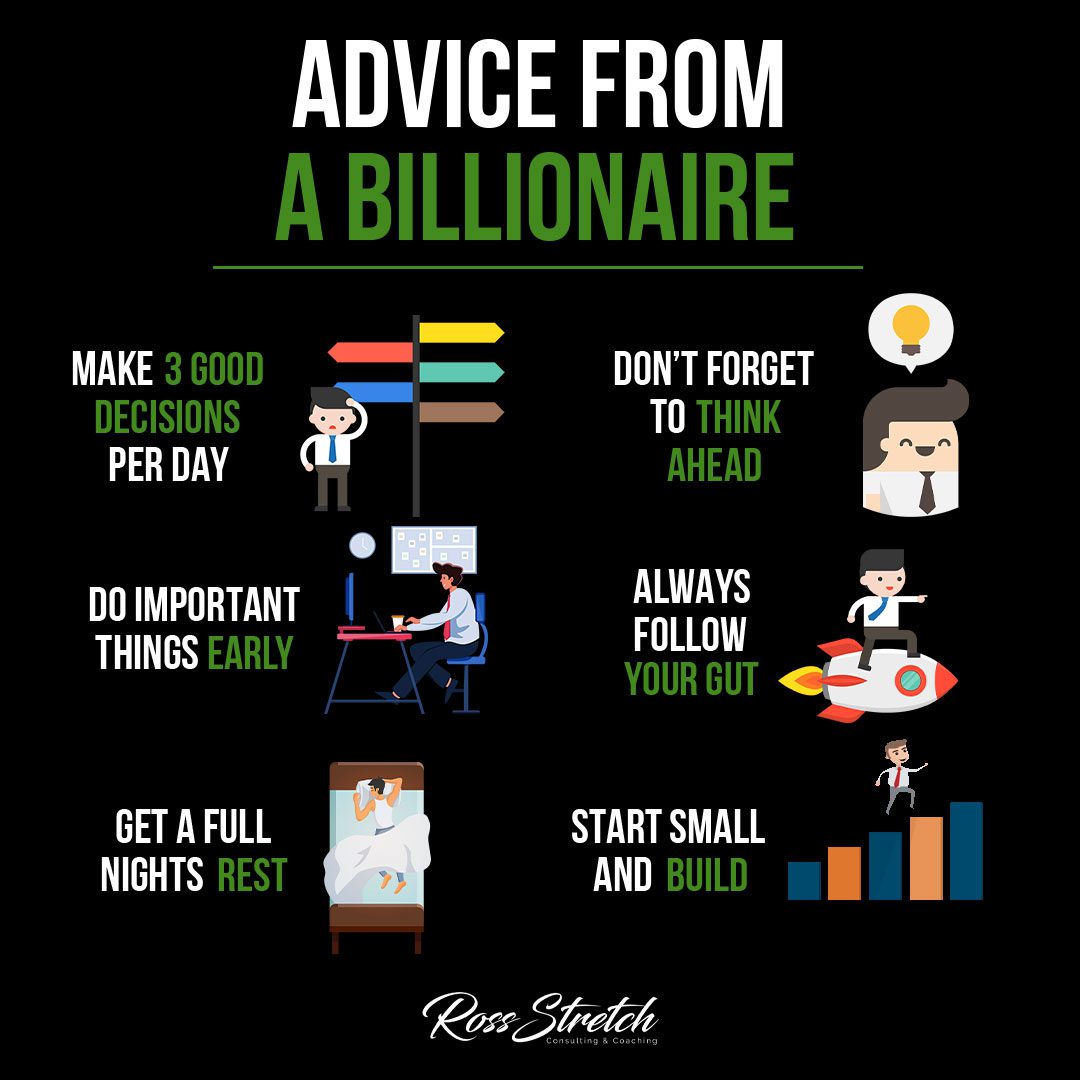
One insight that emerges repeatedly from high-achieving individuals is that the goal is not to make more decisions — it is to make better ones. Jeff Bezos has spoken publicly about aiming for a small number of high-quality decisions per day rather than dozens of reactive ones. Warren Buffett is famous for saying no to almost everything so that his yeses carry genuine weight. The underlying logic is that decision fatigue is real: every choice draws on a finite pool of cognitive energy, and when that pool is depleted by low-stakes decisions, the quality of important ones suffers.
Billionaires protect their decision-making capacity by delegating the routine, automating the predictable, and reserving their best focus for the few choices that actually move the needle. The practical application for anyone: identify the two or three decisions in your week that carry the most consequence. Prepare for those with clear criteria and adequate information. Simplify, delegate, or eliminate everything else wherever possible.
Think Ahead: Long Time Horizons Change Everything
Most people optimize for the next month. Exceptional builders optimize for the next decade. Amazon famously operated at a loss for years because Bezos was playing a competitive game that most of his critics could not see from their shorter time horizons. Thinking ahead is not about prediction — it is about positioning. When you regularly consider where your industry, your market, and your skills will be in five to ten years, you can make decisions today that will look obviously correct in hindsight.
A simple practice: spend thirty minutes per week asking “what will matter more in five years than it does today?” and “what am I doing now that will be irrelevant in five years?” These questions force a longer view that most of your competition is not taking. Over time, consistently thinking at that horizon changes the opportunities you pursue, the skills you develop, and the relationships you invest in.
Prioritize the Most Important Work First
Billionaires understand that energy and focus are not evenly distributed across a workday. Cognitive performance peaks in the morning for most people and declines through the afternoon. Those who build exceptional results tend to guard their early hours fiercely, reserving that peak window for work that requires the most creativity, judgment, or concentration — not email, not meetings, not reactive tasks.
This principle is straightforward in theory and genuinely difficult in practice. Email and meetings expand to fill whatever time is left unprotected. The habit of asking “what is the most important thing I could accomplish today?” and doing that thing first — before anything else — is deceptively powerful. High performers also tend to batch similar tasks together, preserve long blocks of uninterrupted time, and end each workday by setting clear priorities for the following morning so they begin with momentum rather than deliberation.
Trusting Instincts Built From Experience
The concept of “trusting your gut” is often misunderstood as mystical or irrational. In reality, instinct is pattern recognition built from accumulated experience. When a seasoned entrepreneur has a bad feeling about a deal, they are rarely operating on superstition — they are drawing on a database of past experiences, signals, and outcomes that their conscious analysis has not yet fully surfaced.
This is precisely why reading, mentorship, and direct experience all matter: they build the pattern library that instinct draws on. The more relevant experience you accumulate, the more reliable your intuitive responses become. The practical lesson is not to abandon rigorous analysis in favor of gut feeling, but to treat strong intuitive signals as worth investigating seriously. If something feels off despite looking good on paper, dig deeper. If something feels right despite uncertainty, give that feeling its appropriate weight alongside the numbers.
Sleep as a Performance Asset
The glorification of sleep deprivation in hustle culture runs directly counter to what high performers actually practice. Jeff Bezos, Bill Gates, and Warren Buffett have all been vocal about prioritizing eight hours of sleep per night. This is not laziness — it is optimization. Sleep deprivation impairs judgment, reduces creativity, increases emotional reactivity, and degrades decision-making: precisely the capabilities that matter most in high-stakes environments.
The short-term sense of productivity gained by cutting sleep is offset by measurable declines in cognitive performance. Research consistently shows that individuals operating on six hours of sleep or fewer perform as poorly on cognitive tasks as those who are clinically impaired by fatigue, yet most of them believe they are functioning normally. Treat sleep as a non-negotiable input to your performance, not an optional variable to sacrifice when things get busy. Protect your sleep schedule as deliberately as you protect your most important commitments.
Start Small, Scale Deliberately
Nearly every major business began as something far smaller than what it became. Apple started in a garage. Amazon started as an online bookstore selling a single product category. The most successful entrepreneurs did not begin with a master plan for a billion-dollar empire — they began with a focused experiment, learned from real market feedback, and scaled what was working.
Starting small allows you to test assumptions before committing large resources to them. It forces clarity: you cannot hide behind complexity when your team is two people and your budget is minimal. The discipline required to build something that works at a small scale is the same discipline that builds something at a large one — you are simply practicing it at lower stakes. The instinct to wait until conditions are perfect — more capital, more time, more confidence — is one of the most costly delays an aspiring entrepreneur can indulge. Momentum and clarity come from doing, not from preparing to do.
Conclusion
The advice that emerges from studying billionaires is notable for its consistency and its accessibility. Better decisions, longer time horizons, prioritized deep work, calibrated instincts, adequate sleep, and a bias toward starting — none of these require wealth to implement. They require discipline, self-awareness, and the willingness to play a longer game than most people are prepared to sustain. The gap between knowing these principles and living them is where results are built.
Resources
- Principles by Ray Dalio — a detailed framework for decision-making and building high-performance systems
- The Almanack of Naval Ravikant — free resource on wealth, judgment, and long-term thinking
- Farnam Street Blog — in-depth writing on mental models, decision-making, and learning from the best thinkers
- Acquired Podcast — deep-dive business histories of the companies and founders who shaped entire industries

 Ross Stretch