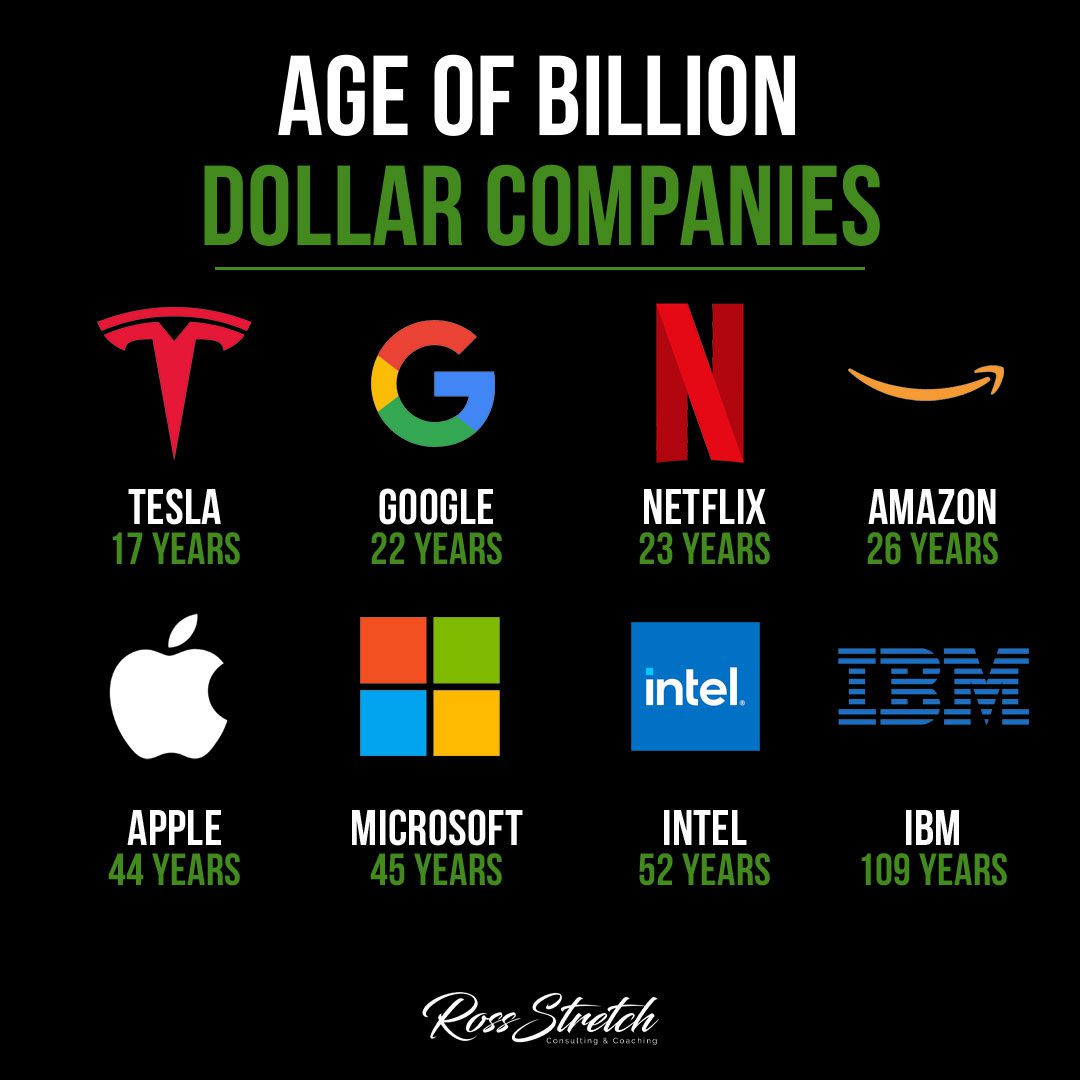
Building a billion-dollar company is one of the rarest achievements in business. Yet when you examine the most successful tech and consumer companies in the world, a consistent truth emerges: extraordinary success almost never happens overnight. Tesla, Google, Netflix, Amazon, Apple, Microsoft, Intel, and IBM are household names today, but each required years — often decades — of relentless execution before achieving their status as global giants. Understanding their timelines reveals patterns that any entrepreneur or investor can apply to their own ambitions.
Why Company Age and Timeline Matter
The relationship between a company’s age and its success is more nuanced than it first appears. Some companies, like Google, achieved billion-dollar valuations within a few years of founding. Others, like IBM, spent decades as an industrial enterprise before becoming a technology giant. What matters is not simply how long a company has existed, but what it did with that time — the pivots it made, the technologies it adopted, and the markets it chose to dominate.
For investors and entrepreneurs, studying these timelines offers a crucial reality check. It counters the mythology that overnight success is the norm. The companies profiled here succeeded not because of luck alone, but because their founders built systems, cultures, and products capable of compounding growth over years and decades. That distinction is worth holding onto when evaluating any business — yours or someone else’s.
The First Movers — IBM and Intel
IBM, founded in 1911, stands as one of the most remarkable examples of corporate longevity in history. What began as a manufacturer of punch-card tabulating machines evolved into a mainframe computing pioneer, then a personal computer trailblazer, and eventually a global IT services and AI company. IBM’s ability to reinvent itself across more than 110 years is a masterclass in strategic adaptation. Companies that survive long enough to see multiple technology cycles — not just ride one — are the true outliers.
Intel’s story, beginning in 1968, traces the arc of the semiconductor industry itself. Co-founded by Gordon Moore — of Moore’s Law fame — Intel delivered the world’s first commercially available microprocessor, the 4004, in 1971. That chip changed computing forever. Over the following five decades, Intel’s relentless investment in chip architecture drove the digital revolution across personal computing, data centers, and mobile devices. Its longevity reflects a core principle: companies that own the foundational technology of an era tend to dominate for a generation.
The Personal Computing Giants — Apple and Microsoft
Apple and Microsoft were both founded in the mid-1970s and grew up alongside the personal computing revolution they helped create. Microsoft, co-founded by Bill Gates and Paul Allen in 1975, built its empire on software. MS-DOS, Windows, and Office became the operating backbone of modern business computing. The company’s pivot to cloud infrastructure through Azure extended its relevance into the next technological era and cemented its position as a multi-trillion-dollar enterprise still growing aggressively into the 2020s.
Apple, founded by Steve Jobs, Steve Wozniak, and Ronald Wayne in 1976, took a different path — one defined by design, user experience, and premium hardware. After a near-bankruptcy in the 1990s, the return of Steve Jobs produced arguably the greatest product comeback in business history: the iMac, iPod, iPhone, and iPad each redefined consumer expectations in their respective categories. Today, Apple’s services division — encompassing the App Store, Apple Music, and Apple TV+ — generates more revenue annually than most Fortune 500 companies do in total.
The Internet Era Disruptors — Amazon and Google
Jeff Bezos launched Amazon in 1994 from his garage as an online bookstore. Within a decade, it had expanded into one of the world’s most diversified companies — selling virtually everything — and then built the cloud infrastructure that now powers much of the internet through Amazon Web Services. Amazon Prime, launched in 2005, created one of the most powerful customer loyalty ecosystems in retail history. Today, Amazon’s market capitalization regularly exceeds $1.5 trillion, a staggering achievement for a company that posted its first annual profit as recently as 2003.
Google, founded in 1998 by Larry Page and Sergey Brin while they were PhD students at Stanford, set out to organize the world’s information. It achieved that and far more. AdWords, launched in 2000, created the advertising business model that finances much of the modern internet. YouTube, Android, Google Maps, and Gmail extended the company’s reach into virtually every corner of digital life. As Alphabet, its parent company, Google now explores self-driving vehicles, life sciences, and quantum computing — an indication of how far its ambitions extend beyond its origins as a search engine.
The Modern Disruptors — Netflix and Tesla
Netflix’s transformation is one of the most studied pivots in business history. Founded in 1997 as a DVD-by-mail rental service, the company recognized the coming wave of broadband internet and shifted to streaming in 2007. That decision allowed Netflix to scale globally in a way that physical distribution could never achieve. Its subsequent investment in original content — producing hits like House of Cards and Stranger Things — gave it the creative firepower to compete directly with traditional Hollywood studios while building a subscriber base surpassing 260 million worldwide.
Tesla, founded in 2003, spent its first decade viewed skeptically by both the automotive establishment and Wall Street. The Roadster, Model S, and Model X proved that electric vehicles could be genuinely compelling. The Model 3, launched in 2017, brought Tesla into mass-market territory. What makes Tesla’s timeline particularly instructive is its refusal to operate as a conventional automaker — by controlling its supply chain, software stack, and direct-to-consumer sales model, Tesla built structural competitive advantages that took incumbents years to even begin addressing.
What These Timelines Reveal About Lasting Success
Examining these eight companies side by side, several patterns emerge that are directly relevant to anyone building a business or investment portfolio. First, compounding over time is the dominant force. Every company on this list benefited from years of reinvested profits, accumulated talent, and brand equity that made each subsequent year more productive than the last. Second, all of them experienced at least one significant crisis or near-failure before achieving their greatest success. IBM nearly collapsed in the early 1990s. Apple almost went bankrupt in 1997. Netflix was slow to profitability. Tesla burned through cash for years before turning a consistent profit.
Third, and perhaps most importantly, the companies that lasted did so by evolving their core business model when the market demanded it. IBM became a services company. Microsoft became a cloud company. Netflix became a studio. The founders and leaders who built these organizations remained anchored to a mission while staying flexible about the means of achieving it. That combination — conviction plus adaptability — is the defining trait of billion-dollar timelines, and it is the single most transferable lesson for any entrepreneur building something today.
Conclusion
The age of billion-dollar companies is not defined by any single moment of inspiration, but by decades of disciplined execution, strategic adaptation, and compounding growth. Tesla, Google, Netflix, Amazon, Apple, Microsoft, Intel, and IBM each offer a different lens through which to study what it takes to build and sustain extraordinary success. For entrepreneurs and investors alike, these timelines are not just history — they are a blueprint. The most valuable companies in the world were built slowly, with intention, and by teams that understood one fundamental truth: lasting success is always a long game.
Resources

 Ross Stretch