Every day, you are being nudged. Algorithms curate your feed to maximize engagement. Advertisers spend billions engineering your desires. Social norms quietly dictate what success looks like, what leisure looks like, and what a life well-lived looks like. Most of it has nothing to do with your actual goals. The ability to distinguish between what society wants you to focus on and what actually matters is one of the most valuable — and most underrated — skills of the modern era. This article makes that distinction explicit so you can reclaim your attention and direct it toward things that will genuinely move your life forward.
Why This Matters More Than You Think
Attention is the scarcest resource of the 21st century. Unlike money, it cannot be earned back once spent. Researcher Gloria Mark at the University of California, Irvine found that it takes an average of 23 minutes and 15 seconds to fully regain focus after an interruption. Every notification, every engineered headline, every piece of algorithmically curated content that pulls you away from meaningful work costs nearly half an hour of deep thinking. Multiplied across a day, a week, a year — the math is staggering.
The stakes extend beyond productivity. Studies consistently show that heavy consumers of passive entertainment — sports media, celebrity news, reality television — report lower levels of life satisfaction than people who spend equivalent time on active pursuits like skill development, meaningful conversation, or creative work. This isn’t about being a cultural curmudgeon. It’s about the documented relationship between how you allocate attention and how you experience your life over time.
Society’s default programming — the content it serves you without effort — is optimized for engagement, not enrichment. Breaking the mold requires deliberate, conscious choice about what you let in and what you filter out. No one is going to protect your attention for you; that responsibility sits entirely with you.
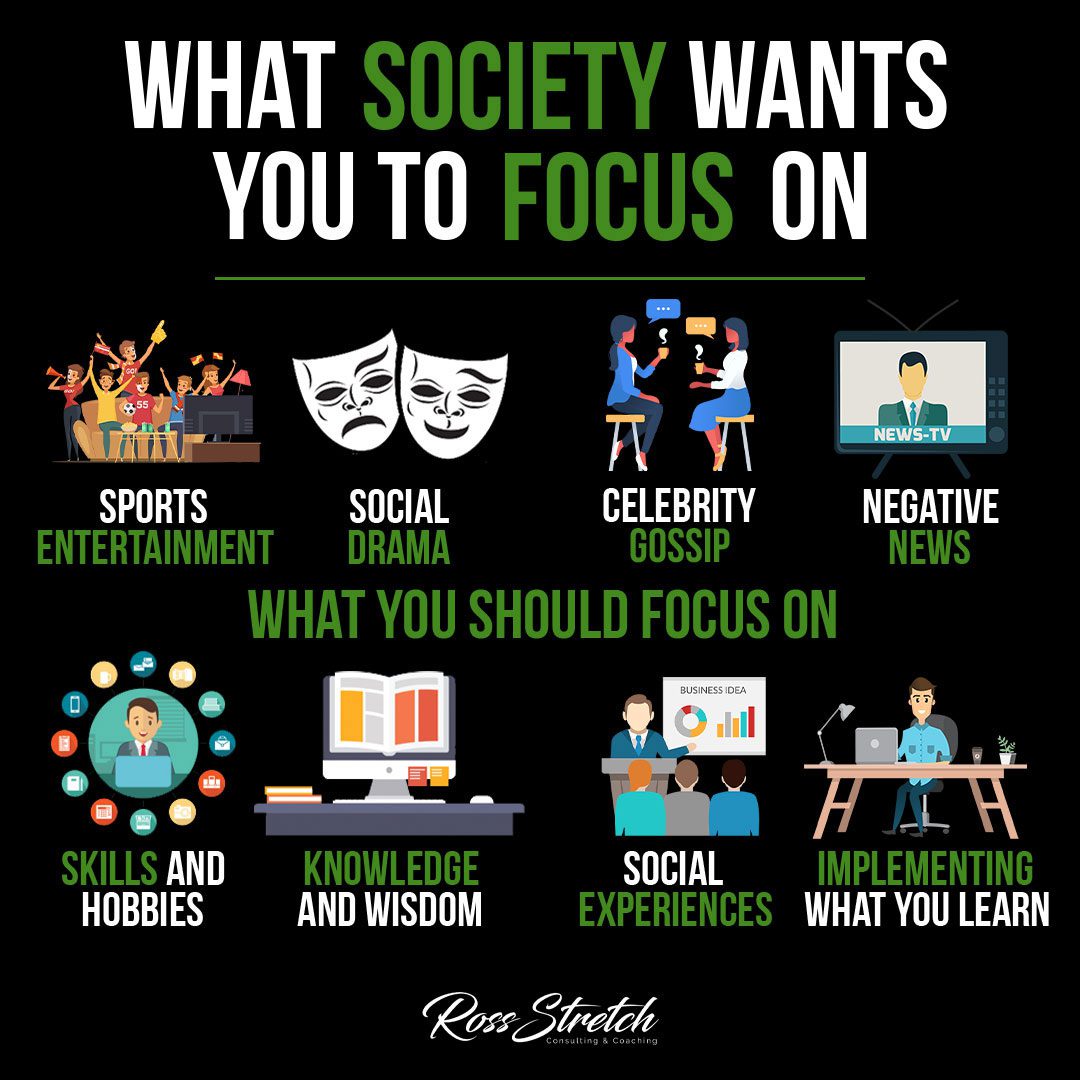
What Society Wants You to Focus On
Sports Entertainment
Sports fandom is a multi-billion dollar industry built on emotional engagement. There is nothing inherently wrong with enjoying sports — community, competition, and shared experience have genuine social value. The problem arises when sports fandom becomes a substitute for personal ambition. The hours invested tracking standings, debating player trades, and watching pre- and post-game analysis are hours that aren’t going toward your own goals. Enjoying sports is healthy. Organizing your identity and schedule around teams that will never know you exist deserves examination.
- Enjoyment versus obsession: Set a conscious time limit on sports media, then fill the reclaimed hours with something that builds your own capabilities or relationships.
- Redirect the energy: Channel the competitive drive that sports fandom activates into personal challenges, fitness goals, or entrepreneurial objectives.
Social Drama and Outrage Culture
Social media platforms are algorithmically optimized to surface emotionally provocative content because outrage drives engagement metrics. Every minute you spend tracking interpersonal drama — whether among celebrities, strangers online, or within your own circle — is a minute spent in reactive, low-value cognitive activity. Neuroscience shows that chronic exposure to conflict activates the stress response system, elevating cortisol levels and degrading both mood and cognitive performance over sustained periods.
- Protect your mental environment: Treat your attention like prime real estate — be deliberately selective about what you allow to occupy it daily.
- Focus on personal growth: Channel the social energy toward conversations that challenge your thinking or expand your network meaningfully rather than consuming others’ conflicts.
Celebrity Gossip
Celebrity culture creates a parasocial relationship — a one-sided emotional connection with people who have no awareness of your existence. Evolutionary psychologists note that the brain processes celebrity information through the same social circuits used for real relationships, which is why it can feel meaningful even when it provides zero practical return. The result is hours spent on information that delivers social stimulation without social benefit — the mental equivalent of eating empty calories.
- Distinguish fantasy from reality: Celebrity portrayals are carefully curated products, not authentic lives. Comparing yourself to them is comparing your reality to someone else’s highlight reel.
- Focus on your own story: The time spent consuming others’ curated success narratives is time not spent writing your own.
What You Should Actually Focus On
Skills and Hobbies That Build Real Capability
Skill development is one of the highest-return investments you can make with your time. Whether it’s learning to code, mastering financial analysis, developing public speaking ability, or building physical fitness, skills compound over time in ways that passive consumption never can. Psychologist Anders Ericsson’s research on deliberate practice demonstrated that focused skill development — not innate talent — is the primary driver of expertise. A commitment of one focused hour daily to skill-building over five years produces results that are genuinely transformative.
- Personal growth and fulfillment: Choose skills that align with both your career ambitions and genuine intrinsic interest — that combination produces sustainable motivation that doesn’t require constant external reinforcement.
- Diversify your capabilities: Build a portfolio of skills across domains — financial literacy, communication, technical ability — that create optionality and resilience in your career.
Knowledge and Wisdom That Changes How You Think
Not all information is equal. There’s a meaningful difference between consuming content that confirms what you already think and engaging with ideas that genuinely challenge and expand your worldview. Reading books — particularly non-fiction in fields adjacent to your own — demands sustained attention and rewards it with depth that social media cannot provide. Charlie Munger attributed much of his investing success to voracious reading across disciplines; Warren Buffett reportedly spends the majority of his working day reading. The pattern is not coincidental.
- Continuous learning: Commit to reading 20 minutes daily minimum. Sustained over a year, that single habit produces the equivalent of 12-15 books read cover to cover.
- Critical thinking: Actively seek ideas that challenge your current beliefs — intellectual discomfort is almost always a sign that meaningful learning is occurring.
Social Experiences That Enrich Your Life
Real social connection — meaningful conversation, shared experiences, collaborative work — is one of the strongest predictors of long-term happiness and health. The Harvard Study of Adult Development, the longest longitudinal study of human wellbeing ever conducted, found that the quality of close relationships was the single strongest predictor of health and life satisfaction into old age. Contrast that with the hollow social stimulation of celebrity gossip or outrage scrolling, and the trade-off becomes impossible to ignore.
- Cultivate depth over breadth: Invest in fewer, deeper relationships rather than a large but shallow social network that requires maintenance without providing real connection.
- Embrace diverse experiences: Deliberately expose yourself to people from different backgrounds, industries, and worldviews — the perspective shift is consistently the most valuable outcome.
Implementation: Turning Knowledge into Results
The final distinction between people who grow and people who stagnate is implementation. Consuming excellent information produces nothing on its own. The competitive advantage belongs to people who close the gap between knowing and doing — applying what they learn within days of learning it, sharing ideas with others to reinforce retention, and treating every piece of knowledge as a potential action rather than just an interesting concept to file away.
- Practical application: For every idea you encounter, ask immediately: “How could I use this in my life or work within the next seven days?”
- Learn from outcomes: Implementation produces feedback that reading alone never can — that real-world feedback is ultimately the most valuable learning available.
Common Mistakes People Make
- Consuming self-improvement content instead of doing self-improvement — reading about habits, watching motivational videos, and listening to podcasts can feel productive while producing nothing tangible.
- Using entertainment as emotional regulation — sports and celebrity content often serve as numbing mechanisms for stress and anxiety that deserve real attention and real solutions.
- Confusing social media engagement with social connection — likes, comments, and follower counts do not provide the emotional and health benefits of genuine human relationship.
- Waiting for external permission to redirect your attention — your attention is yours to allocate. No platform, algorithm, or social norm will protect it for you.
The Bottom Line
Society’s default programming is not designed with your flourishing in mind — it’s designed to capture your attention and monetize it. Breaking the mold requires an active, ongoing decision to evaluate what occupies your mind and to redirect that resource toward things that actually build the life you want to live.
The gap between the life you have and the life you want is, in large part, an attention allocation problem. Redirect even half the hours currently spent on passive entertainment toward skill development, meaningful relationships, and deliberate learning — and the compounding effect over five years will be more dramatic than almost any other single change you could make. Your attention is your most valuable asset. Invest it accordingly.
Resources

 Ross Stretch