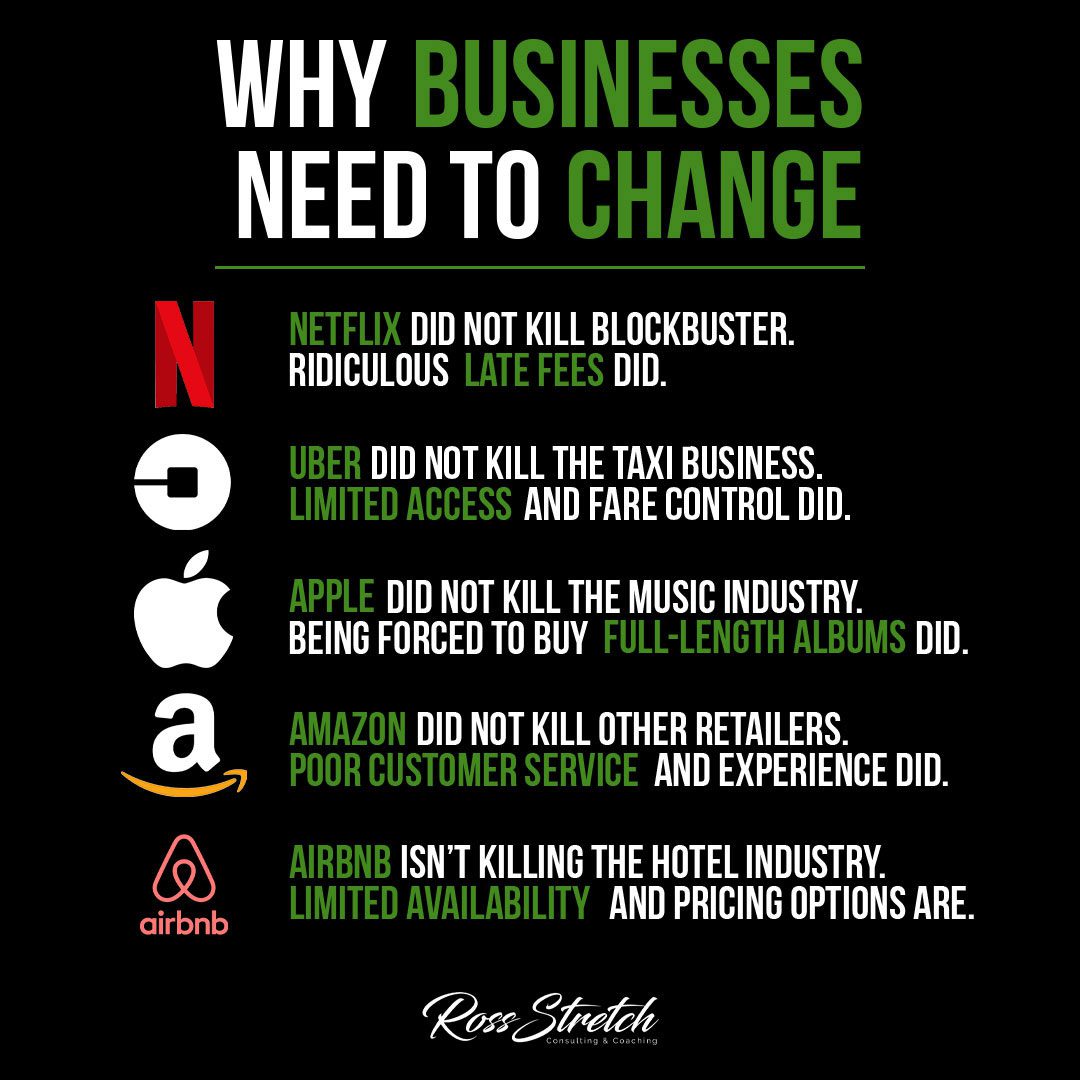
In today’s rapidly evolving business landscape, the ability to adapt and embrace change is not optional — it’s the difference between relevance and extinction. As technology accelerates and consumer preferences shift faster than ever, businesses that cling to outdated models don’t just fall behind; they disappear entirely. The stories of Netflix, Uber, Apple, and Airbnb aren’t just tech success stories — they’re case studies in what happens when companies listen to customers instead of protecting legacy systems.
Netflix and Blockbuster: The Cost of Ignoring Customer Friction
The fall of Blockbuster is one of the most cited examples of business failure in history, but most people misattribute the cause. Netflix didn’t kill Blockbuster — Blockbuster’s own late fees did. At its peak, Blockbuster collected an estimated $800 million annually in late fees. That’s not a revenue model; it’s a punishment system disguised as one. Customers tolerated it until they didn’t have to.
Netflix recognized that the real product wasn’t movies — it was convenience. By eliminating late fees and shifting to a subscription model, Netflix removed the single greatest source of customer frustration. When they later invested in streaming technology, they weren’t disrupting Blockbuster; they were simply continuing to follow the customer. Blockbuster had the opportunity to acquire Netflix for $50 million in 2000 and declined. By 2010, Blockbuster filed for bankruptcy.
The lesson isn’t about streaming versus physical media. It’s about customer friction. Businesses that build revenue models on customer inconvenience are always one innovation away from obsolescence. The question every leader should ask is: what are we making our customers tolerate, and what happens when they no longer have to?
Uber and the Taxi Industry: Pricing Transparency as a Competitive Weapon
Traditional taxi services weren’t killed by Uber’s technology — they were undermined by their own opacity. Inconsistent pricing, cash-only payments, unreliable availability, and no accountability for driver behavior created an industry ripe for disruption. Uber identified every one of these pain points and built its product around eliminating them: GPS tracking, upfront pricing, digital payments, and a two-way rating system that held both parties accountable.
Uber’s real innovation wasn’t the app itself — it was the trust infrastructure it created. When you could see your driver’s name, photo, car model, and rating before they arrived, the anxiety of getting into a stranger’s car dropped dramatically. Add upfront pricing and the ability to share your ride status with a friend, and Uber didn’t just offer a better taxi; it offered a fundamentally different experience at a transparent price.
The taxi industry had regulatory protection that insulated them from competition for decades. That protection became a liability: it discouraged innovation and created complacency. When the regulatory moat disappeared, so did the competitive advantage. Market protection is not the same as market fitness, and businesses that confuse the two are particularly vulnerable when disruption arrives.
Apple and the Music Industry: Unbundling as Innovation
The music industry’s resistance to digital distribution is a textbook case of an industry choosing short-term revenue protection over long-term survival. When Napster launched in 1999, record labels responded with lawsuits instead of solutions. By the time Apple launched iTunes in 2003, consumers had already proven they wanted individual songs, not full albums — and they were willing to pay for them if the price and experience were right.
Apple didn’t destroy the music industry; it saved it from its own refusal to adapt. At $0.99 per song, iTunes provided a legal, convenient alternative to piracy while giving the labels a revenue stream they’d been missing for years. The labels initially resisted the per-song model because it disrupted the album-bundling economics they’d relied on. Apple’s insistence on individual song pricing turned out to be exactly what consumers had been demanding all along.
Streaming services like Spotify and Apple Music have taken the model even further. Spotify’s annual revenue has surpassed $13 billion, proving that consumer-driven pricing models outperform industry-imposed ones every time. The lesson: when consumers consistently find workarounds to your pricing structure, the problem isn’t the consumers — it’s the structure.
Airbnb and the Hotel Industry: Supply as the Competitive Edge
Airbnb’s rise wasn’t about offering cheaper hotels — it was about creating an entirely new supply of accommodation that hadn’t existed before. Traditional hotels are limited by real estate, construction costs, and geographic concentration near business districts. Airbnb unlocked millions of private properties, giving travelers access to neighborhoods, cities, and experiences that hotels simply couldn’t provide at any price point.
The hotel industry’s response was initially dismissive, then regulatory. Many cities enacted restrictions on short-term rentals at the hospitality industry’s urging. But by then, Airbnb had already established a global network of over 7 million listings across more than 220 countries. The dynamic pricing model — where hosts adjust rates based on demand — often delivered better value than fixed hotel pricing, particularly during off-peak periods when hotel rates remain artificially high.
What Airbnb truly disrupted was the assumption that hospitality required a purpose-built facility. Any space with a bed, a clean bathroom, and a reliable host could become accommodation. The sharing economy proved that underutilized assets represent untapped market supply — and businesses that control access to supply control their industry.
How to Build a Business That Embraces Change
The companies that consistently adapt share several traits. They treat customer complaints as product roadmaps rather than PR problems. They measure friction — the steps required to complete a transaction, the time between order and delivery, the cost of switching — and they compete on reducing it. Amazon’s one-click purchasing wasn’t just a convenience feature; it was a declaration of war on checkout friction that generated billions in incremental revenue.
Adaptable businesses also cultivate a culture of innovation at every level. When market signals require rapid response, organizations structured around slow hierarchical approval processes simply can’t keep pace. Netflix’s famous “Freedom and Responsibility” culture gave employees the autonomy to act without waiting for management sign-off. That speed of execution is itself a competitive advantage that compounds over time.
Innovation cultures require psychological safety. Employees who fear failure will not surface early warning signs of disruption. The companies most likely to be blindsided are those where bad news travels slowly up the chain. Building an environment where people can say “our customers are complaining about X and a competitor is addressing it” without career risk is foundational to organizational resilience — and it starts at the leadership level.
Conclusion
The examples of Netflix, Uber, Apple, and Airbnb share a common thread: each succeeded not by inventing entirely new technologies, but by removing friction their competitors had normalized. Blockbuster had DVDs. Taxis had cars. Record labels had music. Hotels had rooms. What they lacked was the willingness to see their industry through the customer’s eyes — and the courage to act on what they found.
To remain competitive, businesses must prioritize innovation, customer obsession, and structural adaptability. The companies that thrive in the next decade won’t necessarily be the ones with the best technology — they’ll be the ones most willing to question their own assumptions before a competitor does it for them. Change is not a threat to be managed; it’s the operating condition of modern business.
Resources


 Ross Stretch