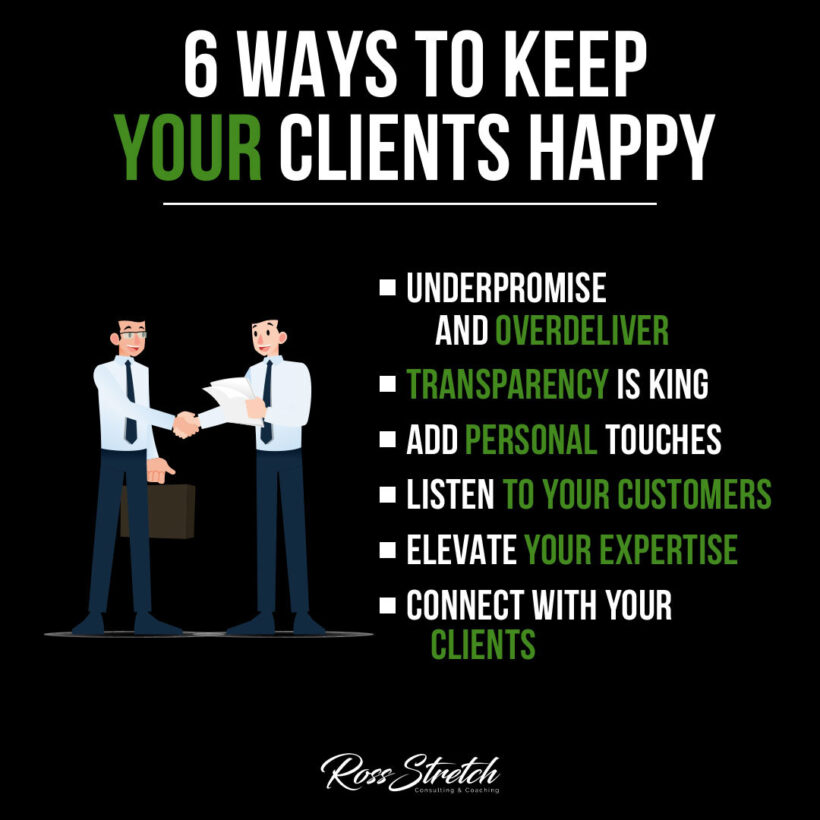

Keeping your clients happy is not a soft skill — it is a hard-edged business strategy that directly determines your revenue, your reputation, and your ability to scale. Research from Bain & Company shows that a 5% increase in client retention can boost profits by 25% to 95%, and that acquiring a new customer costs five to seven times more than keeping an existing one. The professionals who build thriving, referral-driven businesses understand one thing deeply: exceptional client relationships are not an accident. They are a deliberate system. Here are six battle-tested ways to keep your clients so satisfied they become your most powerful marketing engine.
1. Underpromise and Overdeliver
The Promise You Make Defines the Experience You Create
Client expectations are established the moment you make a commitment, which makes those commitments the most powerful lever in your relationship-building arsenal. Overpromising to close a deal creates a hidden liability: every minor slip becomes a disappointment, and sustained disappointment erodes trust faster than almost any other force in business. When you consistently beat your stated timelines and scope, you create a pattern of positive surprise that clients associate with you personally — and that association is what drives referrals and renewals.
- Actionable Tip: For every project, calculate your realistic timeline and add a 20% buffer before quoting the client. If you need five business days, quote seven — then deliver in five. Apply this discipline to your next three projects and track the client’s reaction at delivery.
- Why It Works: Human psychology evaluates outcomes relative to expectations, not in absolute terms. When reality exceeds what was promised, the emotional payoff is disproportionately large — it creates the kind of memorable experience that generates referrals, repeat business, and the willingness to pay premium rates.
Pro Tip:
Keep an internal commitments log — a simple spreadsheet listing every promise made to every client and the actual delivery date. Review it monthly to identify where you consistently underestimate. This single discipline separates good service providers from elite ones, and it grounds every client conversation in accurate data rather than optimism.
2. Communicate with Radical Transparency
Clients Don’t Hate Problems — They Hate Surprises
Most client relationships deteriorate not because problems occur, but because problems are communicated too late, too vaguely, or not at all. When something goes wrong — a delay, an unexpected cost, a scope complication — clients are far more forgiving when they hear about it immediately, directly, and with a clear resolution path. Radical transparency means defaulting to proactive communication, especially when the news is uncomfortable. It signals confidence, professionalism, and a fundamental respect for your client’s time and decision-making.
- Actionable Tip: Implement a standing weekly status update for every active client — even a three-bullet email. Cover what was completed this week, what is in progress, and whether any blockers exist. Choose your top two clients today and send the first update before the week ends.
- Why It Works: Information gaps create anxiety. When clients don’t hear from you, their imagination fills the silence — usually with worst-case scenarios. Consistent structured communication eliminates that anxiety and positions you as a partner in the work rather than a vendor to be managed. Partners get renewed; vendors get replaced.
Pro Tip:
When delivering bad news, use a four-part structure: acknowledge the issue clearly, explain the root cause without making excuses, present your specific action plan, and provide a realistic revised timeline. Clients will remember how you handled the problem long after they’ve forgotten the problem itself — and handling it well can actually strengthen the relationship rather than damage it.
3. Personalize Every Touchpoint
Clients Pay for Results — They Stay for How You Make Them Feel
In an era of automated workflows and AI-generated deliverables, personalization has become the primary differentiator for professionals who want to command premium pricing and long-term contracts. Clients who feel genuinely known — not as an account number, but as individuals with specific goals, pressures, and preferences — develop loyalty that price alone cannot disrupt. The investment in personalization is modest; the competitive moat it builds is enormous.
- Actionable Tip: Build a client profile for each of your key accounts using a free tool like Notion or HubSpot CRM. Record their preferred communication style, key business priorities this quarter, decision-making preferences, and any personal details they’ve shared — a product launch, a company milestone, a family event. Review these notes before every meeting or call.
- Why It Works: The brain responds powerfully to being remembered. When a service provider references something specific and personal, it activates a sense of significance and belonging that creates genuine emotional loyalty. This loyalty is not rational — it is deeply human — which is exactly why it is so durable and so difficult for competitors to replicate.
Pro Tip:
Send brief personalized notes for client milestones — a company anniversary, a major contract win they mentioned, a press feature about their business. A two-sentence email or a handwritten card takes five minutes and creates an impression that lasts years. Most of your competitors are not doing this, which means the bar for standing out is far lower than you think.
4. Listen Actively and Act on Feedback
The Most Valuable Business Intelligence You Have Is Already Talking to You
Most professionals ask for feedback as a courtesy and do little with what they receive. This is a significant missed opportunity. Your clients are giving you a direct roadmap to better service, deeper loyalty, and competitive differentiation — but only if you ask the right questions and visibly demonstrate that their answers drive real change. Active listening is not passive reception; it is deliberate inquiry followed by documented action and transparent follow-through.
- Actionable Tip: After every major project milestone, send a focused three-question feedback request: What worked well? What could have been better? What is one thing that would make this significantly more valuable? Then — within 48 hours — follow up with a specific message confirming exactly what you are changing based on their input.
- Why It Works: When clients see their feedback implemented, they become more invested in the outcome because they helped shape it. Clients who contribute to improving your service become partners in your evolution, not just consumers of your output — and partners are dramatically harder to lose to a competitor offering a marginally lower price.
Pro Tip:
When a client delivers criticism, resist the instinct to explain or defend. Instead, respond with: “Thank you — this is exactly the kind of input that helps me serve you better. Here is what I am going to change.” This single response converts a tense moment into a trust-strengthening one, and clients who have given you hard feedback and seen you act on it become your most loyal advocates.
5. Demonstrate Your Expertise Consistently
Authority Is Earned Between Projects, Not Just During Them
Clients hire you for what you know, but what retains them is the ongoing demonstration that you are operating at the leading edge of your field. When you proactively share insights they have not asked for, flag emerging trends that affect their business, or introduce a better approach before they have encountered the problem, you shift from service provider to trusted advisor. Trusted advisors are nearly irreplaceable — and they command premium rates without having to justify them.
- Actionable Tip: Set up Google Alerts for each client’s industry, key competitors, and main strategic priorities. Once a week, send one of your top clients a brief “thought you would want to see this” email with a relevant article and your two-sentence take on why it matters for their business. This takes ten minutes and positions you as someone who thinks about their success around the clock.
- Why It Works: Consistent unsolicited value delivery fundamentally changes the power dynamic in a client relationship. When contract renewal arrives, instead of the client evaluating whether to continue paying you, they are calculating what it would cost them to lose access to your thinking. That is the question you want them asking — and it justifies premium pricing without a conversation about it.
Pro Tip:
Host a quarterly industry briefing for your top clients — a 30-minute call or a concise written summary covering three developments they should know about and what you recommend doing about each. No selling, no agenda. Just insight. This ritual has a consistent track record of converting project-based clients into long-term retainer relationships worth multiples of the original engagement.
6. Build a Genuine Human Connection
Business Is Personal — The Professionals Who Know This Win
At the foundation of every durable professional relationship is a human one. Clients do not renew contracts with companies — they renew relationships with people they trust, respect, and genuinely enjoy working with. Building this layer beneath the professional one requires intentional effort and the willingness to show up as a real person, not just a service function. The return on this investment is loyalty that survives price increases, market disruptions, and competitive alternatives.
- Actionable Tip: Schedule one non-transactional touchpoint per quarter for each of your top five clients — a brief call with no agenda, a coffee meeting, a voice message about something they would find interesting. Block these in your calendar as recurring appointments so they do not get displaced by urgent work. The relationship is the long game; protect it accordingly.
- Why It Works: Reciprocity is one of the most documented forces in social psychology. When you invest in someone’s success without an immediate ask, it creates a powerful obligation to return the generosity — which, in a business context, translates to loyalty, enthusiastic referrals, and expanded contracts. More than that, it builds relationships worth having independent of the business they generate.
Pro Tip:
Use LinkedIn strategically for relationship-building rather than self-promotion. A thoughtful comment on a client’s post — one that genuinely adds to the conversation — is far more memorable than a like or a share. It signals that you are paying attention to their world even when you are not directly working together, which is precisely the impression you want to sustain between contracts.
Conclusion
Client satisfaction is not a soft metric — it is a direct driver of revenue, referrals, and the long-term resilience of everything you have built. The professionals who master these six disciplines — managing expectations strategically, communicating transparently, personalizing every interaction, acting visibly on feedback, demonstrating expertise continuously, and investing in genuine human connection — build businesses where growth becomes self-sustaining. Choose one strategy to implement this week, build the rest over the next 90 days, and watch how the cumulative effect transforms not only how your clients talk about you, but how you think about the work itself.
Resources


 Ross Stretch