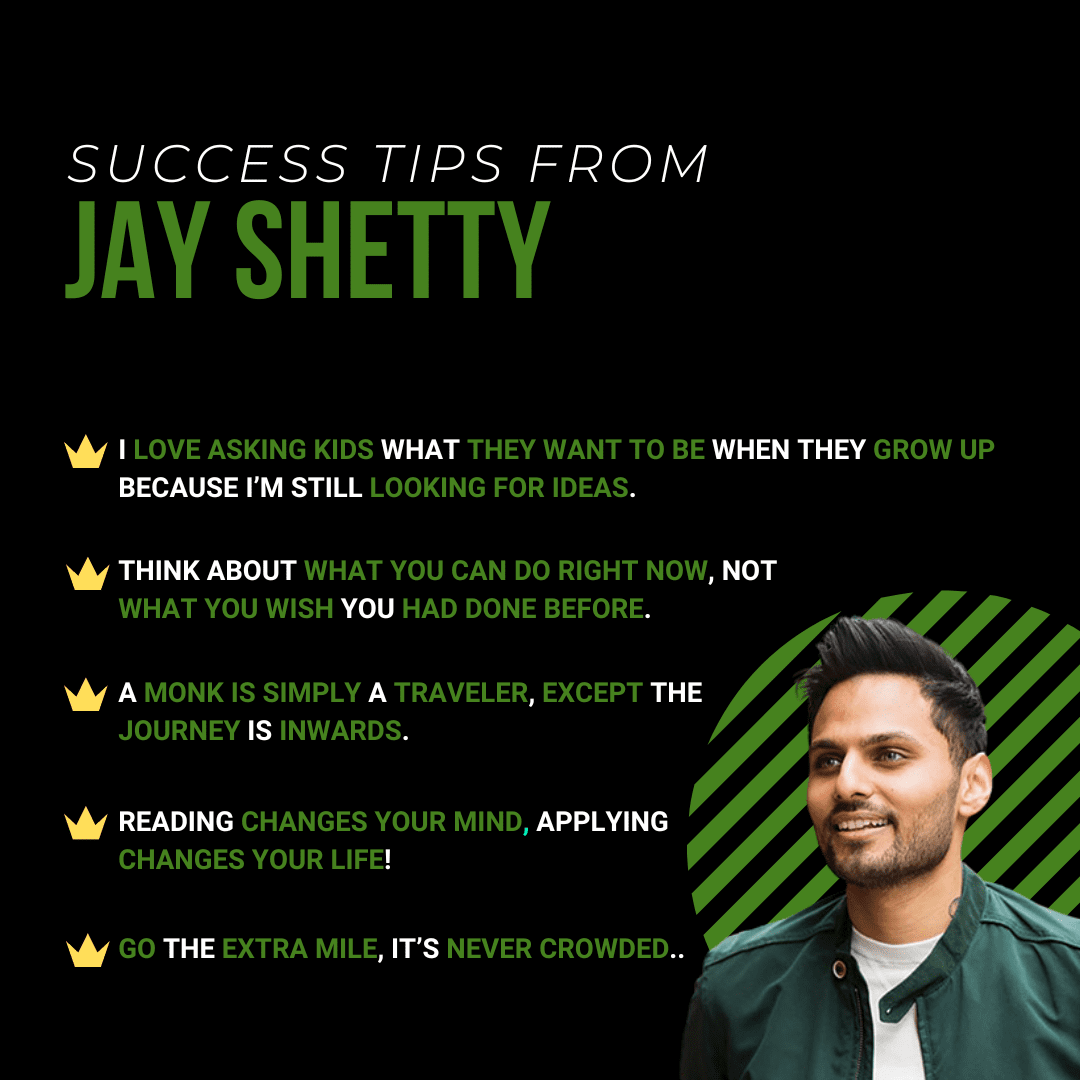
Jay Shetty went from a monastic life in India to reaching hundreds of millions of people worldwide as a motivational speaker, podcast host, and bestselling author. His book “Think Like a Monk” distills the ancient wisdom he absorbed during three years living as a Vedic monk into practical guidance for modern life. Shetty’s success tips are not feel-good platitudes — they are earned insights rooted in genuine self-examination, discipline, and a willingness to live differently than most people dare.
\
\
\
\
Stay Curious Like a Child
\
\
Shetty has said: “I love asking kids what they want to be when they grow up because I’m still looking for ideas.” The message is deliberate. Children explore without embarrassment, ask questions freely, and dream without filtering possibilities through fear of judgment. Adults, by contrast, tend to narrow their thinking as they age — limiting what they consider possible based on past experience, social expectations, or a fixed sense of identity.
\
\
Cultivating curiosity as an adult means actively resisting that narrowing. It means reading outside your field, having conversations with people who think differently, and approaching your own career and habits as an ongoing experiment. The most innovative entrepreneurs and creators tend to be those who never stopped asking basic questions — about their industry, about human behavior, about what’s assumed versus what’s actually true.
\
\
- \
- Read in areas adjacent to your expertise — history, psychology, biology — to generate unexpected connections
- Ask more questions in conversations than you answer
- Revisit assumptions in your work and life that you haven’t questioned in over a year
\
\
\
\
\
\
\
Act on What’s Possible Now
\
\
One of Shetty’s most actionable teachings: “Think about what you can do right now, not what you wish you had done before.” Regret is one of the most reliable paths to inaction. Dwelling on missed investments, relationships allowed to drift, or businesses not started drains exactly the mental energy needed to move forward.
\
\
The present moment is the only place where action is possible. This principle shows up repeatedly in Shetty’s work because it addresses a near-universal pattern: people who know what they should do but remain stuck in a loop of replaying what went wrong. The antidote is not toxic positivity — it’s a practical redirect. Extract the lesson from past decisions and reorient your attention to what’s actionable today.
\
\
- \
- When you notice rumination on past mistakes, write down one lesson and one next action
- Set a daily intention each morning focused only on today’s priorities
- Replace “I should have” with “Next time I will” — a small linguistic shift with real psychological impact
\
\
\
\
\
\
\
Turn Inward
\
\
Shetty draws on his experience as a former monk: “A monk is simply a traveler, except the journey is inward.” The insight here is that most people spend enormous effort building external lives — careers, reputations, relationships — without ever doing the inner work to understand what they actually want and why.
\
\
Self-awareness, in Shetty’s framework, is the foundation of everything else. Without it, external achievement can feel hollow. With it, you make decisions aligned with your real values, sustain motivation through difficulty because you understand your deeper why, and build relationships that are genuinely nourishing rather than transactional. Inner work doesn’t require a monastery — it requires consistency. Daily reflection, journaling, or sitting in quiet without a device are all entry points.
\
\
- \
- Start a daily journaling habit with a single prompt: “What am I actually feeling today?”
- Identify your top three core values and assess weekly whether your choices reflect them
- Try ten minutes of silent meditation in the morning before opening your phone
\
\
\
\
\
\
\
Apply What You Learn
\
\
“Reading changes your mind, applying changes your life.” This distinction matters more than it sounds. Many ambitious people consume books, podcasts, and courses at a high rate and still don’t change their behavior in meaningful ways. The consumption creates a feeling of productivity without the substance of it. Shetty identifies this trap clearly: knowledge only becomes valuable when it changes what you do.
\
\
The practice he recommends is implementation-focused: after reading anything worth reading, identify one idea you’ll experiment with in the next week. Not add to a notes app — actually do differently. Teaching others what you’ve learned is one of the most effective ways to consolidate understanding, because explaining something forces a level of clarity that passive reading rarely produces.
\
\
- \
- Keep an “applied lessons” log — one idea per book, one behavioral change per week
- Share what you’re learning with someone else; teaching accelerates understanding
- Evaluate what you’re reading not by how much you highlight but by how much you actually change
\
\
\
\
\
\
\
Go the Extra Mile
\
\
“Go the extra mile. It’s never crowded.” The reason the extra mile is uncrowded is simple: most people stop at adequate. Shetty’s point isn’t about grinding yourself into exhaustion — it’s about consistent, genuine effort to deliver something better than expected in whatever you do. This applies in business, in creative work, and in relationships.
\
\
Excellence becomes a compounding advantage. The person who consistently over-delivers — on quality, on follow-through, on thoughtfulness — builds a reputation that opens doors that passivity never does. In a world where mediocrity is the default, showing up with real care and effort is genuinely rare, and rarity has value.
\
\
- \
- Identify one area where “good enough” has become your standard and commit to a specific upgrade this month
- Make a practice of the thoughtful follow-up — the note, the check-in, the extra detail that most people skip
- Track how the people around you respond when you consistently deliver more than expected
\
\
\
\
\
\
\
Key Takeaways
\
\
- \
- Curiosity is a discipline worth protecting — actively seek out unfamiliar ideas and perspectives
- The present moment is the only place where meaningful action is possible; redirect from regret to intention
- Self-awareness is the foundation of every other form of success — invest in inner work consistently
- Knowledge without implementation is just entertainment; the measure of learning is behavioral change
- Excellence is rare enough that consistent extra effort creates a compounding competitive advantage
\
\
\
\
\
\
\
\
\
Resources
\
\
- \
- Jay Shetty Official Website — podcast, courses, and coaching resources
- Think Like a Monk on Amazon — Shetty’s bestselling book on applying monastic wisdom to modern life
- On Purpose Podcast — conversations with experts on purpose, mindset, and high performance
- Jay Shetty on YouTube — free content on mindset, relationships, and personal growth
\
\
\
\

 Ross Stretch